What a “Standard” 9" × 9" Polyester Knit Wiper Actually Controls in a Cleanroom
The Technical Vault | By SOSCleanroom
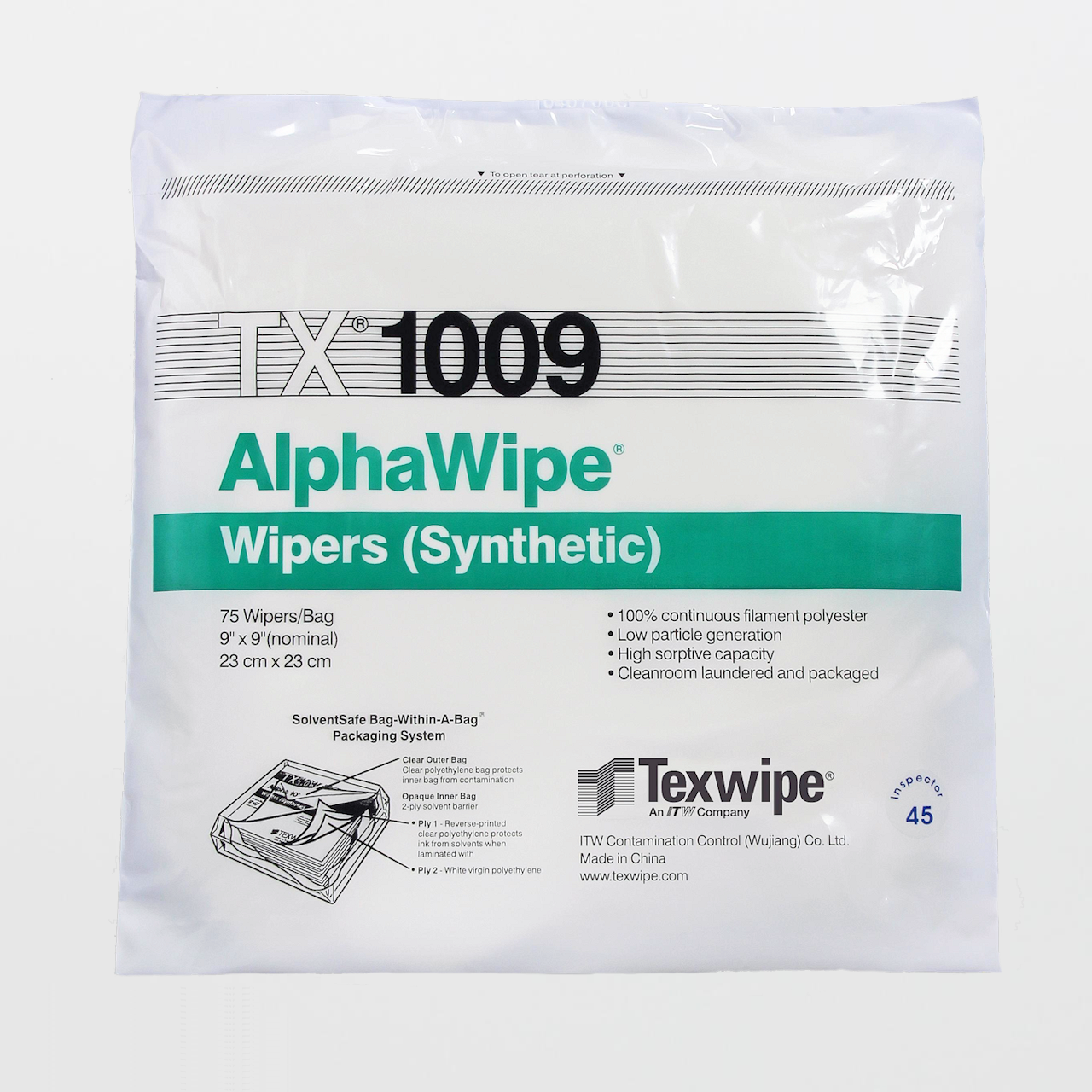
Texwipe TX1009 AlphaWipe (9" × 9") is one of those products that looks simple until you evaluate what it is really doing in a controlled environment. In most cleanrooms, the wiper is the most frequently used “contact tool” on benches, equipment exteriors, carts, pass-through items, fixtures, and non-product-contact surfaces.
TX1009 is designed to remove particulate and light residues while staying low-linting and chemically compatible, with consistent cleanliness from lot to lot. That combination is why knit polyester wipes remain a default in many contamination control programs, especially when the environment demands repeatable outcomes across multiple operators and shifts.
What It’s For
TX1009 is best suited for routine cleaning and wipe-downs, spill pickup, and controlled application and removal of common cleanroom solvents and solutions on hard surfaces such as stainless steel, coated metal, plastics, and glass. It is typically selected where the dominant risks are: (1) the wiper shedding fibers or particles during wiping, (2) leaving a residue film after solvents evaporate, or (3) mechanically breaking down on rough surfaces and becoming the contamination source.
Decision Drivers
These are the attributes that actually determine whether a “general” wiper will behave consistently in your process:
-
Substrate: 100% continuous-filament polyester (reduces short fiber ends that can release during wiping).
-
Construction: double-knit, no-run interlock (durability; resists “running” or unraveling).
-
Edge strategy: laundered cut edge (balanced approach for many ISO 4–8 wipe tasks; sealed-edge/border is typically reserved for higher edge-shedding risk points).
-
Chemical cleanliness: controlled nonvolatile residue (NVR) and extractable ions matter when residue films or ionic contamination can cause defects.
-
Sorption behavior: pickup rate and capacity determine whether the wipe captures contamination or spreads it.
-
Packaging discipline: inner bagging and controlled packaging reduce exposure and variability in handling.
-
Traceability: supports investigations and change control when a wipe becomes part of a validated contamination control strategy.
Materials and Construction: Why the Fabric Does the Work
“Polyester” is not a spec; the behavior is driven by fiber type and fabric formation. TX1009 uses continuous-filament polyester—long filaments rather than chopped or staple fibers—which typically reduces fiber release under abrasion. The interlock knit provides structural integrity and a stable wiping surface so the wipe can tolerate repeated strokes on brushed stainless, tool panels, carts, and other real-world surfaces where lesser wipes can snag, fray, or abrade and create particles.
The laundered cut edge is an intentional choice for a general-purpose knit wiper. Cut edges are not automatically inferior; in many day-to-day wipe tasks they perform well, particularly when the knit is stable and the laundering and packaging controls are robust. The key is to match edge strategy to risk: if edge-driven fibers are your dominant failure mode (highly defect-sensitive surfaces, aggressive edge contact, or critical product-adjacent wiping), sealed-edge or sealed-border wipes become the more appropriate engineering control.
Cleanliness and Performance: What to Look For (and Why It Matters)
Cleanroom teams typically qualify wipes across four measurable risk categories:
-
Readily releasable particles and fibers
This answers: “Does wiping add contamination?” Knit polyester is often selected because it can deliver low-linting behavior under mechanical stress. The practical test is not just the material, but how it behaves under your wiping force, surface roughness, and wet chemistry.
-
Nonvolatile residue (NVR)
This answers: “Will it leave a film?” Residues can cause haze on optics, interfere with adhesives and coatings, and contribute to streaking or cosmetic rejects. A wiper with controlled NVR is a major advantage in final wipe steps and residue-sensitive processes.
-
Extractable ions
This answers: “Will it add ionic contamination?” Ionic residues matter in semicon, microelectronics, optics, and other corrosion-sensitive or electrically sensitive applications. Even outside those industries, ions can contribute to corrosion on tooling and fixtures over time.
-
Sorptive capacity and sorptive rate
This answers: “Will it pick up and retain what I’m removing?” A wipe that wets and loads quickly is typically easier to use correctly because it reduces the temptation to overwork a single wipe face. Conversely, if a wipe is slow to wet or low in capacity, operators often compensate with extra strokes—raising the odds of redeposition.
Best-Practice Wiping: Technique Is Part of the System
A premium wipe cannot compensate for inconsistent technique. TX1009 performs best when operators:
-
Quarter-fold to create multiple clean faces.
-
Wipe with straight, overlapping strokes (not circular wiping that redistributes contamination).
-
Move clean-to-less-clean to prevent dragging soils back over cleaned areas.
-
Rotate faces early—before the wipe is visibly loaded—and discard the wipe when all faces are used.
-
Maintain solvent discipline: consistent wetting, avoid over-saturation that increases dripping and smearing, and align with your site’s dwell-time expectations for any disinfectant chemistry.
Common Failure Modes—and How TX1009 Helps Prevent Them
Most wiping-related contamination issues repeat in predictable patterns:
-
Overusing a wipe face leads to redeposition as solvent flashes off and leaves residues behind.
-
Under-wetting increases drag and can spread residues rather than lifting them.
-
Using the wrong edge strategy (cut edge where sealed edge is needed) can introduce edge-driven fibers in defect-sensitive areas.
-
Snagging and abrasion on rough surfaces can degrade weaker wipes into particle generators.
TX1009’s continuous-filament knit construction and cleanroom processing are designed to reduce the likelihood of mechanical breakdown during routine wiping. The remaining control is procedural: face rotation, stroke discipline, and chemistry alignment.
Closest Competitors (Named, Limited, and Relevant)
In the same “polyester knit cleanroom wipe” class, two common comparators are:
Contec Polynit (polyester knit, knife-cut edge)
Often evaluated when surface softness is a primary concern (scratch-sensitive surfaces) while still maintaining controlled-environment positioning.
Berkshire MicroSeal 1200 (polyester knit, ultrasonically sealed edge)
A frequent comparator when edge-driven fibers are the dominant risk and sealed-edge construction is preferred for higher criticality wipe steps. The correct way to compare is to align on like-for-like construction (knit vs nonwoven; cut edge vs sealed edge), then confirm performance with your process solvents, surfaces, and technique—especially if the wipe is used near critical product or high-defect-sensitivity inspection steps.
Where TX1009 Fits in an SOP-Driven Cleanroom Program
TX1009 is typically a strong “default” dry knit polyester wipe for ISO-classified environments where you need dependable low-linting performance, solvent compatibility, and repeatability for daily wipe-down and spill-control tasks. When the risk profile tightens—edge control becomes paramount, sterile presentation is required, or solvent loading must be controlled more tightly—the technically correct move is to step up to the appropriate sealed-edge/border or sterile/presaturated format rather than forcing a general-purpose wipe into a higher-control role.
Source Basis
-
SOSCleanroom product page: Texwipe TX1009 AlphaWipe 9" × 9" polyester cleanroom wiper (configuration, packaging, positioning, applications).
-
ITW Texwipe manufacturer technical documentation for AlphaWipe and AlphaWipe LP families (construction, processing, typical performance framework: releasables, NVR, ions, sorption behavior).
-
Industry-recognized wiper evaluation frameworks and particle/fiber release methods commonly referenced in manufacturer documentation (IEST wiping materials guidance; ASTM particle/fiber release characterization).
-
Competitor manufacturer documentation: Contec Polynit polyester knit wipes; Berkshire MicroSeal 1200 sealed-edge polyester knit wipes.