Practical solutions in a critical environment
In less-critical controlled areas and industrial work zones, “contamination” often presents as a mechanical problem: viscous residues that string and redeposit, powders that cling in corners, flux that migrates, or grease that smears instead of lifting. A standard small swab can be too small to deliver enough solution or pickup capacity, and a wiper can be too large to establish contact inside a confined space. That is when operators start scrubbing, over-wetting, or reworking the same spot with a loaded tip — and defects show up as streaks, transfer marks, and inconsistent cleanup.
TX805 is designed for that reality: a circular polyurethane foam head with a long polypropylene handle. The geometry is intentional — a broad, rounded contact patch that can apply, absorb, and carry thicker chemistries without behaving like a sharp-edged “squeegee.” The head is thermally bonded (no adhesive at the bond), which removes a common residue variable at the head/handle interface when swabs are used in solvent-wet workflows.
Low-linting outcomes depend on technique and surface condition. No swab is truly lint-free; edge sharpness, surface roughness, solvent load, contact pressure, and stroke discipline govern what you see on the part.
What is this swab used for
Texwipe TX805 is used for applying and absorbing adhesives, greases, and liquids in less critical areas, and for spot cleaning tasks where a wiper cannot reach and a small swab lacks capacity. The circular head is also used for cleaning confined spaces containing thicker solutions (such as paints or inks) and for picking up powders and dust.
TX805 is commonly selected in mixed-production environments (maintenance benches, industrial touch-up, PCB-related tasks, printing and graphic arts, and other “controlled but not ultra-sensitive” work). If your endpoint is film-sensitive (optics, polished metals, coated parts) or residue-trended (verification/validation methods), treat a general-purpose foam swab as a deliberate, segregated tool — and qualify it before use.
Why should customers consider this swab
- Circular foam head provides a stable contact patch for applying and lifting thicker chemistries without sharp edge digging.
- 100% polyurethane foam head is engineered for absorbency and controlled delivery in less critical areas.
- Thermal bond construction eliminates adhesive at the head/handle bond line, removing a common contamination variable.
- Reclosable, silicone-free bag supports bench discipline and reduces open-pack handling exposure between uses.
- Lot-coded packaging supports basic traceability and quality control in multi-shift operations.
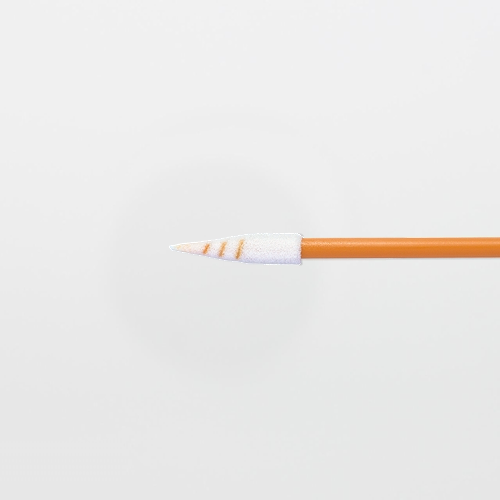
- Orange handle is a practical segregation cue so general-purpose swabs do not migrate into higher-criticality cleaning steps.
- “TEXWIPE” embossed on the handle supports quick, line-level identification when multiple swab types are staged at the bench.
Materials and construction
Head: 100% polyurethane foam
Head bond: thermal bond (no adhesive at the bond)
Handle: polypropylene; long format; handle color: orange; “TEXWIPE” embossed
Practical implication: the foam head is designed to conform slightly and hold thicker solutions. Do not treat it as a scrub tool. Excess pressure can collapse foam cells, spread mobilized residue, and increase snag/damage risk around sharp edges. If chemistry compatibility is uncertain (strong solvents, aggressive cleaners, sensitive plastics/coatings), run a small compatibility check before releasing the swab into production work.
Specifications in context
TX805 is built around a large, circular “lollipop” foam head. Use that head diameter to standardize coverage and contact: define where the circular head should land, how much overlap is required between touches, and when the swab should be rotated or discarded. Head thickness matters because thicker foam can carry more liquid — which is helpful for applying adhesives/greases but increases the risk of over-wetting when you are trying to remove residue without leaving a film line. The long handle improves reach and control in confined spaces, but the work still depends on deliberate, single-direction contact and disciplined discard triggers.
| Attribute |
TX805 |
| Head material |
foam (polyurethane) |
| Head width (diameter) |
19.7 mm (0.776") |
| Head thickness |
9.4 mm (0.370") |
| Head length |
26.4 mm (1.040") |
| Handle material |
polypropylene |
| Handle width |
6.6 mm (0.260") |
| Handle thickness |
3.2 mm (0.126") |
| Handle length |
105.8 mm (4.170") |
| Total swab length |
132.2 mm (5.200") |
| Head bond |
thermal |
| Handle color |
orange |
| Design notes |
large “lollipop” head; long handle |
Cleanliness metrics
The values below represent published typical analyses and are not per-unit specifications. In practice, use them to set realistic baselines for risk assessment and troubleshooting. If your workflow is residue-sensitive, validate the swab with your chemistry, your surfaces, and your inspection/measurement method so the swab does not become the dominant background signal.
Ion extractables (µg/swab)
| Ion |
TX805 (typical) |
| Chloride | 1.3 |
| Potassium | 0.5 |
| Sodium | 0.4 |
Nonvolatile residue (NVR) (mg/swab)
| Extractant |
TX805 (typical) |
| DIW extractant | 0.3 |
| IPA extractant | 0.7 |
Operator takeaway: the circular head can hold a lot of liquid. For “remove” steps, keep it damp, not saturated. If you see smearing or a halo at the edge of the cleaned area, reduce liquid load, rotate to a fresh swab sooner, and separate apply and remove steps for thick chemistries.
Packaging, sterility and traceability
- Packaging (TX805): 80 swabs/reclosable bag; 5 bags/case; 400 swabs/case
- Bag packaging controls: reclosable, silicone-free bag
- Sterility: non-sterile (if sterility/SAL is required, select a sterile validated swab format; do not assume interchangeability)
- Shelf life (manufacturer statement): non-sterile 5 years from date of manufacture
- Storage conditions: ambient 59°F to 86°F (15°C to 30°C)
- Traceability cues: lot-coded packaging; “TEXWIPE” embossed handle; orange handle supports practical segregation for less critical areas
- Country-of-origin (manufacturer statement): Made in The Philippines
Best-practice use
TX805 is a control tool for messy work: apply deliberately, absorb deliberately, and avoid rework with a loaded head. In general-purpose foam swab use, the most common quality failure is not “insufficient cleaning.” It is uncontrolled wetness and repeated re-touching that spreads residue and creates inconsistent surface appearance.
Operator-level swabbing technique module
- Damp control for removal steps: If you are removing (not applying), use a damp head. A practical check is one controlled touch to a blot surface. In confined areas, saturation increases smearing and leaves film at the edge of the cleaned region.
- Apply vs remove separation: For greases/adhesives/fluxes, consider two-swab logic: one swab to apply or mobilize, a second swab (or second pass with a fresh swab) to remove. Do not chase cleanliness with the same loaded head.
- Contact patch discipline: Let the circular head do the work. Use controlled pressure; avoid scrubbing. Rotate the head and discard early when drag increases or visible loading shows up.
- Confined-space guidance: In slots and recesses, approach squarely and withdraw in a single direction when possible. If you must change direction, do it off the surface to avoid redepositing a lifted film line.
- Powder pickup: Use light pressure and a “touch-and-lift” approach. If powder smears, you are pressing too hard or the surface is already wet.
- Segregation and staging: Use the orange handle as a visual cue: stage TX805 as “general-purpose” so it does not migrate into higher-sensitivity wipedown or verification steps. Keep the bag reclosed between uses, and stage only what you need at the bench.
Common failure modes
- Using it like a scrub tool: excess pressure collapses foam, spreads mobilized residues, and increases head damage risk near sharp edges.
- Over-wetting: a saturated head becomes a squeegee that smears films rather than capturing them.
- Reworking the same area with a loaded head, causing streaks and redeposition.
- Poor segregation: general-purpose swabs migrating into residue-sensitive work, creating haze, streaking, or unexplained residues driven by selection rather than the process.
- Chemical mismatch: using an incompatible chemistry without a quick compatibility check, leading to head degradation or performance drift.
Closest competitors
The closest alternatives are polyurethane foam swabs positioned for general-purpose or industrial cleaning where head geometry, bond mechanism (thermal vs adhesive), packaging controls, and documentation depth determine whether the swab remains a stable tool or becomes a process variable. Compare how each option behaves with your thick chemistry (smear vs lift), and whether lot coding and published contamination baselines support repeatable qualification.
- Contec general-purpose / sealed-foam swab families: Often evaluated when programs want foam behavior with defined bonding strategies and documented usage framing.
- Berkshire foam swab families: Common in standardized consumable programs; selection frequently comes down to geometry fit, foam structure, and supplier documentation alignment to the task.
- Puritan foam swab formats: Comparable foam/handle constructions may be available; confirm bond mechanism and the availability of baseline contamination data and traceability controls.
Critical environment fit for this swab
TX805 fits best as a controlled, traceable tool for less critical cleaning and application tasks: applying and removing greases and adhesives, managing thick solutions in confined spaces, and picking up powders and dust. It is intentionally identified (orange handle) so teams can segregate it from higher-criticality swab families used for residue-sensitive endpoints.
SOSCleanroom’s relationship with ITW Texwipe supports continuity of supply and documentation discipline, which reduces the risk of unplanned substitutions that change contact behavior and background residue. That matters when programs align to ISO cleanroom frameworks and when documentation expectations track regulated quality systems and standards-driven methods associated with FDA, ASTM, and IEST.
Operational support matters, too. Fast shipping and responsive customer service help keep work instructions intact by preventing “make-do” material swaps when schedules tighten.
Source basis
- SOSCleanroom product page (TX805): https://www.soscleanroom.com/product/clearance-deals/texwipe-tx805-general-purpose-foam-cleanroom-swab-with-circular-head/
- Texwipe manufacturer product page (TX805): https://www.texwipe.com/foam-tx805
- SOS-hosted Texwipe technical data sheet (TX803/TX804/TX805 Foam Series): “General Purpose Swabs — Foam Series” (803 804 805.pdf): https://www.soscleanroom.com/content/texwipe_pdf/803%20804%20805.pdf
- Texwipe technical data sheet (manufacturer-hosted): “General-Purpose Swab Series” (US-TDS-065 Rev.10/21): https://www.texwipe.com/images/uploaded/documents/Swabs/Texwipe-GeneralPurpose-Swabs-TDS.pdf
- International Organization for Standardization (ISO) reference (ISO 14644-1:2015): https://www.iso.org/standard/53394.html
- FDA (Food and Drug Administration): https://www.fda.gov/
- ASTM (American Society for Testing and Materials): https://www.astm.org/
- IEST (Institute of Environmental Sciences and Technology): https://www.iest.org/
SOSCleanroom is the source for this Technical Vault entry.
Briefed and approved by the SOSCleanroom (SOS) staff.
Last reviewed: January 6, 2026
© 2026 SOSCleanroom