Practical solutions in a critical environment
When electrostatic discharge is part of the risk picture, “quick swab-and-go” can become a yield problem. Tribocharging, uncontrolled solvent wetting and residue streaking show up as intermittent defects: a stubborn haze along an optic edge, a flux smear that fails microscopy, or a particulate line that keeps coming back after rework.
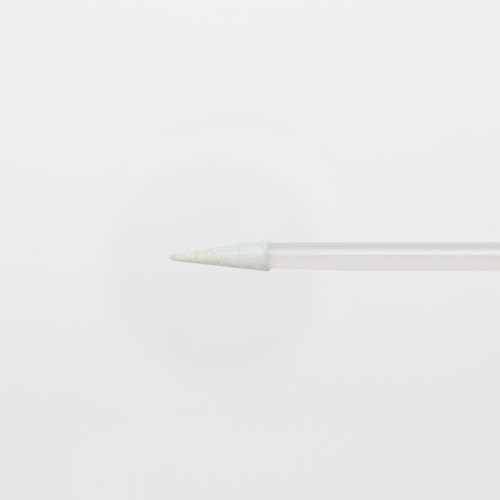
TX757E is designed for that operator reality: a small, flexible CleanFoam® head for access, a Stat-Rite® inherently dissipative polymer handle for clean ESD protection and a complete thermal bond that avoids adhesive-driven variability when solvents are in play.
What is this swab used for
Texwipe TX757E is a non-sterile, ESD-safe micro cleanroom swab used for localized cleaning and controlled application or removal of fluids on static-sensitive parts and assemblies. Common uses include applying and removing lubricants, adhesives and other solutions; scrubbing recessed areas; removing excess material or debris; cleaning intersecting surfaces and joints; cleaning with compatible solutions and solvents; and picking up fine powders.
The manufacturer positions the series for use at temperatures less than 194°F/90°C, which matters when the work surface is warm and residues start to smear instead of lifting cleanly.
Why should customers consider this swab
-
ESD-safe handling posture: Stat-Rite® inherently dissipative polymer handle supports cleaning on static-sensitive components without relying on carbon loading that can shed or “bloom.”
-
CleanFoam® micro access: 100 ppi polyurethane foam and a compact, flexible paddle head reach small features where wipes bridge over geometry.
-
Thermal bond construction: no adhesive at the bond, reducing a common contamination variable under solvent contact.
-
Documented cleanliness signals: published ion extractables and nonvolatile residue results help set realistic background expectations during method development and troubleshooting.
-
Traceability basics: lot coding plus “TEXWIPE” embossing on the handle support segregation, investigations and repeatability in controlled processes.
Materials and construction
TX757E uses a cleanroom processed 100 ppi polyurethane CleanFoam® head with a Stat-Rite® inherently dissipative polymer handle. The head is thermally bonded to the handle.
In practical terms, thermal bonding matters because it removes adhesive chemistry from the bond line, which is often where residue or bond failure shows up first when a swab is used “damp” with IPA or other compatible solvents.
Low-lint reality check
Cleanroom swabs can be low-linting, but nothing is truly lint-free. Technique and surface condition govern outcomes, especially on sharp edges, rough coatings and tacky residues.
Specifications in context
TX757E is sized for micro-feature cleaning where the limiting factor is access and angle control, not bulk solvent delivery. The short overall length keeps the swab stable in gloved hands and reduces lever-arm wobble when you are working along edges, in shallow channels or around connector housings. The flexible paddle head helps maintain contact without “digging in” and creating a residue ridge.
| Head material |
100 ppi CleanFoam® polyurethane foam (cleanroom processed) |
| Head width |
3.8 mm (0.150") |
| Head thickness |
3.4 mm (0.134") |
| Head length |
10.0 mm (0.394") |
| Handle material |
Stat-Rite® inherently dissipative polymer |
| Handle width / thickness |
3.0 mm (0.118") / 3.0 mm (0.118") |
| Handle length |
80.7 mm (3.177") |
| Total swab length |
90.7 mm (3.571") |
| Head bond |
Thermal (no adhesive at the bond) |
| Handle color |
Translucent |
Cleanliness metrics
The manufacturer publishes these results as representative analyses, not acceptance limits. Treat them as a baseline signal for method development and risk review, then qualify the swab in your process (wetting behavior, stroke discipline, inspection criteria and any extractables limits that matter to your product).
Ion extractables for TX757E (µg/swab)
| Ion |
Result |
| Calcium | 0.01 |
| Chloride | 0.04 |
| Fluoride | 0.01 |
| Magnesium | 0.01 |
| Nitrate | 0.05 |
| Phosphate | 0.01 |
| Potassium | 0.02 |
| Sodium | 0.43 |
| Sulfate | 0.05 |
Nonvolatile residue (NVR) for TX757E (mg/swab)
| Extractant |
Result |
| DI water | 0.02 |
| IPA | 0.05 |
Packaging, sterility and traceability
- Sterility: Non-sterile.
- Packaging: 500 swabs per bag (5 inner bags of 100); 5 bags per case; 2,500 swabs per case. Packaged in an anti-static bag.
- Traceability: Lot coded for traceability and quality control. “TEXWIPE” is embossed on the handle as a practical segregation and traceability cue in multi-product cleanroom workflows.
- Shelf life: 5 years from date of manufacture.
- Storage conditions: Store at ambient conditions, defined as 59°F (15°C) to 86°F (30°C).
- Country of origin: Made in the Philippines.
Best-practice use
TX757E works best when you treat swabbing like a controlled operation: define wetness, define stroke direction and define discard triggers. Micro swabs are unforgiving because the contact patch is small; a single over-wet pass can create a tide mark that looks like “new residue.”
Operator technique module (repeatable, inspection-friendly)
-
“Damp” solvent technique (control wetness):
Wet the foam so it is uniformly damp, not dripping. A good field check is to touch the swab to a clean, noncritical area or a compatible staging surface; you want a faint wet track, not a puddle. Over-wetting increases streaks and can drive dissolved residue into edges or pores.
-
Stroke count logic (single direction, then stop):
Use single-direction strokes with slight overlap. After 2 to 4 strokes, rotate to a clean face of the foam. Stop when the head shows visible loading, when drag increases or when you see a residue line forming. Do not “polish” back and forth; it redeposits.
-
Geometry control (tracks, slots, channels):
Use the flexible paddle head to maintain full contact in a slot wall or along a shoulder. Keep gloves, sleeves and knuckles out of the work envelope. For tight channels, lead with the front edge of the foam, maintain a consistent angle and avoid levering the head into corners.
-
Pressure guidance (enough contact, not abrasion):
Apply just enough force to maintain continuous contact. Excess pressure can squeegee dissolved residue into a hard line and can abrade softer coatings. If you need “scrub pressure,” confirm the surface can take it and consider whether the residue requires dwell time or a different chemistry.
-
Solvent compatibility framing:
IPA is common, but always validate compatibility with the surface, coating, adhesive and any marking inks. If you are removing flux, oils or silicone-like films, confirm the chemistry that actually solubilizes the contaminant rather than spreading it.
-
Handling discipline (avoid rework loops):
Stage only what you will use, reseal the bag promptly and avoid laying swabs on benches. Do not re-dip a used swab into a clean solvent source. Avoid re-contacting “clean” areas after touching an edge, seam or loaded spot.
-
Disposal and documentation cues:
Discard after the defined stroke count or at the first sign of loading. If your process is investigation-driven, capture the lot code in the batch record or work order so residue excursions can be traced to time, lot and operator technique.
Common failure modes
-
Streaking or tide marks: almost always a wetness-control or stroke-direction problem. Reduce wet load, use single-direction strokes and change faces sooner.
-
Residue line at the edge of a pass: too much pressure or too many back-and-forth strokes. Decrease pressure, overlap strokes and stop earlier.
-
Particulate redeposit: reusing a loaded head, re-dipping or contacting noncritical surfaces mid-task. Tighten handling discipline and use a defined discard cadence.
-
Access-induced contact damage: using the swab at a steep angle or levering the head into corners. Re-approach with angle control and shorter, controlled strokes.
-
ESD control drift: assuming the swab alone solves ESD. Validate the full ESD program (grounding, garments, work surfaces and humidity) and treat the swab as one component of the control stack.
Closest competitors
In the same functional class (ESD-focused precision swabbing), the meaningful comparisons are less about brand and more about construction mechanism, documentation posture and how each product behaves when you are working damp with solvents on small geometry.
-
Contec CONSTIX® SF-13ESD sealed foam swab:
Sealed foam head on a conductive polymer handle, commonly selected for very small crevices and point access. The sealed construction can reduce snagging, but solvent compatibility and head geometry differ from a flexible paddle foam profile.
-
Berkshire Lab-Tips® ESD swabs (foam, pointed-tip families):
Static dissipative handle options with laundered foam designs and anti-static packaging. These can be strong alternatives when your method is already written around a pointed tip rather than a paddle contact patch.
-
Foamtec ESD-safe foam swabs (series-dependent):
ESD-safe handles and thermally bonded foam tips aimed at static-sensitive assemblies. As with any substitute, the critical check is whether the published cleanliness data, lot traceability and packaging controls match the rigor your process requires.
Critical environment fit for this swab
TX757E fits the “precision cleaning and controlled solvent application” layer in ESD-sensitive workflows: after gross removal and before final verification, especially when geometry prevents effective wipe contact.
In ISO-classified environments, defensible swab use is paired with controlled dispensing, defined discard practices and lot traceability so results hold across shifts.
In FDA-regulated manufacturing, this same discipline supports contamination-control expectations under cGMP: documented consumables, consistent technique and investigation-ready traceability. Align your approach to the rigor of your product and the sensitivity of the surfaces you are cleaning.
SOSCleanroom’s long-standing relationship with ITW Texwipe supports program continuity: consistent documentation, stable product identity and practical access to manufacturer technical data when your method needs to be qualified, defended or updated. Operationally, the value is fewer last-minute substitutions, steadier documentation and fewer unknown inputs when results drift and an investigation needs answers, backed by fast shipping and customer service that understands controlled-environment workflows.
Source basis
- SOSCleanroom product page (TX757E): https://www.soscleanroom.com/product/swabs/texwipe-tx757e-micro-cleanfoam-esd-swab-anti-static-swab/
- SOS-hosted Technical Data Sheet (primary stable reference; ESD Series incl. TX757E): https://www.soscleanroom.com/content/texwipe_pdf/750e%20753e%20757e%20758e%20761d%20769e.pdf
- Texwipe manufacturer product page (TX757E): https://www.texwipe.com/mini-tip-esd-safe-38-tx757e
- Texwipe manufacturer Technical Data Sheet (ESD-Safe Swab Series; PDF): Texwipe-ESD-Safe-Swabs-TDS.pdf (US-TDS-061 Rev.09/21) — https://www.texwipe.com/images/uploaded/documents/Swabs/Texwipe-ESD-Safe-Swabs-TDS.pdf
- International Organization for Standardization (ISO) reference point (cleanroom classification context): https://www.iso.org/standard/53394.html
- FDA (Food and Drug Administration) reference point (cGMP and contamination-control context): https://www.fda.gov/
- ASTM (American Society for Testing and Materials) reference point (test methods and materials standards context): https://www.astm.org/
- IEST (Institute of Environmental Sciences and Technology) reference point (recommended practices context): https://www.iest.org/
- Contec competitor reference (CONSTIX SF-13ESD sealed foam swab data sheet): https://www.contecinc.com/hubfs/Website%20Assets/Product%20Center/Product%20Data%20Sheets/Cleanroom/Swabs/PDSS017_SF-13ESD.pdf
- Berkshire competitor reference (Lab-Tips ESD swabs overview): https://berkshire.com/product-category/cleanroom-cleaning-swabs/esd-swabs/
- Foamtec competitor reference (ESD safe swabs overview): https://www.foamtecintlwcc.com/products/cleanroom-swabs/esd/
SOSCleanroom Technical Vault content is provided for contamination-control and controlled-environment application guidance. Always validate chemistry compatibility, ESD controls and technique in your process and documentation system.
Briefed and approved by the SOSCleanroom (SOS) staff.
Last reviewed: January 5, 2026
© 2026 SOSCleanroom