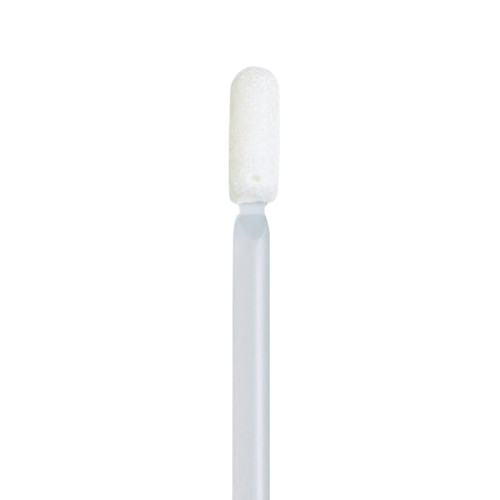
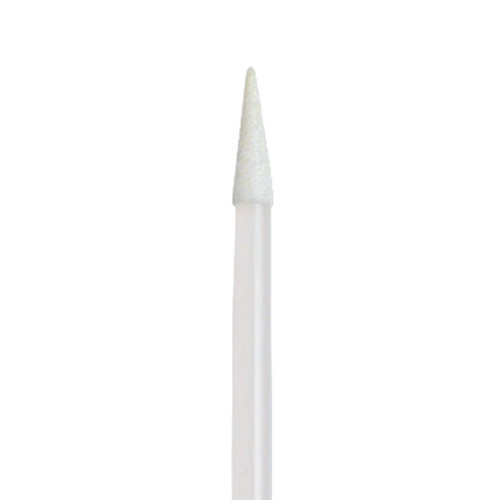
Texwipe TX757E Micro CleanFoam ESD Swab - Anti-Static Precision Cleaning Swab - Non-Sterile
Texwipe TX757E is a micro-size, ESD-safe CleanFoam® cleanroom swab designed for precision cleaning, controlled solvent application, and particulate removal in static-sensitive manufacturing environments. Its cleanroom-processed 100 PPI polyurethane foam head provides controlled contact with small surfaces, while the Stat-Rite® inherently dissipative handle supports electrostatic charge management during cleaning operations.
The TX757E combines a compact foam head with an overall swab length of 90.7 mm for controlled cleaning of connectors, narrow slots, grooves, recessed components, and precision electronic assemblies. The head is thermally bonded to the Stat-Rite® handle without adhesives, helping eliminate adhesive-related contamination at the attachment point. Each swab is supplied in protective anti-static packaging with lot identification for traceability.
Micro Cleaning and ESD Advantage: TX757E combines the absorbency of cleanroom-processed polyurethane foam with a dissipative handle designed for static-sensitive cleaning. Its small head supports precise solvent placement and particulate pickup in confined areas, while Stat-Rite® technology helps manage electrostatic charge when used as part of an appropriately controlled and grounded ESD cleaning process.
Specifications:
- Manufacturer: ITW Texwipe
- Part Number: TX757E
- Product Family: CleanFoam® ESD-Safe Swabs
- Product Type: Micro CleanFoam ESD-Safe Cleanroom Swab
- Swab Format: Dry, single-use swab
- Head Material: Cleanroom-processed polyurethane foam
- Foam Construction: Open-cell CleanFoam®
- Foam Density: 100 pores per inch (100 PPI)
- Head Width: 3.8 mm (0.150"), nominal, published ESD Swab Series TDS
- Head Thickness: 3.4 mm (0.134"), nominal, published ESD Swab Series TDS
- Head Length: 10.0 mm (0.394")
- Handle Material: Stat-Rite® inherently dissipative polymer
- Handle Width: 3.0 mm (0.118")
- Handle Thickness: 3.0 mm (0.118")
- Handle Length: 80.7 mm (3.177")
- Overall Swab Length: 90.7 mm (3.571")
- Head Bond: Complete thermal bond without adhesives
- Handle Color: Translucent
- Head Design: Micro flexible foam paddle
- ESD Protection: Inherently dissipative handle construction
- Charge Dissipation: Manufacturer describes charge dissipation in under 2 seconds when used with a solvent or solution; actual performance depends on test and use conditions
- Handle Additives: Designed without blooming carbon particles, metal fillers, or ionic anti-static additives
- Sterility: Non-sterile
- Cleanroom Processing: Cleanroom-processed foam head
- Packaging Material: Anti-static protective bag
- Bag Quantity: 500 swabs
- Inner Packaging: 5 inner bags of 100 swabs
- Case Quantity: 5 bags of 500 swabs
- Total Case Quantity: 2,500 swabs
- Traceability: Lot coded for quality control
- Temperature Guidance: Applications below 194°F (90°C), subject to material and process compatibility
- Available Purchase Options: Bag of 500 or case of 2,500 swabs
- Availability: Stock item, subject to current inventory
About the Manufacturer:
Texwipe, an ITW company, manufactures contamination-control consumables for semiconductor manufacturing, electronics assembly, pharmaceutical production, biotechnology, precision optics, medical devices, and laboratory operations. Its specialized swab portfolio includes polyurethane foam, knitted polyester, nonwoven polyester, and ESD-safe cleaning materials engineered for critical cleaning applications.
The Texwipe ESD-Safe Swab Series uses Stat-Rite® inherently dissipative polymer technology to support electrostatic charge management without relying on conventional carbon-loaded, metallic, or ionic anti-static additive systems. The CleanFoam® models combine this handle technology with cleanroom-processed polyurethane foam heads and adhesive-free thermal bonding to support controlled solvent application and particulate pickup.
SOSCleanroom is an authorized Master Distributor of ITW Texwipe. Our team assists customers with ESD-safe swab selection, manufacturer documentation, product configuration, lot traceability, and procurement support for contamination-sensitive electronics and precision manufacturing operations.
TX757E Features:
- Micro-size CleanFoam® polyurethane foam head
- Cleanroom-processed 100 PPI open-cell foam construction
- Stat-Rite® inherently dissipative polymer handle
- Compact 90.7 mm overall length for precision handling
- Small flexible head for narrow slots, grooves, and recessed surfaces
- Complete thermal bond construction without adhesives
- Designed to avoid blooming carbon particles, metallic fillers, and ionic anti-static additives
- Manufacturer-described rapid charge dissipation during wet cleaning
- Absorbs compatible solvents and solutions
- Helps capture and remove localized particulate contamination
- Supports controlled application and removal of lubricants and compatible process residues
- Anti-static protective packaging
- Lot coding for traceability and quality control
- Non-sterile configuration
- 500 swabs per bag with 5 inner bags of 100
- 2,500 swabs per case
TX757E Benefits:
- Micro-Precision Cleaning: Small foam head supports localized cleaning of connectors, contacts, seams, and equipment features.
- ESD Management: The Stat-Rite® handle helps manage electrostatic charge during appropriate ESD-controlled cleaning procedures.
- Controlled Solvent Application: Open-cell polyurethane foam absorbs and transfers compatible solvents to small contact areas.
- Localized Particle Pickup: Foam structure helps collect particulate contamination from compatible surfaces and recessed features.
- Low-Fiber Construction: Polyurethane foam avoids the long textile fibers associated with some conventional swab materials.
- Reduced Adhesive Contamination: Thermal bonding eliminates adhesive at the foam-to-handle attachment point.
- Compact Handling: Short overall length provides close control during precision cleaning operations.
- Clean ESD Material Design: Inherently dissipative handle technology avoids conventional anti-static filler systems that may contribute contamination.
- Process Repeatability: Defined head geometry and controlled cleaning procedures support consistent contact and solvent application.
- Material Traceability: Lot coding supports receiving, quality control, and investigation procedures.
- Controlled Packaging: Inner bags of 100 swabs support convenient point-of-use dispensing.
- Procurement Flexibility: Bag and case quantities support small-scale maintenance and recurring production requirements.
Common Applications:
- Precision cleaning of electrostatic-discharge-sensitive electronic assemblies
- Semiconductor manufacturing and microelectronics maintenance
- Cleaning connectors, contacts, narrow slots, and small recesses
- Localized removal of particulate contamination
- Controlled application and removal of compatible solvents
- Cleaning intersecting surfaces, joints, and edges
- Removal of excess lubricants, adhesives, and process materials
- Electronics assembly, inspection, and rework procedures
- Cleaning hard disk drive and precision device components
- Display manufacturing and electronic module assembly
- Laboratory and precision instrument cleaning
- Cleaning sensitive optics-adjacent equipment features
- Picking up fine powders from compatible surfaces
- ESD-controlled workstations requiring precision cleaning consumables
Best-Practice Use:
- Inspect Before Use: Examine the foam head and handle for visible damage, contamination, or deterioration.
- Use an ESD-Protected Workstation: Perform cleaning within the facility's established electrostatic-control program.
- Maintain Approved Grounding: Confirm that personnel, work surfaces, tools, and equipment are controlled according to the applicable ESD procedures.
- Use Compatible Gloves: Select gloves appropriate for both contamination-control and ESD handling requirements.
- Control Solvent Loading: Apply sufficient cleaning solution to the foam without excessive dripping or flooding.
- Maintain Controlled Contact: Use gentle, consistent pressure to avoid deforming or damaging the micro foam head.
- Use Unidirectional Strokes: Clean using controlled, overlapping strokes where appropriate to reduce residue redistribution.
- Manage Swab Loading: Change contact surfaces or replace the swab before accumulated contamination is transferred elsewhere.
- Avoid Excessive Scrubbing: Sharp or abrasive features may damage the foam and increase particle release.
- Prevent Cross-Contamination: Do not return used swabs to clean solvent containers or unused packaging.
- Verify Chemical Compatibility: Confirm compatibility between the foam, handle, cleaning chemistry, and surface.
- Maintain Traceability: Record lot information when required by the facility's procedures.
- Discard After Use: Treat TX757E as a single-use consumable and dispose of it according to applicable procedures.
ESD Dissipation Performance and Test Conditions:
TX757E incorporates a Stat-Rite® inherently dissipative polymer handle designed to help manage electrostatic charge during precision cleaning. Texwipe identifies charge dissipation in under two seconds when the swab is used with a solvent or solution. This performance statement applies to the manufacturer's described wet-use conditions and should be evaluated within the complete cleaning process.
- Wet-Use Performance: The manufacturer's under-two-second charge-dissipation statement is associated with use of a solvent or solution.
- Dry vs. Wetted Conditions: Charge behavior may differ when the foam head is dry, damp, or saturated. Wet-use performance should not automatically be applied to dry swabbing.
- Cleaning Chemistry: The electrical properties of the solvent or solution, including conductivity and composition, can influence charge dissipation.
- Solvent Loading: The amount of liquid retained by the foam affects both cleaning behavior and the conditions under which charge dissipation occurs.
- Grounding Path: Effective dissipation depends on the complete electrical path through the swab, handling interface, workstation, and grounding system.
- Insulating Barriers: Gloves, coatings, packaging, and other insulating materials may interrupt the expected charge-dissipation pathway.
- Environmental Conditions: Relative humidity, temperature, surface material, and handling conditions may influence electrostatic behavior.
- Contact and Friction: Swabbing pressure, movement speed, and surface characteristics can affect triboelectric charge generation.
- Test Method: Qualification should document the applied test method, initial charge or voltage, decay endpoint, liquid condition, grounding arrangement, and environmental conditions.
- ESD Standards: ANSI/ESD S20.20 and IEC 61340-5-1 provide recognized frameworks for facility ESD control programs.
- Application Qualification: Confirm acceptable electrostatic performance under the facility's actual swabbing conditions and device sensitivity requirements.
ESD Performance Guidance: TX757E is designed to support electrostatic charge management, but the manufacturer's under-two-second dissipation statement is associated with use of a solvent or solution and is not a universal dry-use guarantee. Effective electrostatic protection depends on the cleaning liquid, grounding arrangement, handling materials, surface conditions, and complete ESD control program. Facilities should confirm the applicable charge-decay test conditions and establish suitability for their specific process.
ESD Grounding and Workstation Requirements:
- Personnel Grounding: Use approved wrist straps, ESD footwear, flooring, or other grounding methods required by the facility.
- Workstation Grounding: Verify ESD work mats, benches, fixtures, and approved ground connections.
- Equipment Potential: Maintain the required potential control for exposed conductive equipment and sensitive electronic assemblies.
- Glove Selection: Evaluate whether the operator's gloves preserve the electrical characteristics required by the ESD procedure.
- Swab Handling: Use approved handling techniques to avoid interrupting the intended dissipative path.
- Insulating Components: Apply appropriate ionization or other approved controls when insulating materials cannot be grounded.
- Routine Verification: Test personnel grounding and workstation performance at the frequency required by the ESD control program.
- Charge Generation: Minimize unnecessary friction and rapid repetitive swabbing of insulating surfaces.
- Process Documentation: Include the swab material, cleaning chemistry, grounding method, and handling procedure in applicable work instructions.
Solvent Compatibility and Cleaning Qualification:
TX757E uses cleanroom-processed polyurethane foam and an inherently dissipative polymer handle. Compatibility with cleaning solvents and process solutions depends on the chemical formulation, concentration, temperature, exposure time, and surface being cleaned.
- Isopropyl Alcohol (IPA): May be used for controlled cleaning when compatibility with the foam, handle, and component has been established.
- Aqueous Cleaning Solutions: Compatible aqueous processes should be evaluated for residue contribution, drying requirements, and electrostatic behavior.
- Specialty Solvents: Verify compatibility before using ketones, esters, hydrocarbons, and other aggressive formulations.
- Foam Integrity: Certain chemicals can cause polyurethane foam to swell, soften, degrade, or shed particles.
- Handle Performance: Confirm that cleaning chemistry does not compromise the intended material or dissipative properties of the Stat-Rite® handle.
- Surface Compatibility: Verify that the solvent does not damage sensitive coatings, plastics, adhesives, metals, or electronic assemblies.
- Controlled Wetness: Standardize swab loading to reduce unintended liquid migration into small connectors and recessed components.
- Residue Transfer: Evaluate whether the swab contributes extractables or nonvolatile residues under the intended cleaning conditions.
- Particle Generation: Inspect foam performance after solvent exposure and repeated contact with the intended surface.
- Cleaning Recovery: Where critical cleaning or residue sampling is required, evaluate contaminant pickup, analyte recovery, and blank values.
- Temperature: Observe manufacturer temperature guidance and the applicable flash-point and flammability precautions for the cleaning solution.
- Validated Procedures: Define solvent volume, contact time, wiping direction, stroke count, and swab replacement requirements.
Cleaning Qualification Guidance: Polyurethane foam provides absorbency and controlled liquid transfer, but solvent compatibility and residue performance depend on the actual cleaning process. Evaluate foam integrity, swab extractables, surface compatibility, and electrostatic behavior using the intended chemistry and application conditions before standardizing TX757E for critical cleaning.
Selection Notes (TX757E vs. Other ESD and CleanFoam Swabs)
Texwipe CleanFoam® swabs are available in multiple head sizes, constructions, and handle configurations. The appropriate swab depends on cleaning geometry, solvent compatibility, ESD requirements, surface sensitivity, and the amount of liquid or contamination being removed.
Product Selection Guidance: Choose TX757E when a micro-size foam head and ESD-safe handle are required together. Select compressed foam versions for specific narrow-slot cleaning needs, long-handle designs for recessed equipment features, and conventional CleanFoam® swabs when an inherently dissipative handle is not required. Confirm the cleaning geometry, solvent compatibility, particle requirements, and ESD control procedures before substituting swab models.
Contamination Control and Material Compatibility:
- Cleanroom-Processed Foam: Supports controlled particle and residue characteristics for appropriate precision cleaning applications.
- Open-Cell Structure: 100 PPI polyurethane foam absorbs compatible solvents and helps capture fine particulate contamination.
- Low-Fiber Cleaning: Foam construction avoids long textile fibers but can still release particles if damaged or used aggressively.
- Thermal Bond: Adhesive-free attachment reduces one possible contamination source at the head-to-handle interface.
- Stat-Rite® Construction: Inherently dissipative polymer technology avoids conventional carbon, metallic, and ionic anti-static additives.
- Nonvolatile Residue: Evaluate residue contribution when cleaning sensitive electronic and optical components.
- Ionic Extractables: Consider extractable background where trace ionic contamination could affect device performance.
- Solvent Compatibility: Verify the foam and handle materials against the intended cleaning chemistry.
- Mechanical Wear: Avoid excessive force, sharp edges, and abrasive contact that may damage the foam head.
- Electrostatic Control: Maintain appropriate workstation grounding and defined solvent-loading conditions during use.
- Sterility: TX757E is supplied non-sterile and is not a substitute for a sterile swab where sterility is required.
Packaging and Storage Recommendations:
- Bag Quantity: 500 swabs
- Inner Packaging: 5 inner bags of 100 swabs each
- Case Quantity: 5 bags
- Total Case Quantity: 2,500 swabs
- Packaging Material: Anti-static protective bag
- Lot Traceability: Retain manufacturer lot information according to facility requirements
- Storage Environment: Clean, dry conditions protected from uncontrolled contamination
- ESD Handling: Follow the facility's ESD handling and packaging procedures when staging swabs near sensitive components
- Package Integrity: Inspect protective bags before opening
- Inner-Bag Handling: Open only the quantity required for the cleaning procedure
- Opened Packaging: Protect unused swabs from dust, oil, chemical vapors, and uncontrolled contact
- Head Protection: Avoid crushing or deforming the micro foam heads during handling and storage
- Single-Use: Discard used swabs according to the applicable cleaning and waste-management procedure
Manufacturer Technical Documents:
Texwipe TX757E Manufacturer Product Information: Click Here
Texwipe ESD-Safe Swab Series Technical Data Sheet (PDF): Click Here
Texwipe Swab Technical Data Sheet Library: Click Here
SOSCleanroom TX757E Product Information: Click Here
Other Similar Products Available From SOSCleanroom.com
CleanFoam ESD-Safe Swabs
Non-ESD CleanFoam Alternative
- TX757B Micro CleanFoam Swab: Micro open-cell polyurethane foam swab with polypropylene handle for precision cleaning where an ESD-safe handle is not required
Notes: Need assistance selecting an ESD-safe micro swab for semiconductor manufacturing, electronics assembly, or precision cleaning? Open the SOSCleanroom Technical Vault tab above for additional guidance on electrostatic charge control, solvent compatibility, cleaning procedures, contamination limits, and appropriate product selection.
SOSCleanroom.com supports contamination-control programs with cleanroom swabs, wipers, cleaning solutions, ESD-safe consumables, and specialized precision-cleaning products. Our team provides manufacturer documentation, packaging information, product-selection assistance, and dependable procurement support for semiconductor, electronics, pharmaceutical, optical, and laboratory applications.
Product description updated: October 19, 2026 (SOS Technical Staff)
© 2026 SOS Supply. All rights reserved.