
Cleanroom Wipers Polyester, Nonwoven, Microfiber, Pre-Wetted IPA & Sterile Cleanroom Wipes Includes edge construction differences, sterility assurance (SAL), extractables/NVR guidance, and ISO-class recommendations. ▼ EXPAND TECHNICAL REFERENCE (click here to open)
 Category Overview
Lint-Free & Low-Lint Cleanroom Wipers for Controlled Environments
Dry wipes, pre-wetted IPA wipes, and sterile cleanroom wipes for ISO-class operations.
Cleanroom wipers are contamination-control tools engineered to remove particles, residues, ions, and bioburden without introducing new contaminants. Performance depends on matching the substrate, edge construction, and format to your SOP, surface type, and room classification.
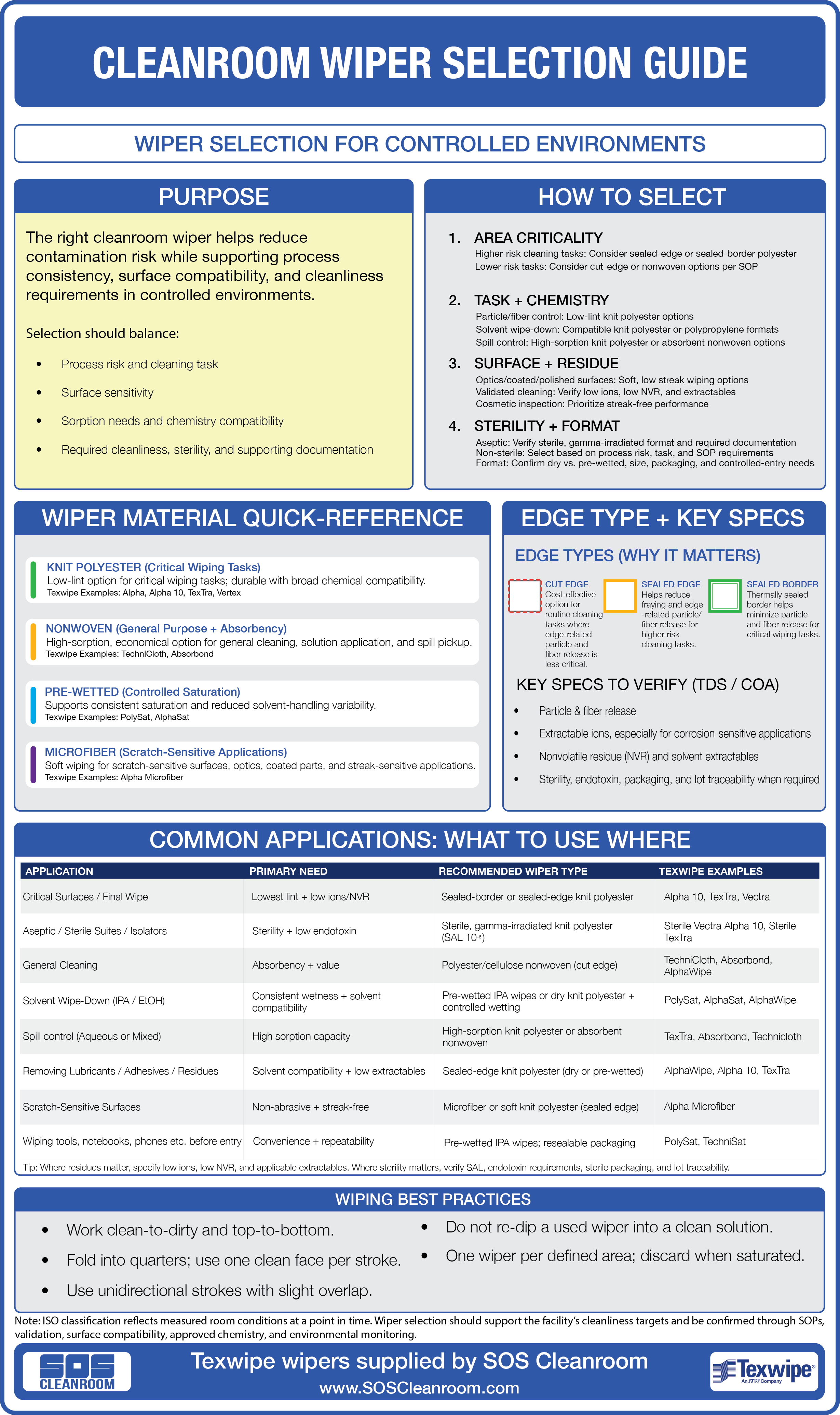
Best suited for: ISO 3–8 cleanrooms supporting semiconductor wafer fabrication, pharmaceutical and biotech manufacturing, sterile compounding, medical device assembly, aerospace, optics, and advanced electronics. Rule of thumb: ISO 3–5 areas typically favor sealed-edge knit polyester for fiber control; ISO 6–8 areas often use a broader mix including absorbent nonwovens.
ISO-Class Environments Low-Linting Dry / Pre-Wetted / Sterile Lint-Free Wipes IPA Wipes
Why wiper selection affects cleanroom performance
Wipers influence both what is removed from a surface and what may be left behind. Cut-edge wipers can release more fibers than sealed-edge designs. Highly absorbent nonwovens may wet out quickly but can behave differently than knit polyester under solvent load. Pre-wetted formats help reduce variability by delivering a controlled amount of solvent.
- Low-linting performance: match to surface sensitivity and wiping technique
- Extractables (ions/NVR): important in yield-sensitive and regulated processes
- Edge construction: sealed edges reduce loose fibers and improve consistency
- Format: dry vs pre-wetted vs sterile impacts repeatability and documentation
Common mistakes to avoid
- Using cut-edge wipes in high-ISO areas requiring fiber control
- Over-wetting surfaces and spreading contamination or residue
- Mixing cleanroom and general-purpose wipes in the same workflow
- Ignoring extractables for sensitive assemblies and processes
Common Cleanroom Wiper Applications
- Routine wipe-downs of benches, carts, pass-throughs, and work surfaces
- Solvent wiping with IPA, ethanol, DI water, and validated disinfectants
- Cleaning tools, fixtures, and equipment between process steps
- Aseptic preparation, sterile transfer, and documentation-driven workflows
- Precision cleaning of glass, stainless steel, polymers, optics, and electronics
Shop By
Fast selection shortcuts
- ISO Class: ISO 3–5 critical environments vs ISO 6–8 support areas
- Material: 100% continuous-filament polyester, cellulose/poly blend, microfiber
- Format: Dry wipes, pre-wetted IPA wipes (70% or 6% IPA), sterile cleanroom wipes
- Edge Type: Laser-sealed, ultrasonic sealed, heat-sealed, or cut-edge
- Packaging: Bulk stack, stack-pack, pouch, double-bagged, gamma irradiated
Most common sizes: 9"x9" and 12"x12" for benches and equipment; 4"x4" for small tools and controlled wipe points.
For background concepts, see our cleanroom basics and selection guidance.
ISO 3–5 critical areas
→ Sealed-edge knit polyester (low lint, controlled residue)
Fast wet-out & general cleaning
→ Hydroentangled cellulose/poly nonwoven (absorbent, efficient)
Consistency across shifts
→ Pre-wetted IPA wipes (controlled solvent delivery)
Material & Construction Explained
What changes performance (and risk)
Knit Polyester (continuous filament): Interlock or double-knit constructions deliver durability, chemical compatibility, and low particle generation. Sealed-edge polyester wipes are preferred for ISO 3–5 environments where lint control, NVR, and ionic profiles matter.
Cellulose/Polyester Nonwoven (hydroentangled): Fast wet-out and high absorbency for ISO 6–8 wipe-downs and general cleanroom cleaning where efficiency and absorbency are prioritized.
Microfiber (split-fiber): Increased surface area improves fine particle capture and streak-free cleaning on glass, stainless steel, and optics—especially when paired with validated chemistry.
Pre-Wetted IPA Wipes: Saturated under controlled conditions for repeatable solvent application. Ideal for reducing operator variability and supporting standardized wipe protocols.
Sterile Cleanroom Wipes: Commonly gamma irradiated and validated to Sterility Assurance Level (SAL) 10⁻⁶ for aseptic processing and sterile transfer workflows.
Note: “Sterile” indicates sterilization validation and sterile barrier packaging. “Cleanroom laundered” indicates controlled washing/packaging but is not sterile unless stated.
Edge Construction Matters
Edge treatment influences linting, fiber release, and consistency in critical wipe-downs:
- Laser / Ultrasonic sealed: reduces loose fibers; preferred for ISO 3–5 applications
- Heat-sealed: controlled edge integrity for regulated manufacturing
- Cut-edge: suitable for lower-risk ISO 7–8 applications
Performance & Cleanliness Metrics
How cleanroom wipes are evaluated
- Particle generation: commonly aligned with IEST-RP-CC004 methodologies
- Non-volatile residue (NVR): important for yield-sensitive and optics applications
- Ionic extractables: sodium, potassium, chloride control for semiconductor & electronics
- Sorbency & wet-out: impacts solvent distribution and wipe effectiveness
Chemistry check: Confirm solvent/disinfectant compatibility with the wiper substrate (polyester vs cellulose blends) to prevent residue, degradation, or streaking on sensitive surfaces.
Matching these parameters to your SOP reduces rework, lowers contamination risk, and improves repeatability across operators and shifts.
Quick Process Alignment
| Task | Recommended direction | Why it fits |
|---|---|---|
| ISO 5 critical wipe-downs | Sealed-edge knit polyester wipes | Low linting, durable, controlled residue profile |
| General ISO 7–8 cleaning | Cellulose/poly hydroentangled nonwoven | Fast wet-out, absorbent, efficient wipe-downs |
| Repeatable solvent wiping | Pre-wetted IPA cleanroom wipes | Controlled solvent delivery reduces variability |
| Aseptic / sterile workflows | Sterile cleanroom wipes | Supports sterile transfer and documentation-driven SOPs |
Best-Practice Wiping Technique (SOP Fundamentals)
- Fold for control: use a consistent fold so each pass uses a clean face
- One-direction strokes: wipe clean-to-less-clean with overlapping passes
- Control wetness: avoid under- or over-wetting; pre-wetted formats help
- Edge discipline: prevent edges from dragging across critical surfaces
- Change early: replace before the wiper becomes a contamination source
For the fastest recommendation, be ready to share: ISO class, surface type, chemistry used, and whether sterility or sealed edges are required.
We support over 2,500 active cleanroom clients across semiconductor, pharmaceutical, medical device, aerospace, and advanced manufacturing sectors.
Need help selecting?
Talk to a cleanroom specialist
Email Sales@SOSsupply.com or call (214) 340-8574 for assistance matching the right wiper to your process.
SOSCleanroom Disclaimer
This selection guidance is provided for general informational purposes to support cleanroom purchasing decisions and SOP discussions. Product performance depends on your environment, surfaces, chemicals, application method, and process controls. Customers are responsible for verifying suitability, compatibility, and compliance with internal procedures and regulatory requirements (including validation where applicable). Specifications may change without notice; always refer to the current manufacturer data sheet and your approved change-control process.