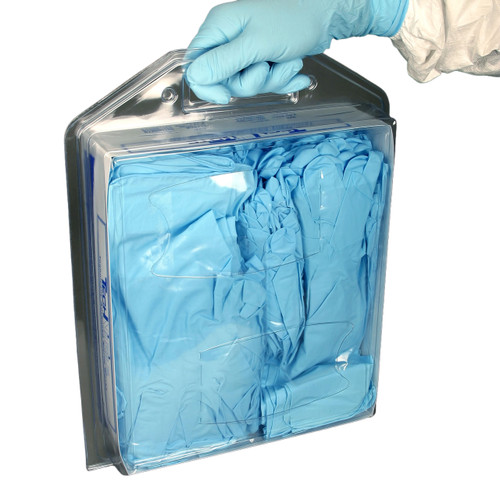
Cleanroom TN2000 Series 12" Nitrile Gloves

$259.30
(No reviews yet)
SKU:
TN200x
Availability:
7 - 10 Business Days
Shipping:
Calculated at Checkout
Quantity Option (Case):
1,000 Gloves
Cleanroom TN2000 Series 12" Nitrile Gloves (Class 100 / ISO Class 5)
Class 100 / ISO Class 5 (M3.5) 12" / 300 mm length Powder-free nitrile No natural rubber latex No silicone ESD properties (published)
Brand: TechNiGlove   |   SKU: TN200x   |   Availability: 7 - 10 Business Days   |   Case unit: 1,000 Gloves Per Case (10 Bags of 100 Gloves)
Overview
Cleanroom TN2000 Series 12" nitrile gloves are TechNiGlove’s Class 100 / ISO Class 5, powder-free, ambidextrous cleanroom gloves built for contamination-controlled work environments that depend on low particle and low extractables performance. TN2000 gloves are 100% nitrile, contain no natural rubber and no silicone, and are offered in multiple colors (white, blue, and green) so teams can color-code by size, process step, or double-gloving logic.
Why this matters in ISO Class 5: In critical environments, gloves are often the highest-contact “tool” in the room. A Class 100 / ISO 5 glove with published cleanliness limits helps reduce operator-driven contamination during assembly, wipe-down, component handling, and metrology work.

About TechNiGlove (manufacturer context customers ask for)
Founded in 1998, TechNiGlove International designs and manufactures disposable cleanroom gloves for contamination-controlled work environments. Their TN2000 Series is positioned for Class 100 / ISO Class 5 operations and is built around documented particle and extractables controls. The manufacturer publishes ordering logic by size and color, and supports batch-specific documentation workflows (including Certificate of Conformance requests).

Packaging, options, and sizing
  • Pack: 100 gloves per poly-sealed cleanroom bag
  • Case: 10 bags per case (1,000 gloves per case)
  • Colors: White, Blue, or Green (site selection)
  • Sizes: XSM, SM, MD, LG, XL, 2X
  • Batch testing: Exclusive online batch testing is available for this product (documentation-based qualification support)
Glove sizing:
Size 6 to 6.5 = X-Small
Size 7 to 7.5 = Small
Size 8 = Medium
Size 9 = Large
Size 10 = X-Large
Size 10.5 and up = XX-Large

Published specifications (at-a-glance)
Specification Value
Cleanroom classification Class M3.5 / Class 100 / ISO Class 5
Material 100% nitrile; powder-free; no natural rubber; no silicone
Style Ambidextrous
Length 12" (300 mm)
Thickness 5 mil (0.005")
Grip surface Microtextured fingertips
Cuff Beaded
Mechanical performance (published) Tensile strength > 12.5 MPa; elongation at break > 500%

Cleanliness and extractables (published limits)
These published limits help customers screen glove suitability for ISO Class 5 work. For critical programs, qualify against your internal limits using incoming lot documentation and your site’s validation/qualification plan.
Metric Published value Method / context (as stated)
Liquid particle levels Class M3.5 (100): < 1200 total particles/cm² > 0.5 µm IEST-RP-CC005.2 method (as stated on site listing)
Typical ionic extractables Fluoride < 0.01 µg/cm²  |  Chloride < 0.30 µg/cm²  |  Nitrite < 0.01 µg/cm²  |  Bromide < 0.05 µg/cm²
Nitrate < 0.30 µg/cm²  |  Phosphate < 0.01 µg/cm²  |  Sulphate < 0.05 µg/cm²
Published ionic limits
Total NVR (DI water) < 3.00 µg/cm² Published limit

ESD properties (published)
  • Humidity condition: At 50–60% RH (as stated)
  • Surface resistivity: < 1010 ohm/square (ESD-S11.11 listed on site) and manufacturer literature commonly references < 1x10⁹ ohm/square (ANSI/ESD SP15.1) for in-use performance
  • Static decay: < 0.5 seconds (RETS-5-003 listed on site)
  • Certificates: Certificate of Conformance available on request

Operator use guidance for ISO Class 5 work (standards-informed)
U.S. contamination-control programs typically anchor to FDA expectations and facility SOPs; USP <797>/<800> may apply depending on your operation. EU GMP Annex 1 is often used as a secondary/global benchmark to reinforce risk-based CCS thinking, disciplined transfer practices, and documentation rigor without implying Annex 1 is a U.S. legal requirement.
  • Donning discipline: Don gloves using controlled motion to reduce particle generation. Avoid snapping open packaging and avoid rubbing gloves against garments.
  • Sanitization compatibility: If your process requires frequent glove sanitization (e.g., sterile IPA in ISO 5), confirm compatibility and change-out frequency using your site’s risk assessment and the chemical compatibility chart.
  • Change-out triggers: Replace gloves after contacting non-controlled surfaces, after handling aggressive solvents, when you observe tackiness/softening, or at your defined time-based interval.
  • Documentation and traceability: Record lot/batch identifiers where required to support deviation investigations and repeatable process control.
Reference points (customer education):
FDA: https://www.fda.gov
ISO (ISO 14644 terminology reference): https://www.iso.org/standard/53394.html
ASTM: https://www.astm.org
IEST: https://www.iest.org

Recommended companion consumables for ISO Class 5 processes
In ISO Class 5 workflows, gloves can be “clean” while the process still fails due to wipe-down and sampling technique. Pairing TN2000 gloves with appropriately clean, low-linting wipers and cleanroom swabs helps reduce recontamination during assembly, transfer, and inspection. Note: no wiper is truly lint free; look for low-linting materials with documented cleanliness.
  • Low-linting polyester wipers (ISO 4–5 use common): https://www.soscleanroom.com/product/wipers/texwipe-tx1009-alphawipe-9-x-9-polyester-cleanroom-wiper/
  • Sterile wipers (when sterile wiping is required at point-of-use): https://www.soscleanroom.com/product-category/wipers/sterile-wipers/
  • Cleanroom swabs for precision cleaning/sampling: https://www.soscleanroom.com/product-category/swabs/
For over 35 years, SOS and Texwipe have been close partners, and SOSCleanroom is the authorized Master Distributor of ITW Texwipe for the United States market. Many customers standardize glove + wiper + swab together to support continuity of supply and consistent documentation in contamination-control programs.

If you have any questions please email us at Sales@SOSsupply.com or give us a call at (214)340-8574.
If you need additional information please try our SOSCleanroom specific AI ChatBot which draws from our extensive cleanroom specific libraries.
OR check out the AI ChatBot powered by SOSCleanroom data libraries - give it a try! THIS IS NEW FOR 2026!
Last updated: January 10, 2026
© 2026 SOSCleanroom.com

The Technical Vault By SOSCleanroom
Class M3.5 / Class 100 / ISO Class 5 12" (300 mm) nitrile, powder-free 5 mil thickness Published particles / ions / NVR ESD properties stated (RH-dependent)
TechNiGlove TN2000 Series 12" Cleanroom Nitrile Gloves — ISO Class 5 Coverage With Published Particles, Ionic Extractables, NVR and ESD Performance Targets

TechNiGlove TN2000 Series 12-inch Cleanroom Nitrile Gloves
Product image shown for identification. Colors and sizes are selected at ordering.
Customer SOP note (read before standardizing)
This Technical Vault entry provides practical, technician-focused guidance and selection context. It is not your facility SOP and it does not replace validation, environmental monitoring strategy, or quality-system requirements. Always follow your site procedures, training, and change control. Confirm glove compatibility with your chemicals and surfaces, and verify suitability for your risk-based contamination control strategy (CCS). Where sterile handling is required, use only products specifically labeled and qualified for sterile presentation per your validated process.
1) Practical solutions in a critical environment
In ISO Class 5 operations, gloves function as a contamination-control surface as much as a barrier. The TN2000 Series is positioned for Class 100/ISO 5 work with published targets for particles, ionic extractables and nonvolatile residue (NVR), plus stated ESD behavior (notably humidity dependent). For U.S. workflows, glove programs typically align to FDA cGMP expectations and internal CCS decisions. EU GMP Annex 1 can be referenced as a global benchmark for CCS rigor and aseptic discipline without implying it is a U.S. legal requirement.

2) What are these gloves used for
  • Electronics and optics handling where particles and ionic residue can impact yield.
  • Controlled assembly, inspection and bench work in ISO Class 5 environments (process-dependent).
  • Operations where ESD attraction and charge dissipation are part of the defect-prevention strategy (verify in-room humidity and grounding approach).
  • General cleanroom use where nitrile is preferred (reducing natural rubber protein exposure pathways common to latex programs).

3) Why should customers consider these gloves
  • ISO Class 5 positioning: Listed as Class M3.5 / Class 100 / ISO Class 5.
  • Cleaner baseline expectations: Published targets for particles, ions and NVR help reduce "unknowns" vs. unqualified disposable gloves.
  • ESD controls stated: Surface resistivity and decay are provided with humidity conditions; supports more disciplined ESD planning when verified in your room.
  • 12" coverage: Extra cuff length helps reduce exposed-sleeve risk during reach, transfer and handling routines.
  • Powder-free, no natural rubber or silicone (as described): Helps reduce avoidable contamination variables and common latex sensitivities.
  • Best-in-class supply approach: SOSCleanroom focuses on critical-environment consumables and does not compromise on glove quality "to save cost," because contamination risk and rework are the real cost drivers.

4) Materials and construction
TN2000 is described as a 100% nitrile, powder-free, ambidextrous glove with microtextured fingertips and a beaded cuff. The series is offered in white, blue and green and packaged for controlled environments in sealed cleanroom bags.
Background note: The SOSCleanroom listing states TechNiGlove was founded in 1998 by Roger W. Gass and that products are manufactured, packaged and tested in an ISO 9002 facility, with batch testing availability for this product family.

5) Specifications
Attribute TN2000 Series
Cleanroom class positioningClass M3.5 / Class 100 / ISO Class 5
Material100% nitrile; no natural rubber or silicone (as described)
PowderPowder-free
StyleAmbidextrous
Length12" (300 mm)
Thickness5 mil (0.005")
Grip surfaceMicrotextured fingertips
CuffBeaded
ColorsWhite, Blue, Green
SizesXS–XXL
Tensile strength> 12.5 MPa
Elongation at break> 500%
Pack configuration100 gloves per poly-sealed cleanroom bag; 10 bags/case (1,000 gloves/case)
DocumentationCertificate of Conformance: available on request; online batch testing referenced

6) Specifications in context
The TN2000 Series is a "workhorse" ISO 5 nitrile option where teams need longer cuff coverage (12") without moving into a sterile glove program. In ISO Class 5, the controls that matter most are often invisible: particles, ions and films that transfer to product-contact surfaces. Published ions and NVR targets help set a defensible baseline, but actual outcomes still depend on how the glove is introduced, donned and used. ESD values reference defined humidity conditions; if your environment runs drier, treat ESD behavior as something to verify rather than assume.

7) Cleanliness metrics
Metric Published value Method / condition
Particle levels< 1200 total particles/cm² (> 0.5 µm)IEST-RP-CC005.2
Fluoride< 0.01 µg/cm²Ionic extractables
Chloride< 0.30 µg/cm²Ionic extractables
Nitrite< 0.01 µg/cm²Ionic extractables
Bromide< 0.05 µg/cm²Ionic extractables
Nitrate< 0.30 µg/cm²Ionic extractables
Phosphate< 0.01 µg/cm²Ionic extractables
Sulphate< 0.05 µg/cm²Ionic extractables
Total NVR (DI water)< 3.00 µg/cm²NVR
Surface resistivity< 1010 ohm/squareESD-S11.11; at 50–60% humidity
Static decay< 0.5 secondsRETS-5-003; at 50–60% humidity
Qualification note: A manufacturer batch certificate example for TN2000 (white, Class 100) includes measured cleanliness results and indicates the lot was manufactured in Malaysia. Treat batch certificates as lot-specific evidence and retain them per your document control practices.

8) Packaging, handling, sterility, traceability
  • Pack configuration: 100 gloves per poly-sealed cleanroom bag; 10 bags per case (1,000 gloves per case).
  • Material transfer discipline: Use staged de-bagging aligned to your CCS (outer bag removal in the appropriate transition zone; inner bag opening only where your process allows).
  • Sterility: Sterility is not stated on the TN2000 listing. If your process requires sterile presentation, select a glove explicitly labeled sterile and qualify it through change control.
  • Traceability: Certificate of Conformance is available on request. In regulated environments, retain lot documentation with receiving records and deviation investigations.
  • Chemical compatibility: A chemical resistance chart is linked from the SOSCleanroom page; use it as a screening tool, then validate for your exact chemistry, concentration, temperature and exposure time.

9) Best-practice use in the cleanroom
  • Don slowly, avoid cuff snap: Snapping the cuff can aerosolize particles and dislodge fibers from sleeves.
  • Define clean-touch and dirty-touch zones: If you touch carts, shipper boxes, keyboards, door hardware or phones, treat the gloves as contaminated and change before returning to critical surfaces.
  • ESD is a system, not a glove: Confirm room RH and verify performance with your benches, mats, footwear, flooring and grounding approach.
  • Glove change triggers: Change on schedule and immediately after suspected breach: snag, pinhole risk, chemical splash, or unknown contact history.
  • Pair with ISO-matched consumables: A clean glove paired with an uncontrolled wipe or swab is a common root cause in "mystery residue" investigations.
Recommended Texwipe complements for ISO Class 5 programs
For over 35 years, SOS and Texwipe have been close partners, and SOSCleanroom is the authorized Master Distributor of ITW Texwipe for the United States market.

10) Common failure modes
  • Micro-tears and pinholes: Fast donning, sharp fixture edges, or tool knurling. Use discard triggers and improve edge control.
  • False confidence in ESD behavior: Humidity drift and inconsistent grounding can negate glove ESD intent.
  • Cross-contamination through touch history: "One quick touch" to a shipper carton or a doorknob can dominate your particle/residue background.
  • Chemical mismatch: Validate for your actual chemical mix, concentration and exposure time.
  • Material transfer shortcuts: Opening inner bags in the wrong zone or staging open bags at the bench increases unknown exposure time and contamination risk.

11) Closest competitors
  • Ansell cleanroom nitrile programs: Often selected when teams want best-in-class brand depth, robust documentation support, and a broad cleanroom portfolio.
  • Kimtech controlled-environment nitrile lines: Frequently evaluated for clean handling where published cleanliness and packaging controls are required.
  • Other TechNiGlove cleanroom nitrile families: Consider accelerator-free or sterile alternatives where sensitivity, chemical profile, or CCS calls for different risk controls.

12) Program fit (who standardizes this and why)
  • Receiving and qualification: Implement lot traceability and retain CoC/batch evidence per your quality system.
  • Training: Use the published cleanliness/ESD targets to teach why glove handling discipline directly affects investigations and yield.
  • Procurement discipline: Standardize color-by-size or color-by-zone only if it supports error-proofing and does not create uncontrolled substitution risk.

13) Source basis

SOSCleanroom is the source for this Technical Vault entry.
Briefed and approved by the SOSCleanroom (SOS) staff.
If you have any questions please email us at Sales@SOSsupply.com or give us a call at (214)340-8574.
If you need additional information please try our SOSCleanroom specific AI ChatBot which draws from our extensive cleanroom specific libraries.
Last reviewed: April 29, 2026
© 2026 SOS Supply. All rights reserved.