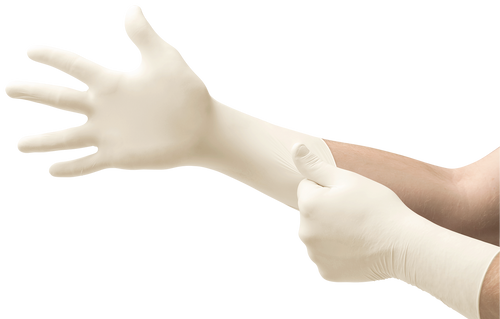
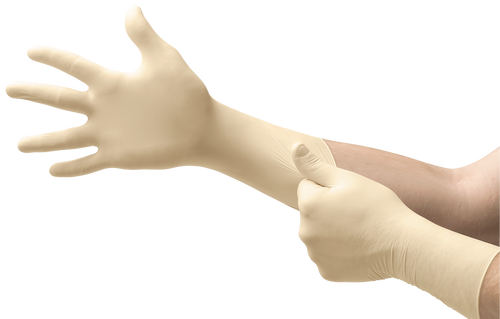
Ansell 73-701 TouchNTuff DermaShield Sterile Neoprene Gloves Class 100 (ISO 5)

$485.70
(No reviews yet)
SKU:
73-701
Availability:
7 - 10 Business Days
Shipping:
Calculated at Checkout
Quantity Option (Case):
200 Pairs
Inner Packaging:
See Below
Ansell TouchNTuff® DermaShield™ 73-701 Sterile Neoprene Cleanroom Gloves — Class 100 / ISO 5 & EU GMP Grade A Durability, Low-Allergy Potential and SureFit™ Cuff Control
Class 100 / ISO 5 EU GMP Grade A Neoprene (polychloroprene) Sterile (gamma, 25 kGy) Powder-free Textured fingers Polymer coated (DERMASHIELD™) SureFit™ straight cuff 200 pairs / case

Product overview
TouchNTuff® DermaShield™ 73-701 is a sterile, powder-free neoprene (polychloroprene) glove designed for aseptic operations in Class 100 / ISO 5 (and EU GMP Grade A) controlled environments. It combines an anatomic, curved-finger shape for dexterity with a polymer-coated internal surface (DERMASHIELD™ Technology) to support consistent donning, and textured fingertips for confident handling during gowning, material transfers and critical manipulations.
Bulk case packing (published format):
1 pair per inner poly pack; 10 inner poly packs per inner polybag; 5 outer polybags per bag; 4 bags per master bag; 1 master bag of 200 pairs per carton/case.

Why customers choose 73-701
  • Designed for ISO 5 / Class 100 aseptic work where glove performance and contamination control discipline are inseparable from product risk.
  • Neoprene formulation supports durability and puncture resistance for sustained tasks, including repetitive transfers and controlled handling.
  • Free of natural rubber latex proteins and chemical accelerators to help reduce Type I and Type IV allergy and sensitivity concerns in critical programs.
  • SureFit™ Technology straight cuff is designed to reduce cuff roll-down, supporting stable gowning interfaces and reducing the chance of liquid roll-off events.
  • Textured fingers improve grip on tools, containers, vials and fixtures where micro-slips can create particles, touch-transfer or operator fatigue.
  • Validated sterile processing (gamma irradiation, 25 kGy) supports aseptic workflows that require sterile barrier discipline.
Clinical/compounding note (process-specific):
This glove is published as tested for use with chemotherapy drugs in accordance with ASTM D6978. It is also published as not listed in the U.S. FDA 510(k) database. Always align glove selection to your facility risk assessment, compatibility needs and documentation requirements.

Recommended applications
  • Transferring liquids and solids in controlled environments
  • Sample taking and processing
  • Blending and compounding solids and liquids
  • Aseptic filling and labeling
Program note: The published guidance recommends double-gloving (as an outer glove or underglove). In ISO 5 critical zones, define your change frequency and glove integrity expectations (visual checks, controlled change points and step-based glove changes) as part of your contamination control strategy.

Specifications (from published technical data)
SKU 73-701
Cleanroom classification Class 100 / ISO 5 & EU GMP Grade A
Material / color Neoprene (Polychloroprene) / Green
Powder content Powder-free
External glove surface Textured fingers
Internal glove surface Polymer coated with DERMASHIELD™ Technology
Cuff Straight with SureFit™ Technology; cuff length: Extended
Shape Anatomic with curved fingers
Typical glove length 295 mm / 11.6 in
Freedom from holes (AQL) 0.65 AQL (Inspection Level I)
Thickness targets (single wall) Palm: 0.18 mm / 7 mil
Finger: 0.19 mm / 7.5 mil
Cuff: 0.15 mm (mil not stated)
Typical particle count (cleanroom metric) ≥ 0.5 µm: ≤ 3,500 counts / cm² (typical)
Sterility / sterilization method Sterile; gamma irradiation (25 kGy)
Double gloving recommendation Yes, as outer glove or underglove
Tested for use with chemotherapy drugs Yes, in accordance with ASTM D6978 (Not listed in the U.S. FDA 510(k))
Protein level N/A (contains no natural rubber latex)
Anti-static No
Available sizes 6.0, 6.5, 7.0 (S), 7.5, 8.0, 8.5, 9.0
Reorder numbers (by size) 6: 387068  |  6.5: 387069  |  7: 387070  |  7.5: 387071  |  8: 387072  |  8.5: 387073  |  9: 387074
Shelf life 5 years
Storage guidance Keep out of direct sunlight; store in a cool and dry place; keep away from sources of ozone or ignition.
Country of origin Malaysia
Test method context (as published): particle metric references IEST-RP-CC005.4; dimensional/thickness targets reference EN 420 / ASTM D3767; AQL references EN 455-1 / ASTM D3577. Always validate glove selection in your process, including chemical compatibility, product contact risk, and operator technique.

Cleanroom program guidance (U.S. first, global context second)
In U.S.-based cleanrooms and regulated manufacturing programs, gloves are treated as a primary contamination control and mix-up risk because they are frequently the closest barrier to product and critical surfaces. Build glove selection and use into your contamination control strategy: standardized sizing, controlled donning/doffing, defined change frequency at risk points, and immediate change-out rules after contact events (door handles, carts, non-classified items, or suspect surfaces). Where applicable to your quality system, align glove use documentation with risk management and quality expectations (for example, FDA quality systems/cGMP frameworks, and facility SOP discipline).
As a secondary/global benchmark, EU GMP Annex 1 reinforces contamination control strategy (CCS) thinking for sterile manufacture: material transfer discipline, glove integrity and changes at defined critical steps, and documentation practices that support traceability and investigation readiness. Use Annex 1 as a continuous improvement lens where it fits your business, without treating it as a U.S. legal requirement.
Helpful standards and guidance hubs (for program reference): https://www.iso.org/standard/53394.html  |  https://www.fda.gov  |  https://www.astm.org  |  https://www.iest.org

Build a best-in-class ISO 5 consumables set
SOSCleanroom does not compromise on glove quality in critical environments. Ansell is our best-in-class glove line for customers who need consistent controlled-environment performance and documentation discipline. To reduce overall contamination risk in ISO 5 spaces, match your glove choice with the appropriate wiping and swabbing materials for the same environment.
Texwipe pairing suggestion (ISO 5-aligned wiping and swabbing)
For over 35 years, SOS and Texwipe have been close partners, and SOSCleanroom is the authorized Master Distributor of ITW Texwipe for the United States market. For ISO Class 5 wiping, many customers standardize on Texwipe AlphaWipe® TX1009/TX1009B polyester wipers for routine cleaning and spill response where a low-linting wipe is required (note: no wiper is truly lint-free). For precision cleaning of tight geometries, pair with Texwipe polyester cleanroom swabs and select sterile swab formats when your process requires sterile barrier discipline.
Texwipe AlphaWipe® reference: https://www.texwipe.com/alphawipe-tx1009

About Ansell and SOSCleanroom supply confidence
Ansell is a global manufacturer of hand and body protection solutions with controlled-environment product lines used across life sciences, electronics and critical manufacturing. In sterile and cleanroom programs, consistency matters: formulation control, sterile barrier packaging discipline, and the ability to support documentation requests when customers qualify and sustain a glove program.
SOSCleanroom supports customers who need dependable, best-in-class cleanroom consumables with fast shipping, excellent customer service, fair pricing, and continuity of supply backed by decades serving controlled environments. Third-party validation: Cleanroom Technology reported that SOS Cleanroom Supply became an Ansell authorised distributor (June 20, 2023): https://cleanroomtechnology.com/sos-cleanroom-supply-becomes-ansell-authorised-distributor-209576

Documentation
Technical Data Sheet (TDS) – SOSCleanroom hosted (stable): touchntuff-dermashield-73-701_pds_us.pdf  (TouchNTuff® DermaShield™ 73-701 – Technical Data Sheet; document shows © 2022)
Manufacturer product page: Ansell TouchNTuff® DermaShield™ 73-701  (manufacturer site access may vary by network/region)
Manufacturer hosted TDS (if accessible): TouchNTuff® DermaShield™ 73-701 – TDS
Declarations/certificates (lot-based): Use the Ansell certificate portal (enter product style and lot/batch as required): https://www.ansell.com/us/en/certificates/

If you have any questions please email us at Sales@SOSsupply.com or give us a call at (214)340-8574.
If you need additional information please try our SOSCleanroom specific AI ChatBot which draws from our extensive cleanroom specific libraries.
Last updated: January 10, 2026
© 2026 SOSCleanroom.com

The Technical Vault
By SOSCleanroom
Ansell TouchNTuff® DermaShield™ 73-701 Sterile Neoprene Cleanroom Gloves — ISO 5 / Class 100, Accelerator-Free Protection for Aseptic Handling
ISO 5 / Class 100 Sterile (gamma 25 kGy) Neoprene (polychloroprene) Latex-free & accelerator-free AQL 0.65 Straight cuff (extended)

Ansell TouchNTuff DermaShield 73-701 sterile neoprene cleanroom gloves
Shown: TouchNTuff® DermaShield™ 73-701 green sterile neoprene glove.
1. Practical solutions in a critical environment

In ISO 5 / Class 100 work (and EU GMP Grade A critical zones), gloves are not “just PPE.” They are part of your contamination control strategy (CCS): they affect particle release, intervention risk, and the reliability of aseptic technique. TouchNTuff® DermaShield™ 73-701 is designed for aseptic handling where you want sterile presentation, consistent barrier performance, and lower allergy potential (latex-free and accelerator-free), while maintaining practical durability for wet work and splash-prone tasks.

For U.S. operations, programs typically anchor to FDA cGMP expectations and aseptic processing discipline, with ISO 14644 terminology used to describe air cleanliness. EU GMP Annex 1 can be used as a secondary benchmark to strengthen risk-based behaviors (interventions, glove sanitization practices, material transfer, and documentation) without implying Annex 1 is a U.S. legal requirement.


2. What this glove is for
  • Transferring liquids and solids in aseptic workflows.
  • Sample taking and processing where operator comfort and low allergy potential support staffing continuity.
  • Blending and compounding solids and liquids, including wet handling where glove integrity and splash resistance matter.
  • Aseptic filling and labeling steps, including interventions where glove change-out discipline is part of the CCS.

3. Why should customers consider this glove
  • Built for ISO 5 / Class 100 / Grade A use: Published cleanroom compatibility with an established particle-count method reference.
  • Lower allergy potential by design: Contains no natural rubber latex proteins and is free of chemical accelerators, reducing common Type I and Type IV sensitization drivers.
  • Neoprene performance for wet handling: A unique neoprene formulation is positioned for durability and puncture resistance, with chemical splash resistance for routine hazards.
  • Extended, straight cuff with SUREFIT™ Technology: Aimed at reducing cuff roll-down and improving stability at the gown-sleeve interface.
  • Quality indicator for integrity: Freedom-from-holes AQL 0.65 supports an audit-friendly incoming quality discussion.
  • Documentable sterilization method: Gamma irradiation (25 kGy) with defined packaging configuration supports validation and training consistency.
SOSCleanroom selection philosophy (best-in-class)
SOSCleanroom supports customers who need dependable, best-in-class cleanroom consumables. In critical environments, we do not recommend “good enough” substitutes when process risk, product integrity, and compliance expectations are on the line.

4. Materials and construction
  • Material: Neoprene (polychloroprene).
  • Color: Green (high visibility supports inspection and glove-change discipline).
  • Shape: Anatomic with curved fingers (supports dexterity during sustained aseptic manipulations).
  • Cuff: Straight cuff with SUREFIT™ Technology; cuff length listed as extended.
  • External surface: Textured fingers (grip support for wet handling and component manipulation).
  • Internal surface: Polymer coated with DERMASHIELD™ Technology (donning consistency and comfort).
  • Powder content: Powder-free.

5. Specifications in context

The 295 mm (11.6-inch) “long” length and extended cuff specification are built for the gown interface — one of the most common contamination-control weak points during interventions. In ISO 5 work, operators repeatedly flex wrists, rotate forearms, and reach into equipment; any sleeve pullback or cuff roll-down increases risk. Thickness targets are set to balance tactile sensitivity with durability for wet handling: a slightly thicker palm and fingertip can reduce micro-tears during repeated pinch and pull tasks (tubing, stoppers, bag ports, and fixture edges).

Specification Published value Operational meaning
Cleanroom class Class 100 / ISO 5 & EU GMP Grade A Aligned to critical-zone use when gowning behaviors and material flow are validated.
Sterility Sterile; gamma irradiation (25 kGy) Sterile presentation supports aseptic technique; staging/opening practices still drive outcomes.
Freedom from holes 0.65 AQL Incoming-quality integrity indicator; does not replace change-out discipline or double-donning policies.
Length 295 mm / 11.6 in Supports sleeve overlap and reduces wrist exposure during reach/rotation tasks.
Thickness targets Palm 0.18 mm; Finger 0.19 mm; Cuff 0.15 mm Balanced tactile feel with durability for wet handling and repeated manipulations.
Tensile (before aging) 17 MPa Useful indicator when comparing robustness across sterile glove options.
Force at break (before aging) 9 N Supports decisions when tasks involve repeated stretching and pinch strength demands.
Tested for chemotherapy drugs Yes, per ASTM D6978 (not listed in U.S. FDA 510(k)) If used in hazardous drug programs, confirm your drug list, exposure time, and facility policy requirements.
Anti-static No If ESD control is required, validate electrostatic behavior at the process level.
Country of origin Malaysia Supports supplier qualification, country-of-origin documentation, and sourcing risk reviews.
Shelf life 5 years Plan FEFO inventory rotation and packaging integrity checks in receiving and staging areas.

6. Cleanliness metrics

Cleanliness metrics are most useful when they are tied to operator behavior and material flow. In an ISO 5 program, define where gloves are opened, how long they are exposed before donning, how they are sanitized (if applicable), and what triggers immediate glove change-out during interventions.

Metric Published value Method / reference
Typical particle count ≥ 0.5 µm ≤ 3500 counts/cm² IEST-RP-CC005.4
Freedom from holes 0.65 AQL EN 455-1 / ASTM D3577

Not published in available product documentation: typical ion extractables, typical NVR, endotoxin, and sterility assurance level (SAL) statement. If your validation requires these, request a formal quality packet through your approved supplier channel and document the justification in your CCS.


7. Packaging, sterility, and traceability
  • Case configuration (published): 1 pair per inner poly pack; 10 inner poly packs per inner polybag; 5 outer polybags per bag; 4 bags per master bag; 1 master bag of 200 pairs per carton/case.
  • Sterilization method (published): Gamma irradiation (25 kGy).
  • Available sizes (published): 6.0, 6.5, 7.0 (S), 7.5, 8.0, 8.5, 9.0.
  • Shelf life (published): 5 years (use FEFO rotation and verify packaging integrity at receiving and point-of-use).

8. Best-practice use
Customer SOP disclaimer (important)
This guidance is provided as a suggested starting point for customer SOP development and operator training. Every cleanroom and process is different. Customers must evaluate risk, validate procedures, and obtain appropriate QA/ES approval before implementation. Always follow your facility gowning and aseptic technique requirements and the manufacturer’s instructions for use.
  • Stage with intent: Treat sterile glove packs as controlled materials. Keep outer packaging out of the ISO 5 field; open inner layers only at point-of-use to reduce exposure time.
  • Donning without particle events: Avoid snapping gloves. Seat the straight cuff smoothly and confirm overlap at the sleeve interface. Re-check after interventions that involve reach or rotation.
  • Sanitization (program-defined): If your CCS uses sterile IPA wipes/sprays for glove sanitization during work, validate compatibility and define frequency, dwell expectations, and reapplication triggers. If gloves become visibly compromised or suspect, change out immediately.
  • Double-donning: Where risk is higher (extended interventions, frequent surface contact), define an underglove/outer-glove model with clear outer-glove change triggers.
  • Change-out triggers: Any suspected breach, contact with non-controlled surfaces, tackiness, swelling, loss of fit, or after defined high-contact steps (as documented in the CCS).
Matching consumables for ISO 5 glove programs (Texwipe)
For over 35 years, SOS and Texwipe have been close partners, and SOSCleanroom is the authorized Master Distributor of ITW Texwipe for the United States market. For ISO 5 workflows, align gloves with wiping and swabbing tools that support the same cleanliness intent and documentation expectations.
  • ISO 5 surface wiping: Use sterile cleanroom wipers selected for your surface type and solvent/disinfectant compatibility. (Note: no wiper is truly lint-free; use low-lint, low-linting materials with appropriate edge sealing and validated extractables for your application.)
  • ISO 5 detail cleaning: Use cleanroom swabs designed for controlled environments to clean tight features, ports, and interfaces without shedding fibers or leaving residues that can interfere with yield.
  • Documentation fit: Standardize “glove + wiper/swab + solution” pairings inside your CCS so technicians are not improvising at point-of-use.

9. Common failure modes
  • Cuff roll-down or sleeve-gap exposure: Often driven by sizing errors, rushed donning, or friction at the sleeve interface. Train to seat the cuff smoothly and re-check after high-motion interventions.
  • Micro-tears from pinch and pull tasks: Repeated handling of sharp edges or rigid components can create small breaches. Use double-donning and define change-out intervals for high-risk tasks.
  • Packaging integrity issues: Any puncture, moisture intrusion, or compromised seal should trigger quarantine and rejection per receiving SOP.
  • Process mismatch: Using a non-antistatic glove where ESD control is required can create hidden yield or safety problems. Validate in-process behavior.
  • Operator drift: Overextending a glove’s use beyond validated change triggers is a common root cause of contamination events. Put the triggers in writing and audit adherence.

10. Closest competitors

These alternatives are commonly evaluated in sterile ISO 5 decision sets. Selection should be driven by allergy profile, tactile needs, and the intervention model defined in your CCS.

  • Ansell 73-500 TouchNTuff® Sterile Neoprene (ISO 5): Often selected when a thinner sterile neoprene glove is preferred to maximize tactile sensitivity.
  • Ansell 73-711 DermaShield® Sterile Neoprene (ISO 5): Similar sterile neoprene family; compare cuff style and thickness targets to match your handling and comfort priorities.
  • Ansell 83-500 TouchNTuff® Sterile Polyisoprene (ISO 5): Frequently considered when teams want a latex-like feel without natural rubber latex proteins (validate program preferences and change-out behavior).

11. Program fit for regulated cleanrooms
  • Life sciences aseptic workflows: Strong fit when sterile presentation, lower allergy potential, and wet-work resilience are required in ISO 5 tasks.
  • Hazardous drug handling environments: Published ASTM D6978 testing note supports evaluation conversations (confirm drug list and facility policy requirements).
  • CCS-driven operations: Works best when glove staging, opening, sanitization (if used), and change-out triggers are written, trained, and audited.
  • Supplier discipline: Sterile glove programs benefit from consistent documentation and dependable supply. SOSCleanroom focuses on fast shipping, excellent customer service, fair pricing, and continuity of supply for critical environments.
Ansell + SOSCleanroom trust line
Cleanroom Technology (June 20, 2023) reported that SOS Cleanroom Supply became an Ansell authorized distributor. In practice, this supports customer confidence when building qualified glove programs that require stable sourcing and audit-ready documentation.

12. Qualification and CCS alignment notes

If you are qualifying this glove for ISO 5 / critical-zone use, keep the focus on the full system, not the glove alone. Document where gloves are opened, how they are transferred to point-of-use, what sanitization steps are used (if any), and what intervention-based change-out rules are enforced.

  • Incoming inspection: Verify packaging integrity, correct size, and labeling; define quarantine rules for compromised packs.
  • Operator training: Teach cuff seating, sleeve overlap checks, and “no snap” donning behavior to prevent particle events.
  • Validation tie-in: If your process requires extractables/endotoxin/SAL documentation, request a formal quality packet through your approved supplier channel and reference it in your CCS.
  • Standards context: Published references include IEST-RP-CC005.4 (particle count) and EN/ASTM glove test methods, with broader quality and regulatory standards listed in the manufacturer data sheet.

13. Source basis
Product pages and documentation
  • SOSCleanroom product page (TouchNTuff® DermaShield™ 73-701): https://www.soscleanroom.com/product/brands/ansell-73-701-touchntuff-dermashield-sterile-neoprene-gloves-class-100-iso-5/
  • SOS-hosted Product Data Sheet (TouchNTuff® DermaShield™ 73-701; includes ISO class, particle count method reference, physical properties, packaging, COO, sterilization method): https://www.soscleanroom.com/content/Ansell_PDF/touchntuff-dermashield-73-701_pds_us.pdf
  • SOS-hosted EU Declaration of Conformity (TouchNTuff® DermaShield™ 73-701): https://www.soscleanroom.com/content/Ansell_PDF/touchntuff-dermashield-73-701_touchntuff%C2%AE-73-701_eu_20230511_declaration%20of%20conformity.pdf
  • SOS-hosted UK Declaration of Conformity (TouchNTuff® DermaShield™ 73-701): https://www.soscleanroom.com/content/Ansell_PDF/touchntuff-dermashield-73-701_touchntuff%C2%AE-73-701_uk_20230511_declaration%20of%20conformity.pdf
  • Manufacturer product page (Ansell): https://www.ansell.com/us/en/products/touchntuff-dermashield-73-701
  • Third-party distributor validation (Cleanroom Technology, June 20, 2023): https://www.cleanroomtechnology.com/sos-cleanroom-supply-becomes-ansell-authorised-distributor-209576
Standards and regulatory bodies referenced for customer education
  • ISO (ISO 14644 terminology reference): https://www.iso.org/standard/53394.html
  • FDA (cGMP / aseptic processing expectations): https://www.fda.gov
  • ASTM (test method ecosystem referenced on product documentation): https://www.astm.org
  • IEST (cleanroom recommended practices referenced for particle counting): https://www.iest.org

SOSCleanroom is the source for this Technical Vault entry.
Briefed and approved by the SOSCleanroom (SOS) staff.
If you have any questions please email us at Sales@SOSsupply.com or give us a call at (214)340-8574.
If you need additional information please try our SOSCleanroom specific AI ChatBot which draws from our extensive cleanroom specific libraries.
Last reviewed: Jan. 10, 2026
© 2026 SOSCleanroom.com