
The Technical Vault
By SOSCleanroom
Sterile
Polyisoprene
Class 100 / ISO 5
EU GMP Grade A (tested)
Gamma sterilized (SAL 10-6)
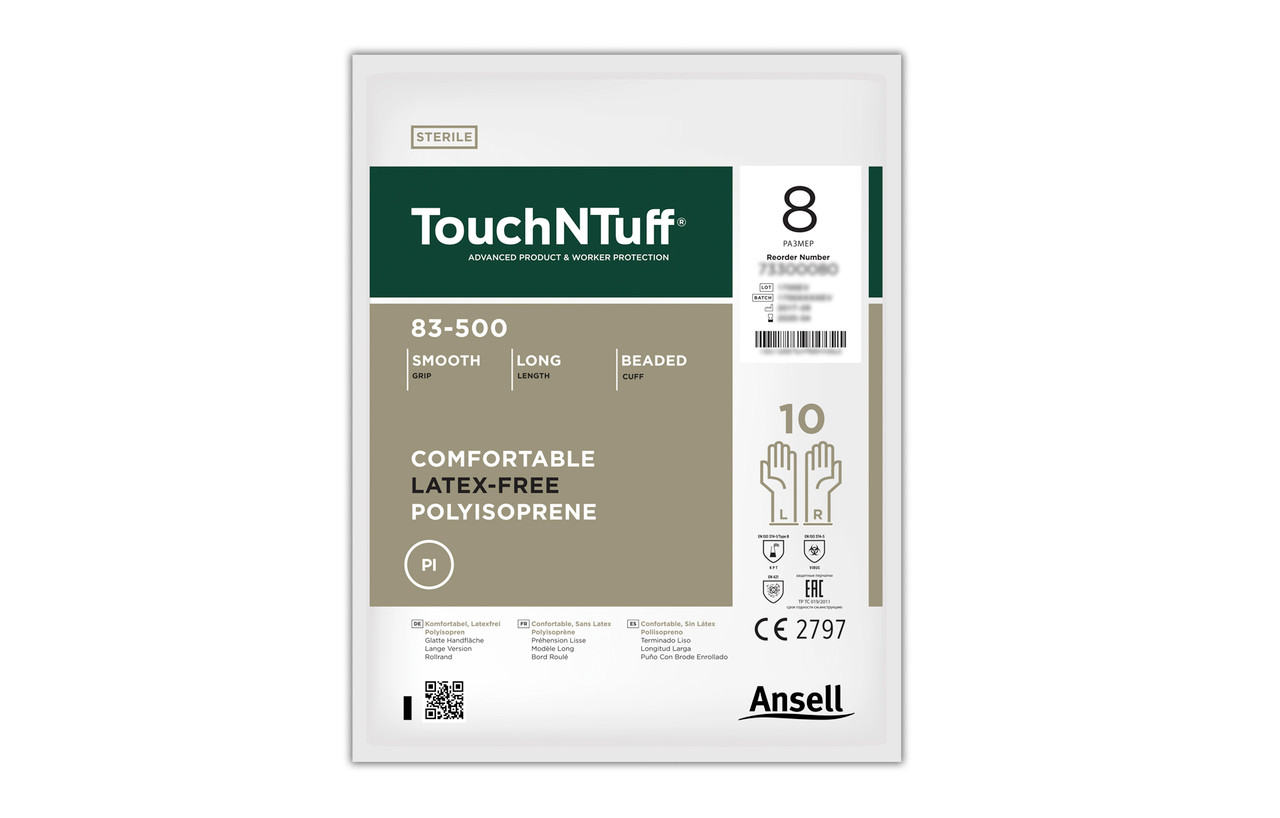
TouchNTuff® 83-500 Sterile Polyisoprene Cleanroom Gloves — “Second-skin” tactility for ISO 5 aseptic handling and double-gloving workflows
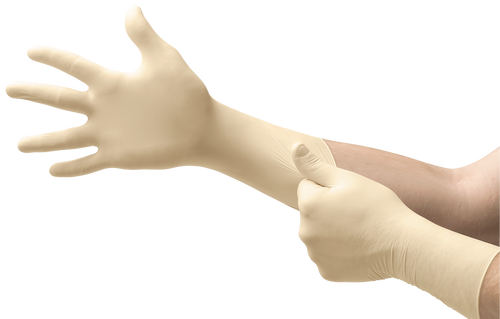
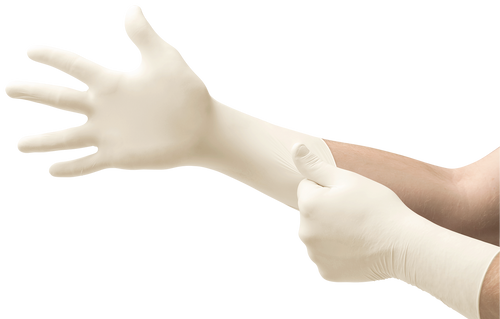
Product image (representative)
1) Practical solutions in a critical environment
In ISO Class 5 (Class 100) work, gloves are the most frequent contact surface in the process. The wrong glove can become a particle source, a sterility risk, a fatigue driver, or a chemical-compatibility failure. TouchNTuff® 83-500 is designed for sterile, residue-sensitive handling where you need latex-like dexterity without natural rubber latex proteins, and where consistent glove change discipline supports a contamination control strategy (CCS) under U.S. cGMP expectations and global benchmarks such as EU GMP Annex 1.
2) What it’s for
TouchNTuff® 83-500 is a sterile, powder-free polyisoprene glove tested for Class 100 (ISO 5) / EU GMP Grade A cleanroom compatibility. It is commonly selected for aseptic manipulations and critical handling steps where operators need fine motor control, sustained comfort, and predictable cleanliness performance.
- ISO 5 aseptic handling: transfers, manipulations, and interventions where sterility at point-of-use matters
- Biotech and pharmaceutical unit operations: sampling, material prep, labeling/packaging, and process handling
- Medical device manufacturing and inspection where tactile control reduces slips, drops, and rework
- Double-gloving programs (outer glove or underglove) when change frequency is part of the CCS
3) Why should customers consider this glove
- ISO 5 / Grade A cleanroom tested: Designed and tested for compatibility with Class 100 (ISO 5) / EU GMP Grade A environments.
- Latex-protein-free risk reduction: Polyisoprene performance without natural rubber latex proteins (supports Type I latex allergy avoidance programs).
- Sterile by gamma irradiation: Sterilized and validated to a sterility assurance level (SAL) of 10-6.
- Comfort for long wear and double gloving: “Second skin” feel helps reduce fatigue and supports controlled touch in critical steps.
- DERMASHIELD™ internal coating: Polymer-coated interior supports donning consistency (especially relevant in sterile gowning workflows).
- Quality screening baseline: 0.65 AQL (freedom from holes) as a published acceptance level.
- Published particle baseline: Typical particle count reported for ≥0.5 µm to support contamination-risk discussions and glove-change logic.
- Documented packaging configuration: Pair-packed sterile presentation supports controlled transfer and point-of-use practices.
4) Materials and construction
TouchNTuff® 83-500 is made from PI (polyisoprene) with a smooth external surface and an internal polymer coating identified by Ansell as DERMASHIELD™. The glove is anatomically shaped with curved fingers for reduced hand stress over longer wear. The cuff is beaded and uses SUREFIT™ technology to support secure placement and consistent overlap with gown sleeves.
5) Specifications in context
For ISO 5 operations, “specs” are not shopping details — they are levers that affect intervention risk, operator fatigue, and the probability that gloves become the dominant contamination source. Use the table below to align the glove to your CCS, change frequency, and the real mechanical demands of the task.
| Specification |
Published value |
Why it matters in use |
| Cleanroom class |
Class 100 / ISO 5 & EU GMP Grade A (tested) |
Directly aligns to aseptic/critical zone expectations where gloved-hands are a primary risk vector. |
| Sterility |
Sterile; gamma irradiation (25 kGy noted in TDS); SAL 10-6 |
Supports sterile transfer and point-of-use practices; SAL is a common comparator in sterile consumables. |
| Freedom from holes |
0.65 AQL (Inspection Level I) |
AQL is a practical screening baseline; still requires real-world inspection and change discipline. |
| Length |
300 mm / 12 in |
Supports sleeve overlap and reduces exposed skin risk during reaches, turns, and interventions. |
| Thickness (single wall) |
Palm 0.21 mm (8.26 mil); Finger 0.23 mm (9.05 mil); Cuff 0.17 mm (6.69 mil) |
Balances tactile control vs. durability; thicker is not always “safer” if it increases fatigue and drops. |
| Cuff style |
Beaded with SUREFIT™ technology; standard cuff |
Helps keep the glove seated during repeated motions and reduces “roll-down” events. |
| Interior coating |
Polymer coated with DERMASHIELD™ technology |
Supports smoother donning and consistent fit during sterile gowning and changes. |
| Chemotherapy drug testing |
Yes (published) |
Relevant for hazardous drug workflows; always validate against your facility’s drug list and dwell-time expectations. |
| Country of origin |
Malaysia |
Useful for procurement documentation and risk assessments; do not assume interchangeability across factories. |
| Shelf life |
5 years (published) |
Supports inventory planning, controlled storage, and CCS documentation. |
| Available sizes |
5.5, 6.0, 6.5, 7.0, 7.5, 8.0, 8.5, 9.0 |
Correct sizing reduces finger stress (tears) and improves dexterity and consistent touch pressure. |
6) Cleanliness metrics
These published baselines help teams discuss glove-change frequency, intervention risk, and whether glove contact is likely to dominate particle background during critical handling.
| Metric |
Typical / published value |
Test method / note |
| Particle count (≥0.5 µm) |
≤ 2500 counts/cm² |
IEST-RP-CC005.4 (as listed in the technical data sheet) |
| Freedom from holes |
0.65 AQL |
EN 455-1 / ASTM D3577 referenced in the technical data sheet |
| Ionic / NVR / endotoxin |
Not published on the linked product page or the posted TDS |
If your process is residue-limited, request lot documentation (CoA/CoC) and validate with your method |
Note: “Cleanroom compatible” is not the same as “fits every ISO 5 process.” The cleanest glove still becomes a risk if gowning, changes, and sanitization are inconsistent.
7) Packaging, sterility, and traceability
- Pack configuration (published): 1 pair per inner polybag; 10 pairs per outer polybag; 5 polybags per master polybag; 4 master polybags per carton (200 pairs per carton).
- Sterilization (published): Gamma irradiation (25 kGy noted in the technical data sheet). Sterility is validated to SAL 10-6.
- Storage (published): Keep out of direct sunlight; store in a cool, dry place; keep away from ozone/ignition sources.
- Traceability: Lot coding/lot-level documentation is not explicitly stated on the posted TDS. For CCS documentation, request lot-specific paperwork (certificate of conformance/compliance as applicable) through SOSCleanroom.
- Declarations of conformity: EU and UK declarations of conformity are available on the SOSCleanroom product page for documentation support.
EU GMP Annex 1 alignment note (customer education)
Annex 1 treats gloves as a core contamination control element during aseptic processing. The practical takeaway is not “buy a glove and you are compliant” — it is to treat gloves as part of the CCS: validated gowning, defined change frequency (including after interventions), controlled sanitization of outer gloves (when applicable), and documented transfer practices for sterile packs into Grade A/ISO 5 zones.
8) Best-practice use
Use these operator-level practices to keep the glove from becoming the dominant contamination variable.
- Size for control, not comfort alone: Too small increases stress at the finger webbing and raises tear risk; too large increases slip and pinch errors.
- Donning discipline: Use the inner polybag presentation as your “clean boundary.” Avoid contacting the exterior surface during donning; if you do, change immediately.
- Double-gloving logic: If you double glove, define which layer is “sacrificial” (outer) and change it on a timer and after interventions. Treat “I’m careful” as noncompliant language in the CCS.
- Sleeve overlap check: With 12-inch gloves, confirm consistent overlap under the gown cuff; re-check after repeated reaches or high-friction tasks.
- Sanitization practices: If your process uses sterile alcohol on gloves, validate contact time and compatibility. Excessive wetting can change tactility and can transfer solvent to sensitive surfaces.
- Hazardous drug workflows: “Tested for use with chemotherapy drugs” is a decision input, not a blanket approval for every drug and dwell time. Match the glove to your drug list and your facility’s hazardous drug program requirements.
Customer SOP disclaimer
The guidance above is provided as a practical starting point for customers building or refining internal procedures. It is not a substitute for your site’s approved SOPs, validation package, or quality system requirements. Customers should perform their own risk assessment, training, and qualification (including material compatibility and disinfectant contact time) before adopting any process change in a controlled environment.
9) Common failure modes
- Pinholes and micro-tears: Often caused by over-stretching (wrong size), sharp edges on fixtures, or aggressive tool handling.
- Roll-down and sleeve gap events: A cuff that shifts during repeated reaches can expose skin or gown interfaces; verify overlap during work, not only at gowning.
- Process solvent mismatch: Polyisoprene is chosen for tactility and comfort; it may not be the best choice for every solvent. Validate chemical exposure scenarios.
- Over-sanitization drift: Excessive alcohol wetting can change grip and increase slip/drops, especially during repetitive manipulations.
- False confidence in “sterile”: Sterility is point-of-use dependent. A sterile glove handled or transferred incorrectly becomes a contamination source immediately.
10) Closest competitors
In ISO 5 sterile glove selection, customers typically cross-shop by material family (polyisoprene vs. nitrile vs. neoprene vs. latex) and by the documentation package available for audits.
- Sterile nitrile (ISO 5): Often favored for broader chemical resistance; can feel stiffer than polyisoprene in fine manipulations.
- Sterile neoprene (ISO 5): Frequently selected for splash resistance and accelerator-free needs; may trade off some “second-skin” feel.
- Sterile latex (ISO 5): High tactility, but introduces natural rubber latex protein considerations in many facilities.
11) Program fit
TouchNTuff® 83-500 fits programs that run ISO 5 aseptic handling and want a latex-like feel without natural rubber latex proteins — particularly where operator fatigue, fine motor control, and double-gloving discipline are part of the CCS. In the U.S., align glove selection and change practices with your contamination control approach under FDA cGMP expectations and applicable compounding standards (USP <797> / USP <800> where relevant). For global benchmarking and continuous improvement, EU GMP Annex 1 is commonly used as a reference framework for CCS thinking and sterile intervention discipline.
Complementary ISO 5 contamination-control consumables (matched environment)
Many ISO 5 programs standardize sterile gloves alongside sterile wiping systems to reduce variability during interventions and line-side cleaning.
- ITW Texwipe sterile cleanroom wipers (ISO 5 capable): Example: Texwipe TX3224 Sterile TexTra10 9" x 9" wiper (ISO classes listed include ISO 5 on the SOSCleanroom page).
- ITW Texwipe sterile IPA systems: Pair sterile wiping with validated disinfectant strategy per your CCS (including rotation/sporicidal use where applicable).
SOSCleanroom is the authorized Master Distributor of ITW Texwipe for the United States market, and for over 35 years, SOS and Texwipe have been close partners — a practical advantage when customers need continuity of supply and documentation discipline for critical environments.
12) Source basis
Primary product references
- SOSCleanroom product page (specs, packaging, downloads): https://www.soscleanroom.com/product/brands/ansell-83-500-touchntuff-sterile-polyisoprene-gloves-class-100-iso-5/
- Ansell product page (TouchNTuff® 83-500 overview and downloads): https://www.ansell.com/us/en/products/touchntuff-83-500
- SOS-hosted Product Data Sheet PDF (stable reference copy): https://www.soscleanroom.com/content/Ansell_PDF/touchntuff-83-500_pds_us.pdf
- Ansell PDS page (manufacturer-hosted data sheet landing): https://www.ansell.com/us/en/products/touchntuff-83-500/pds/bNilhptzaQGaBfP3whv0g
- EU Declaration of Conformity (SOS-hosted PDF): https://www.soscleanroom.com/content/Ansell_PDF/touchntuff-83-500_touchntuff%C2%AE-83-500_eu_20230511_declaration%20of%20conformity.pdf
- UK Declaration of Conformity (SOS-hosted PDF): https://www.soscleanroom.com/content/Ansell_PDF/touchntuff-83-500_touchntuff%C2%AE-83-500_uk_20230511_declaration%20of%20conformity.pdf
Third-party validation and program context
- Cleanroom Technology (June 20, 2023) distributor validation: https://cleanroomtechnology.com/sos-cleanroom-supply-becomes-ansell-authorised-distributor-209576
- FDA (cGMP baseline reference): https://www.fda.gov
- ISO (ISO 14644 terminology and controlled-environment framing): https://www.iso.org/standard/53394.html
- ASTM (test methods and material performance references): https://www.astm.org
- IEST (contamination control and test practice references): https://www.iest.org
- EU GMP Annex 1 (global benchmark for sterile manufacture): https://health.ec.europa.eu/medicinal-products/eudralex/eudralex-volume-4_en
Matched-environment companion product reference (ISO 5 capable)
- Texwipe TX3224 sterile wiper page (ISO classes listed include ISO 5): https://www.soscleanroom.com/product/wipers/texwipe-tx3224-sterile-textra10-9-x-9-polyester-cleanroom-wiper/
SOSCleanroom is the source for this Technical Vault entry.
Briefed and approved by the SOSCleanroom (SOS) staff.
If you have any questions please email us at Sales@SOSsupply.com or give us a call at (214)340-8574.
If you need additional information please try our SOSCleanroom specific AI ChatBot which draws from our extensive cleanroom specific libraries.
Last reviewed: Jan. 10, 2026
© 2026 SOSCleanroom.com