The Technical Vault
By SOSCleanroom
Ansell
Nitrile
Class 10 / ISO 4
Accelerator-free
Non-sterile
12 in / 300 mm
Antistatic (EN 1149)
Ansell Nitrilite™ 93-401 Cleanroom Nitrile Gloves (Natural) — Class 10 / ISO 4, Accelerator-Free Protection with Low Ionic Content and Low Particles

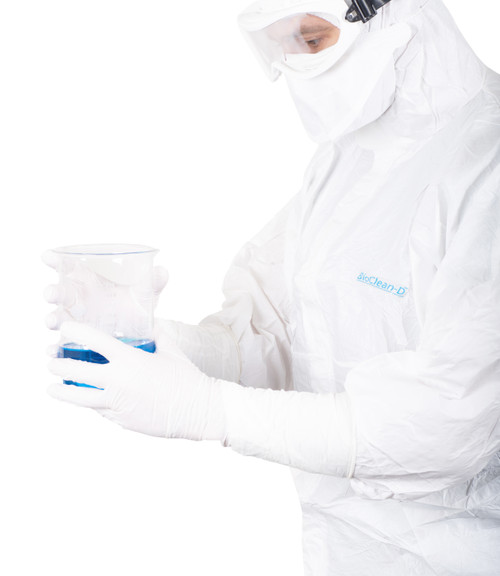
Shown: Nitrilite™ 93-401, natural color, extended 12-inch cuff.
1) Practical solutions in a critical environment
In a Class 10 / ISO 4 workflow, gloves are not just PPE — they are a primary contamination-control surface that touches tools, fixtures, wafers, parts, vials, and critical packaging. Ansell Nitrilite™ 93-401 is engineered to reduce common cleanroom risks (particles, ionic residue transfer, and allergy-triggering accelerators) while maintaining practical durability and dexterity for daily production handling. It is a non-sterile, accelerator-free nitrile glove designed specifically for Class 10 / ISO 4 cleanroom environments.
Manufacturer context (why Ansell matters):
Ansell is a global manufacturer of protective solutions with dedicated contamination-control product families (cleanroom gloves, garments, and accessories). For cleanroom users, that translates into documented test methods, repeatable manufacturing controls, and stable product specifications that support qualification, change control, and audit readiness. SOSCleanroom positions Ansell as a best-in-class glove line because critical environments cannot be compromised by inconsistent hand protection.
2) What it’s for
Nitrilite™ 93-401 is intended for product-protection tasks where glove-borne contamination can become a yield loss, a cosmetic defect, a test failure, or a cleanliness excursion. It is commonly selected for:
- Cleanroom cleaning and preparing (non-sterile operations)
- Blending and compounding solids and liquids
- Spill or leakage cleanup
- Transferring liquids and solids; weighing and dispensing raw materials
- Loading centrifuges and chromatography columns
- Assembly of parts in electronics and life sciences manufacturing
3) Why should customers consider this swab
(Glove selection drivers for ISO 4 environments.)
- Accelerator-free nitrile formulation: designed to reduce susceptibility concerns tied to chemical accelerators and latex proteins.
- Low ionic content + low particles: supports residue-sensitive handling where ionic transfer can disrupt cleaning outcomes, coatings, bonding, or metrology.
- Class 10 / ISO 4 room fit: a practical match when the cleanroom classification is tight enough that glove quality becomes a process variable, not a commodity.
- 12-inch extended cuff: improves coverage when sleeves, gown cuffs, or wrist exposure are common contamination pathways.
- Antistatic behavior (EN 1149): relevant where static charge can attract particles or disrupt sensitive electronics handling.
4) Materials and construction
Nitrilite™ 93-401 is made from nitrile (acrylonitrile-butadiene) and is powder-free with a chlorinated internal surface to support donning and reduce tack. The external surface is textured at the fingers to improve grip without forcing heavy texturing across the full palm (a common trade-off between grip and surface roughness). The glove is ambidextrous, with a beaded cuff and an extended 12-inch (300 mm) length.
From a contamination-control standpoint, the construction intent is straightforward: minimize loose particles, minimize extractable ions, avoid accelerator chemistry that can raise allergy concerns, and keep the glove stable enough that it does not abrade easily during routine handling.
Country of origin (published): Malaysia.
5) Specifications in context
Below is the operational spec set most cleanroom supervisors and validation teams actually care about — the parameters that affect gowning discipline, cross-contamination pathways, and day-to-day usability.
| Cleanroom fit |
Class 10 / ISO 4 |
| Sterility |
Non-sterile |
| Material |
Nitrile |
| Color |
Natural |
| Length |
300 mm / 12 in (extended cuff) |
| Cuff |
Beaded |
| Surface finish |
Textured fingers (external); powder-free, chlorinated (internal) |
| Freedom from holes |
1.5 AQL (Inspection Level I) |
| Thickness targets |
Palm: 0.11 mm (4.3 mil) | Finger: 0.13 mm (5.1 mil) | Cuff: 0.08 mm (3.1 mil) |
| Antistatic |
Yes (EN 1149 referenced in product data sheet) |
| Available sizes |
XS (5.0–5.5), S (6–6.5), M (7–7.5), L (8–8.5), XL (9–9.5), XXL (10–10.5) |
| Shelf life |
5 years |
Packaging (published case build): 50 gloves per inner bag; 2 inner bags per master polybag; 10 master polybags (1,000 gloves) per liner bag.
6) Cleanliness metrics
Cleanroom gloves are often qualified using a mix of room fit, particle behavior, and extractables. The values below are published typicals from the Nitrilite™ 93-401 product data sheet and can be used for method planning and risk assessment.
Typical particle count
| Metric |
Typical value |
Referenced method |
| Particles ≥ 0.5 µm |
< 400 particles / cm² |
IEST-RP-CC005.4 (referenced) |
Typical ion extractables (concentration in µg/cm²)
| Ion |
Typical |
Ion |
Typical |
| Calcium |
0.175 |
Potassium |
0.006 |
| Lithium |
0.0001 |
Sodium |
0.012 |
| Magnesium |
0.001 |
Sulphate |
0.004 |
| Nitrate |
0.048 |
Zinc |
0.017 |
Note: Not all ions are listed as numeric values in the published table (for example, chloride is shown as N/A). Use your internal qualification plan to confirm fit for process-critical residue limits.
7) Packaging, labeling, and traceability
For ISO 4 operations, packaging design is part of contamination control: it reduces handling events, prevents outer-carton debris from migrating inward, and supports controlled opening sequences. Nitrilite™ 93-401 is packaged as a 1,000-glove case with a published inner-bag / master-bag configuration (50 per inner bag; 2 inners per master; 10 masters per case).
Practical implication: if you stage gloves inside a gowning area, keep the outer shipper out of the clean side, transfer only the cleanroom-compatible packaging inward, and open the smallest unit that matches your shift usage to reduce time-open exposure.
Documentation available for this product includes a Product Data Sheet and Declarations of Conformity (EU and UK), which helps with supplier qualification and change control packages.
8) Best-practice use
Customer SOP disclaimer (read before implementing):
The handling steps below are general best-practice suggestions for cleanrooms. They are not a substitute for your site procedures. Your quality system, risk assessment, and validation requirements must govern glove selection, gowning order, disinfectant compatibility, and change frequency. Always follow the manufacturer’s Instructions for Use and qualification documentation, and confirm fit-for-use for your specific chemicals, surfaces, and process sensitivities.
Operator-level guidance for ISO 4 workflows:
- Donning sequence: Don the first glove without snapping the cuff; seat the beaded cuff flat. If double-gloving, ensure the outer cuff overlaps the gown cuff and does not roll.
- Touch discipline: Treat the glove surface like a tool: avoid contact with door handles, pens, phones, cardboard, and non-cleanroom plastics. Those contacts often introduce the highest particle loads.
- Change frequency: Change gloves on defined triggers: after contact with non-cleanroom items, after spill cleanup, after chemical exposure, after a process step change (from dirty-to-clean), and whenever tactile sensitivity drops.
- Wiping and solvent work: If you wipe tools or benches while gloved, avoid aggressive scrubbing that can abrade glove material. Use a low-linting cleanroom wiper and a validated solvent/disinfectant, and keep the glove in the “damp” regime rather than wet pooling.
- Storage: Store away from UV/direct sunlight and ozone sources; keep cartons closed to prevent particulate ingress and odor pickup.
9) Common failure modes
In ISO 4 operations, glove issues tend to show up as contamination symptoms (particles, residues) before they show up as obvious tears. Common failure modes include:
- Micro-tears from hard edges: fixture burrs, sharp stamped parts, or threaded hardware can cut thin nitrile at the fingertip.
- Abrasion from repetitive wiping: using the glove as a scrub pad can generate particles and reduce barrier integrity.
- Chemical incompatibility: certain solvents can swell nitrile or reduce tensile strength over time; confirm compatibility for extended exposure.
- Cross-contamination via “clean/dirty” touches: handling outer packaging or tools outside the clean boundary and then returning to critical parts.
- Static attraction: in dry environments, charged surfaces can attract particles; confirm your ESD controls (grounding, humidity, antistatic program) are aligned with the task.
10) Closest competitors
For Class 10 / ISO 4 nitrile glove programs, most alternatives cluster into three practical categories: sterile cleanroom nitrile (paired, hand-specific), non-sterile cleanroom nitrile (bulk-packed), and critical-environment nitrile that is “cleanroom packaged” but targeted at slightly different room classes. Commonly evaluated options include:
- Kimtech™ Pure G3 Sterile White Nitrile: a sterile, hand-specific program option recommended for Class 10 / ISO 4 critical environments (often chosen when aseptic donning/sterility is required).
- Valutek™ Nanotek cleanroom nitrile families: positioned for cleanroom Class 1–10 / ISO 3–4 usage depending on the specific model and packaging configuration.
- Other ISO 4 nitrile cleanroom gloves (various private-label programs): evaluate carefully for published particle/ion data, bag architecture, and documentation discipline before treating them as equivalent.
Selection logic: 93-401 is a strong fit when you need ISO 4 room compatibility and published cleanliness metrics but do not require sterility. If you require sterile transfer into EU Grade A / ISO 5 aseptic zones, move to a sterile, paired, hand-specific cleanroom glove program.
11) Program fit at SOSCleanroom
SOSCleanroom is built for controlled environments and prioritizes best-in-class consumables because the critical environment cannot be compromised. SOSCleanroom also became an Ansell authorized distributor (third-party coverage noted by Cleanroom Technology, June 20, 2023), supporting continuity of supply and a documented manufacturer relationship.
How this glove pairs with wiping (same room class, ISO 4):
For over 35 years, SOS and Texwipe have been close partners, and SOSCleanroom is the authorized Master Distributor of ITW Texwipe for the United States market. If you are running ISO 4 / Class 10 operations, glove quality and wiper quality should be aligned. Two common ISO 4-compatible, low-linting dry wipe families used in similar environments include:
- Texwipe AlphaWipe® TX1009 (cut-edge polyester; designed for ISO Class 4–8 environments): https://www.texwipe.com/alphawipe-tx1009
- Texwipe Vectra® Alpha® 10 family (sealed-border polyester; designed for critical cleaning applications): https://www.texwipe.com/vectra-alpha-10
Note on terminology: you will see the market use the phrase “lint-free” for wipes; in practice, no wiper is truly lint-free. In ISO 4 operations, use low-linting materials, control technique, and validate residues/particles for your process.
12) Standards and compliance notes (U.S. first, EU as a benchmark)
Cleanroom glove programs typically align to multiple layers of expectations: room classification language, test-method traceability, and risk-based contamination control. For U.S. teams, use U.S. standards and regulatory expectations as primary references, then apply EU GMP Annex 1 as a secondary/global benchmark for continuous improvement (without treating it as a U.S. legal requirement).
- Cleanroom classification language: ISO 14644-1 terminology is the common reference for ISO Class 4 environments: https://www.iso.org/standard/53394.html
- Glove particle testing reference: IEST-RP-CC005.4 is referenced for particle count reporting (use your internal protocol to define acceptance criteria): https://www.iest.org
- ASTM methods: ASTM D3577 / ASTM D3767 / ASTM D412 are commonly referenced for holes, dimensions, and tensile properties in glove data packages: https://www.astm.org
- U.S. regulatory context: FDA expectations for contamination control and materials handling are commonly navigated through FDA guidance portals and cGMP frameworks: https://www.fda.gov
- EU benchmark: EU GMP Annex 1 emphasizes risk-based contamination control strategy (CCS), disciplined gowning/gloving, and documentation/traceability. Many U.S. sites use it as a continuous-improvement reference when building or upgrading aseptic practices.
If you want a glove-specific ISO spec reference for nitrile cleanroom gloves, ISO 23464:2020 is published as a nitrile cleanroom glove specification covering ISO Class 4–6: https://www.iso.org/standard/75641.html
13) Source basis
SOSCleanroom product page (primary):
https://www.soscleanroom.com/product/brands/ansell-93-401-nitrilite-cleanroom-nitrile-gloves-class-10-iso-4/
Manufacturer page:
https://www.ansell.com/us/en/products/nitrilite-93-401
Documentation (SOS-hosted PDFs):
Product Data Sheet (PDS): https://www.soscleanroom.com/content/Ansell_PDF/nitrilite-93-401_pds_us.pdf
EU Declaration of Conformity: https://www.soscleanroom.com/content/Ansell_PDF/nitrilite-93-401_nitrilite%C2%AE-93-401_eu_20230511_declaration%20of%20conformity.pdf
UK Declaration of Conformity: https://www.soscleanroom.com/content/Ansell_PDF/nitrilite-93-401_nitrilite%C2%AE-93-401_uk_20230511_declaration%20of%20conformity.pdf
Third-party validation (Ansell authorized distributor announcement):
Cleanroom Technology (June 20, 2023): https://www.cleanroomtechnology.com/sos-cleanroom-supply-becomes-ansell-authorised-distributor-209576
Companion wiping options for ISO 4 environments (manufacturer pages):
Texwipe AlphaWipe® TX1009: https://www.texwipe.com/alphawipe-tx1009
Texwipe Vectra® Alpha® 10: https://www.texwipe.com/vectra-alpha-10
Standards / bodies referenced for customer education:
ISO 14644-1 page: https://www.iso.org/standard/53394.html
FDA: https://www.fda.gov
ASTM: https://www.astm.org
IEST: https://www.iest.org
SOSCleanroom is the source for this Technical Vault entry.
Briefed and approved by the SOSCleanroom (SOS) staff.
If you have any questions please email us at Sales@SOSsupply.com or give us a call at (214)340-8574.
If you need additional information please try our SOSCleanroom specific AI ChatBot which draws from our extensive cleanroom specific libraries.
Last reviewed: January 10, 2026
© 2026 SOSCleanroom.com