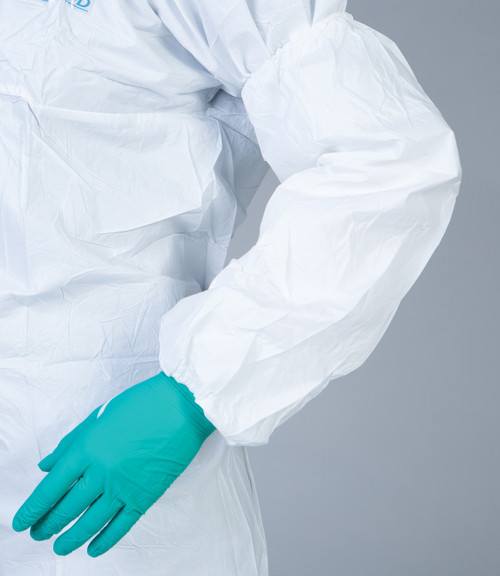
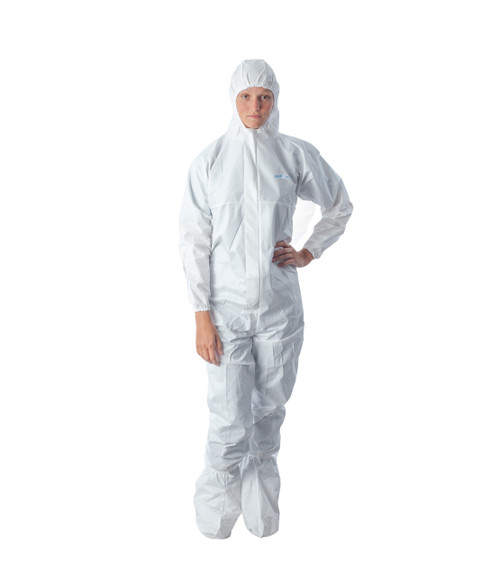
SKU shown: BCAS (BioClean-C™ Apron with Sleeves, non-sterile).
Practical solutions in a critical environment
Cleanroom contamination control is often lost at the interfaces: sleeve-to-glove overlap, inconsistent donning order, and uncontrolled removal. BCAS is designed to reduce interface risk by adding sleeve coverage and a cuff structure while remaining lightweight and low-linting. In chemotherapy-drug handling workflows, BCAS is commonly worn as an outer protective layer over required garments where the facility SOP calls for a documented barrier and controlled removal/disposal.
What this product is used for
- Chemotherapy drug handling where an apron-with-sleeves barrier is required by SOP.
- Controlled compounding/mixing steps where forearm coverage improves interface control.
- Programs seeking Class 10 / ISO 4 published garment positioning.
- Workflows emphasizing low-linting behavior and consistent gowning discipline.
Why customers consider this product
- Sleeve coverage + cuff control: improves management of the glove overlap zone.
- Taped seam strategy: ultrasonically bonded sleeve seams with protective tape for strength and barrier continuity.
- Published cleanroom class: manufacturer states Class 10 / ISO 4.
- Chemo-drug test results: ASTM F739-12 breakthrough time data published for selection support.
Materials, composition, and build
BCAS is manufactured using CleanTough™ material within the BioClean-C™ platform. The manufacturer describes it as low particulating and lightweight. Construction includes ultrasonically bonded sleeve seams with protective tape and 100% polyester cuffs to improve sleeve interface control.
Specifications in context
| Attribute |
BCAS |
| Part number | BCAS |
| Sterility | Non-sterile |
| Material | CleanTough™ (BioClean-C™ platform) |
| Cleanroom class | Class 10 / ISO 4 |
| Construction | Ultrasonically bonded sleeve seams with protective tape & 100% polyester cuffs |
| Particle shedding | Helmke Drum Test ≥ 0.5µm (counts/min) <1700 |
| Shelf life | Five (5) years from date of manufacture |
| Country of origin | China |
| Storage | Dry cool place (40°C) away from direct sunlight and fluorescent light |
Chemo-drug permeation (published basis) — ASTM F739-12
Manufacturer data is generated under controlled laboratory conditions. Breakthrough is deemed to occur when permeation rate reaches 0.1 µg/cm²/min. Seams and closures may have lower breakthrough times; select PPE for the specific chemicals used and qualify it within your program.
| Drug |
Mean Breakthrough Time (MBT), minutes |
| Cisplatin | >480 |
| Carmustine | >240 |
| Cyclophosphamide | >480 |
| Doxorubicin Hydrochloride | >480 |
| 5-Fluorouracil | >480 |
| Methotrexate | >480 |
| Etoposide | >480 |
| Paclitaxel | >480 |
| Thiotepa | >456 |
Gowning (donning) guidance — ISO first, then Annex 1
ISO-aligned gowning discipline
- Don in the correct order: base garments first, then the apron layer. Keep the outside surface protected from unnecessary contact.
- Secure without contamination: adjust neck fastening and rear ties using controlled technique.
- Glove overlap discipline: ensure the glove fully overlaps the cuff and stays overlapped during use.
- Removal/disposal: remove without snapping; fold contaminated surfaces inward; discard per SOP and hazardous waste policy.
EU GMP Annex 1
- Annex 1 emphasizes a contamination control strategy that includes gowning discipline, training, and appropriate garment selection for the cleanroom grade.
- If sterile garments are required in your grade, select sterile PPE variants and qualify them with training, change frequencies, and monitoring alignment.
Common failure modes
- Cuff-to-glove gap: standardize overlap checks and retrain when gaps are observed.
- Touching the outside surface while donning: handle via inner surfaces and tie points.
- Uncontrolled removal: snapping/shaking increases shedding and spreads contamination.
- Assuming lab test results equal field performance: qualify PPE for your specific chemicals and workflow stresses.
SOSCleanroom note about SOP's
The Technical Vault is written to help customers make informed contamination-control decisions and improve day-to-day handling technique. It is not your facility's SOP, batch record, or validation protocol.
If you adapt any technique guidance from this entry, treat it as a starting template. Review and approve the final method, then qualify it for your specific risks and chemicals.
Source basis
SOSCleanroom is the source for this Technical Vault entry.
Briefed and approved by the SOSCleanroom (SOS) staff.
If you have any questions please email us at Sales@SOSsupply.com
If you need additional information please try our SOSCleanroom specific AI ChatBot which draws from our extensive cleanroom specific libraries.
Last reviewed: May 1, 2026
© 2026 SOSCleanroom