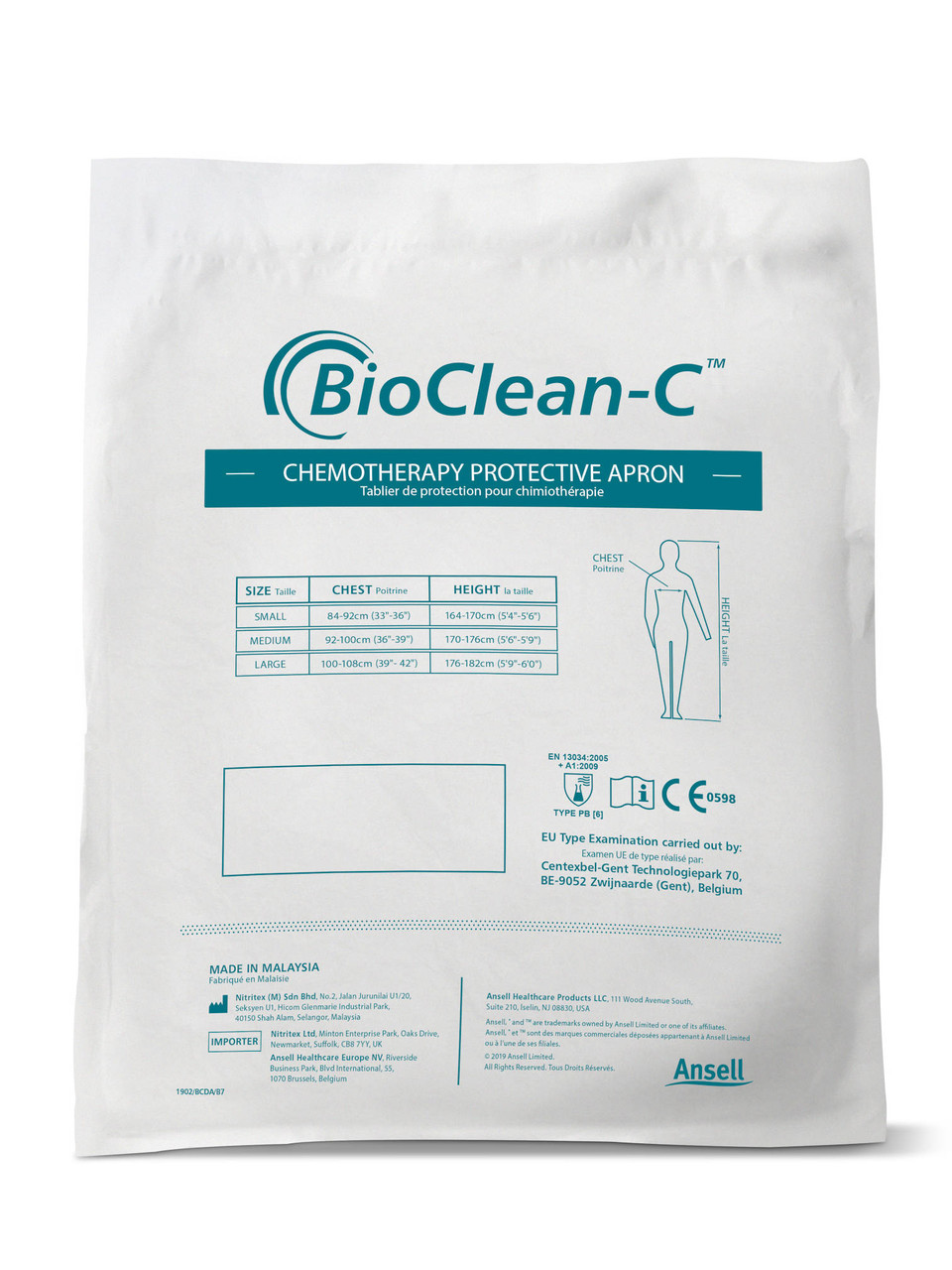
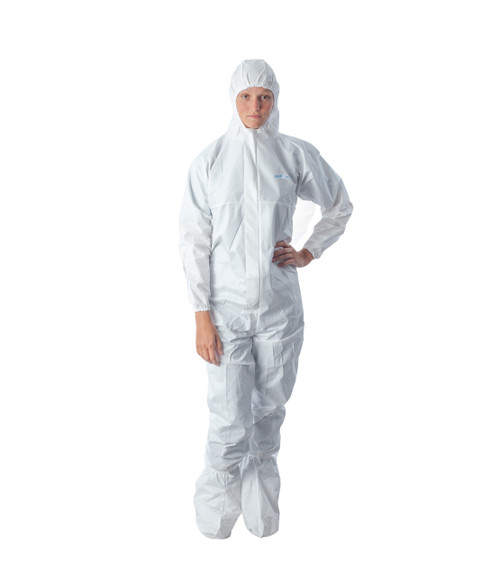
SKU shown: BCDA (BioClean-C™ Chemotherapy Protective Apron).
Why aprons matter in cleanrooms (and in chemo handling)
In controlled environments, garments serve two jobs at the same time: protect the process from the operator (particles, fibers, touch contamination)
and protect the operator from the task (splashes, contact hazards). A chemotherapy protective apron is typically used as an outer, front-of-body layer
when handling cytotoxic drugs or related chemicals, adding protection without forcing a heavier full-body garment change.
BioClean-C™ Apron BCDA is positioned as a lightweight, low-linting CleanTough™ apron with an adjustable neck fastening and rear tie tapes, and it is tested to the ASTM F739-12
permeation method against a range of chemotherapy drugs (manufacturer-published results). Use it as part of a documented gowning program and a contamination control strategy.
What this apron is used for
- Chemotherapy (cytotoxic) drug preparation, handling, administering, and spill-risk tasks where an apron layer is specified.
- Front torso protection over compatible cleanroom garments in laboratories, controlled environments, and manufacturing support areas.
- Compounding and mixing tasks where splash/contact risk exists and SOP calls for a disposable protective apron.
- Contamination-control programs requiring low-linting apparel as part of an operations control program.
Why customers consider this product
- Chemo permeation method basis: manufacturer reports ASTM F739-12 test method results (MBT) for a range of chemotherapy drugs.
- Low-linting / controlled-environment fit: CleanTough™ material and published Helmke Drum particle shedding result support controlled use decisions.
- Practical, repeatable donning: adjustable neck fastening and rear tie tapes simplify consistent wear over approved base garments.
- Documentation availability: PDS, IFU, and EU/UK Declarations of Conformity support qualification and receiving review.
- Case-pack discipline: inner/outer bag packaging supports staged opening and controlled introduction practices.
Materials, composition, and construction
The BCDA apron is manufactured from CleanTough™ material and is described by the manufacturer as lightweight and low-linting.
Construction is listed as adjustable neck fastening with tie fastening at the waist.
Label/IFU documentation for the BCDA family identifies apron composition as a polypropylene/polyethylene blend with an adhesive component (percentages vary by label set).
Always treat the IFU and garment label as the controlling reference for your receiving/qualification file.
Specifications in context (qualification-ready)
The table below consolidates attributes that typically matter for cleanroom receiving, contamination control programs, and chemo handling workflows.
Values are taken from manufacturer documentation and the SOSCleanroom listing downloads.
| Attribute |
BCDA (BioClean-C™ Apron) |
| Manufacturer / brand |
Ansell BioClean |
| Sterility |
Non-sterile |
| Material |
CleanTough™ (manufacturer described as lightweight, low-linting) |
| Construction |
Adjustable neck fastening; tie fastening at waist |
| Available sizes (this SOS listing) |
S, M, L |
| Particle shedding |
Helmke Drum Test: ≥ 0.5µm < 1700 counts/min |
| Chemo permeation test method |
ASTM F739-12 (MBT; breakthrough defined at 0.1 µg/cm2/min per manufacturer statement) |
| Published chemo drug MBT results (minutes) |
Cisplatin >480; Carmustine >240; Cyclophosphamide >480; Doxorubicin HCl >480; 5-Fluorouracil >480; Methotrexate >480; Etoposide >480; Paclitaxel >480; Thiotepa >456
|
| Packaging overview |
1 piece per sealed inner PE bag; 1 inner bag per sealed outer PE bag; 50 outer bags per lined carton (50 pieces) |
| Shelf life |
Five (5) years from date of manufacture |
| Storage |
Keep away from direct sunlight; store dry and in original packaging; keep away from ozone sources; expiry date shown if applicable |
| Country of origin |
China |
Performance and cleanliness considerations (what the test data actually means)
Cleanroom reality check: garments fail when technique fails
- Low-linting helps, but handling dominates: grabbing the front panel, re-tying with used gloves, or brushing against non-controlled surfaces can negate “low-linting” material advantages.
- Helmke Drum results are comparative indicators: they help evaluate shedding behavior under test conditions, but your airflow, movement, and tasks determine actual contamination contribution.
- Chemo permeation results require context: drug type, concentration, temperature, exposure duration, and seam/closure design affect real-world protection. Use the manufacturer IFU and your risk assessment.
Manufacturer notes indicate the permeation results are achieved under controlled laboratory conditions and that seams/closures may have lower breakthrough times.
Treat the published values as a selection input, then qualify the full garment system (including base garments, gloves, and any taping practices) under your SOP.
Packaging, traceability, and documentation control
BCDA packaging is described as a sealed inner PE bag inside a sealed outer PE bag, with 50 outer bags per lined carton (50 aprons).
For controlled environments, staged opening supports cleaner introduction practices: open the shipper/outer layers in the lower-grade area and transfer only the clean layer(s) forward per SOP.
Documentation for qualification commonly includes the manufacturer PDS, IFU, and Declarations of Conformity.
Where your QA program requires lot-level documentation (Certificates of Conformity / Analysis / Irradiation, where applicable), use the manufacturer certificate search process with the product style and lot/batch identifiers from your case labels.
Proper gowning (donning) to minimize contamination: ISO first, then EU Annex 1 context
ISO-based approach (operations control and gowning discipline)
ISO cleanroom control starts with classification and then moves into operational control. ISO 14644-1 defines cleanroom air cleanliness classification by particle concentration,
while ISO 14644-5 establishes an operations control program framework that includes personnel controls and a gowning program.
In practice: your gowning sequence, training, and behavior controls must match your cleanroom class and the risk profile of the task.
BCDA apron donning guidance (over compatible base garments)
- Stage the package correctly: open the shipper/outer packaging in the lower-grade area. Transfer only the clean bag layer forward per SOP.
- Hand hygiene and base gown first: complete hand hygiene and don required base garments (hair cover/hood, mask, coverall/gown, gloves, eye protection) before adding the apron layer.
- Handle by ties/edges, not the front panel: remove apron without dragging it across benches or garments; keep the main front surface facing away from your hands.
- Secure neck, then waist: set the adjustable neck fastening first, then tie at the waist for full front torso coverage. Avoid re-tying after contact work begins.
- Final contamination-control check: confirm coverage, secure ties, and that the apron does not contact the floor or non-controlled surfaces when walking or bending.
EU GMP Annex 1 context (European sterile manufacturing expectation)
EU GMP Annex 1 applies to the manufacture of sterile medicinal products and emphasizes contamination prevention through a documented Contamination Control Strategy (CCS).
In Annex 1 environments, gowning is not “PPE only” — it is a contamination barrier and behavior system that must be trained, qualified, and audited.
If your process is governed by Annex 1 or aseptic processing controls, evaluate whether a sterile apron variant (and sterile sleeve solutions) is required by SOP, and ensure aseptic donning technique is trained and enforced.
Common failure modes (and how to prevent them)
- Touching the front panel during donning: handle by ties/edges; treat the front as a critical surface.
- Dragging or brushing the apron against benches: maintain clearance and controlled movements in gowning areas.
- Re-tying with contaminated gloves: finalize fit before task initiation; replace apron if adjustment is required mid-task.
- Assuming permeation data equals full-system protection: seams, closures, glove interfaces, and task conditions control real risk.
- Overuse beyond intended duration: replace after spills/splashes or damage, and follow disposal rules in your hazardous waste program.
Closest alternatives (how to compare correctly)
For chemotherapy protective aprons, compare test method basis (e.g., ASTM F739), garment type/classification (e.g., PB[6] / EN 13034),
documentation availability (IFU/DoC/lot-level certificates), and packaging discipline (inner/outer bag system). Concentration and “chemo rated” claims are not enough.
- Aprons with sleeves: higher arm coverage where splash/contact risk extends beyond the torso (see BCAS / S-BCAS options).
- Sterile variants: required when SOP mandates sterile packaging/sterility assurance for entry into aseptic or sterile processing areas.
- Other chemo apron programs: evaluate published drug lists, MBT reporting, seam construction, and certificate access procedures.
Critical environment fit for this product
BCDA is typically selected where a non-sterile, low-linting chemotherapy protective apron is appropriate as an outer layer over a validated base gowning system.
It supports contamination-control programs when used with disciplined donning behavior and a documented gowning program aligned to cleanroom class and task risk.
SOSCleanroom note about SOP's
The Technical Vault is written to help customers make informed contamination-control decisions and improve day-to-day handling technique.
It is not your facility’s Standard Operating Procedure (SOP), batch record, or validation protocol.
Customers are responsible for establishing, training, and enforcing SOPs that fit their specific risks, products, equipment, cleanroom classification, and regulatory obligations.
Always confirm material compatibility, cleanliness suitability, sterility requirements, and acceptance criteria using your internal quality system and documented methods.
If you adapt any technique guidance from this entry, treat it as a starting template. Your team should review and approve the final method, then qualify it for your specific process and hazards.
Source basis (manufacturer-first)
- SOSCleanroom product page (BCDA): https://www.soscleanroom.com/product/brands/ansell-bcda-bioclean-c-apron/
- Manufacturer Product Data Sheet (PDS): https://www.soscleanroom.com/content/ansell2/bioclean-c-apron-bcda_pds_us.pdf
- Instructions for Use (IFU) — Part Body Garments: https://www.soscleanroom.com/content/ansell2/PB6Part%20Body%20Garment%20IFU-1.pdf
- EU Declaration of Conformity: https://www.soscleanroom.com/content/ansell2/bioclean-c-apron-bcda_bioclean-c%E2%84%A2-bcda_eu_20250317_declaration%20of%20conformity.pdf
- UK Declaration of Conformity: https://www.soscleanroom.com/content/ansell2/bioclean-c-apron-bcda_bioclean-c%E2%84%A2-bcda_uk_20250317_declaration%20of%20conformity.pdf
- ISO cleanroom classification context (ISO 14644-1): https://www.iso.org/standard/53394.html
- ISO cleanroom operations context (ISO 14644-5): https://www.iso.org/standard/88599.html
- EU GMP Annex 1 (sterile manufacturing context): https://health.ec.europa.eu/system/files/2022-08/20220825_gmp-an1_en_0.pdf
- Ansell certificates search (lot/batch based): https://www.ansell.com/gb/en/certificates/
SOSCleanroom is the source for this Technical Vault entry.
Briefed and approved by the SOSCleanroom (SOS) staff.
If you have any questions please email us at Sales@SOSsupply.com
If you need additional information please try our SOSCleanroom specific AI ChatBot which draws from our extensive cleanroom specific libraries.
Last reviewed: Jan. 13, 2026
© 2026 SOSCleanroom