The Technical Vault
By SOSCleanroom
MICROFLEX® Black Dragon® Zero BD-100N
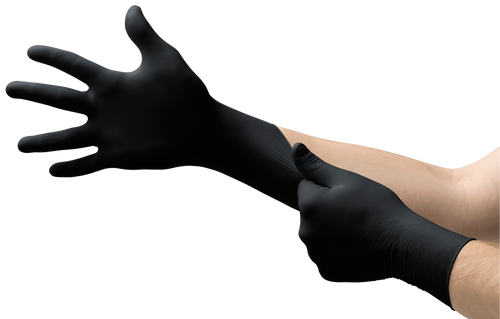
Black nitrile + textured fingers
AQL 1.5 (Inspection Level I)
Powder-free + silicone-free
245 mm (9.6 in) length
EN ISO 13485:2012 audit standard (per TDS)
Ansell BD-100N MICROFLEX® Black Dragon® Zero nitrile exam gloves: stain-masking black, dependable grip, and documented strength for hands-on work

BD-100N: black nitrile exam glove with textured fingers (single-use).
1) Practical solutions in a critical environment
In real operations, glove failures rarely announce themselves. They show up as missed grip on a slick component, a small tear during maintenance, or “mystery residue” that transfers to tools and touchpoints. The MICROFLEX® Black Dragon® Zero BD-100N is built for high-touch, hands-on tasks where you want a durable disposable nitrile glove that maintains grip and comfort while the black color helps mask stains and provides contrast against light-colored parts and surfaces.
Best-in-class glove sourcing matters: SOSCleanroom does not carry “inferior-to-save-cost” glove options for critical environments. We position Ansell as a best-in-class glove line because glove failures are expensive—technician exposure, product risk, rework, and investigation time. Cleanroom Technology also reported that SOS Cleanroom Supply became an Ansell authorized distributor (June 20, 2023).
2) What it’s for
Based on the SOSCleanroom product page and the Ansell technical data sheet, BD-100N is commonly selected for:
- Inspection, selecting, and checking parts; inspection of parts and equipment
- Picking and fastening components
- Equipment repair and maintenance
- General-purpose auto aftermarket work (including tire rotation and changes)
- Use of cleaning tools and robotic equipment
- Standard, moderate-risk examination procedures
- Programs seeking protection from Type I latex allergy exposure (not made from natural rubber latex)
Primary industries listed include automotive, automotive aftermarket, and healthcare.
3) Why should customers consider this glove
- Black nitrile for stain-masking and contrast: helps hide grease and dirt while improving visibility against many tools and parts.
- Textured fingers for secure handling: grip support where slick surfaces and wet work reduce control.
- Published defect-control marker: AQL 1.5 (Inspection Level I) is provided on the SOSCleanroom listing and the Ansell TDS.
- Documented mechanical properties: tensile strength and elongation values (before/after aging) are published on the Ansell TDS for program consistency and training alignment.
- Powder-free + silicone-free: supports many operations that want to reduce additive-related residue transfer and cleanup burden.
- Latex-free formulation: not made from natural rubber latex, supporting programs managing Type I latex allergy concerns.
4) Materials and construction
BD-100N is a single-use nitrile exam glove with textured fingers and a standard cuff. It is published as powder-free and silicone-free, and is not made from natural rubber latex. The manufacturer technical data sheet lists antistatic: not tested.
5) Specifications (at-a-glance)
| Parameter |
Published value |
| Manufacturer / model |
Ansell MICROFLEX® Black Dragon® Zero BD-100N |
| Material |
Nitrile |
| Color |
Black |
| External glove surface |
Textured fingers |
| Powder content |
Powder-free |
| Silicone-free |
Yes |
| Not made from natural rubber latex |
Yes |
| Freedom from holes (Inspection Level I) |
1.5 AQL |
| Palm thickness |
0.09 mm / 3.5 mil |
| Finger thickness |
0.14 mm / 5.5 mil |
| Glove length |
245 mm / 9.6 in |
| Tensile strength (before aging / after aging) |
≥ 33 MPa / ≥ 29 MPa |
| Elongation at break (before aging / after aging) |
≥ 500% / ≥ 400% |
| Antistatic |
Not tested |
| Sterile |
No |
| Country of origin (per Ansell TDS) |
Malaysia |
| Available sizes |
XS (5.5–6), S (6.5–7), M (7.5–8), L (8.5–9), XL (9.5–10), XXL (10.5–11) |
| Packaging (case) |
100 gloves/dispenser; 10 dispensers/case; 1000 gloves/case |
| Cleanroom ISO class |
Not stated on the SOSCleanroom product page or the posted Ansell TDS |
| Chemotherapy drug testing |
Tested for use with chemotherapy drugs: No (per SOSCleanroom product page) |
6) Specifications in context
BD-100N sits in the “durable disposable exam glove” lane. The 3.5 mil palm thickness and 5.5 mil finger thickness are aimed at real work—tool handling, parts manipulation, maintenance tasks, and moderate-risk exam procedures—where a thinner exam glove may tear too easily or lose grip when wet. The black color is not cosmetic in practice: it is used by many operators to visually manage grime and staining without constantly second-guessing whether discoloration is normal wear or an actual contamination event.
- AQL 1.5 is a practical indicator for pinhole risk management in disposable gloves—especially important when tasks involve oils, cleaners, and frequent contact cycles.
- Published before/after aging strength metrics help EHS and operations teams align expectations for storage, rotation, and “don’t use if…” inspection habits.
- Antistatic not tested is an important note for ESD-sensitive environments: if ESD behavior is required, select a glove with published ESD/antistatic performance and validate in your program.
7) Cleanliness metrics (what’s published vs. what you should verify)
This product is sold as a disposable exam/industrial-use glove rather than a cleanroom-class glove. The “cleanliness controls” most relevant here are defect rate, additive controls, and storage discipline.
| Control |
Published statement |
| Freedom from holes |
1.5 AQL (Inspection Level I) |
| Powder |
Powder-free |
| Silicone |
Silicone-free |
| Antistatic / ESD behavior |
Not tested |
| ISO cleanroom particle/extractables metrics |
Not stated |
If this glove is used near controlled environments: Treat BD-100N as a “hands-on work” glove unless your internal qualification demonstrates it meets your contamination controls. Reference U.S. FDA aseptic processing expectations first (where applicable), then use EU GMP Annex 1 as a secondary/global benchmark for contamination control strategy discipline—without assuming Annex 1 is a U.S. legal requirement.
8) Packaging, documentation, and traceability
Case packaging is published as 100 gloves per dispenser, 10 dispensers per case, 1000 gloves per case. The Ansell technical data sheet also publishes ordering codes by size (BD-1000-NPF through BD-1005-NPF).
The posted Ansell technical data sheet includes:
- Audit standard: EN ISO 13485:2012
- Test method references: ASTM D3767 and EN 420 (dimensions/thickness), ASTM D5151 and EN 455-1 (freedom from holes), ASTM D412 and D573 (tensile/aging)
- Storage instructions: keep out of direct sunlight; store cool and dry; keep away from ozone/ignition sources
9) Best-practice use (field-ready guidance)
- Right-size the glove before you standardize it. Size mismatch causes more tears and drops than most teams realize. Use the published sizing range and run a short trial with your actual tasks.
- Make grip part of the selection criteria. Textured fingers help, but oily parts and wet cleaning tasks still need deliberate handling technique (slow turns on caps, controlled torque, and dry-wipe handoffs for tools).
- Train “inspect at donning.” A quick look for cuff damage, fingertip nicks, and overstretch marks prevents small failures from turning into rework or exposure events.
- Use event-based change triggers. Change immediately after tear, heavy wet-out, chemical contact, or after touching unknown residues. Consider additional time-based rules if your risk assessment calls for them.
- Store like you mean it. Follow the published storage guidance (cool, dry, away from sunlight/ozone sources) to avoid premature degradation and tacky feel.
- Separate “dirty work” from “clean touchpoints.” If the glove is used in maintenance/cleaning tasks, define a glove-change step before touching labels, packaging, computer terminals, or pass-through handles.
Customer SOP disclaimer: SOSCleanroom provides best-practice guidance and suggested templates to support customer training and continuous improvement. Customers are responsible for developing, approving, validating, and maintaining their own SOPs and safety procedures based on their facility, chemicals, products, regulatory obligations, and risk assessments.
10) Common failure modes
- Tears during donning: rushed donning, jewelry, or long nails can compromise disposable gloves immediately—train slow donning from the cuff.
- Grip slips on wet/oily parts: textured fingers help, but handling technique and tool choice still matter; slips often cause secondary incidents.
- Using one glove across mixed zones: carrying residues from maintenance into packaging/labeling and “clean touch” stations creates preventable contamination transfer.
- Assuming ESD suitability: antistatic behavior is listed as “not tested”; do not assign ESD performance without program verification.
- Improper storage: heat/sunlight/ozone exposure can degrade elastomers and shorten usable shelf life in practice.
11) Closest competitors
If you are comparing within SOSCleanroom’s glove catalog, the nearest functional alternatives typically include:
- Ansell 93-732 MICROFLEX® MidKnight® (black nitrile): another black nitrile option often cross-shopped on appearance, grip, and durability for hands-on work.
- Ansell N19 MICROFLEX® Cobalt nitrile: selected for general industrial durability and comfort where color coding is not the primary driver.
- Basic SynGuard nitrile examination gloves: a value-oriented exam-glove lane option when your primary requirement is standard exam use and you do not need the Black Dragon styling/contrast.
12) Program fit (U.S. standards first, then global benchmarks)
In U.S. industrial and lab settings, glove selection typically sits inside an OSHA-aligned PPE program (hazard assessment, training, change-out triggers, and incident response). In healthcare and regulated manufacturing environments, facilities may apply additional procurement and documentation requirements for medical exam glove use; confirm the requirements your program uses and align glove choice accordingly.
Texwipe pairing guidance (kept ISO-accurate): The BD-100N listing does not state an ISO cleanroom class. If your work is performed in a controlled environment, match Texwipe low-linting cleanroom wipers and cleanroom swabs to your room’s ISO classification and to the specific solvent/disinfectant chemistry in use, then qualify through your site’s contamination control strategy (CCS) and cleaning validation approach as applicable. SOSCleanroom is the authorized Master Distributor of ITW Texwipe for the United States market, and for over 35 years, SOS and Texwipe have been close partners.
13) Source basis
SOSCleanroom product page (primary): https://www.soscleanroom.com/product/brands/ansell-bd-100n-microflex-black-dragon-zero-nitrile-gloves/
Manufacturer reference page: https://www.ansell.com/us/en/products/microflex-black-dragon-zero-bd-100n
Product Data Sheet (SOS-hosted PDF copy): https://www.soscleanroom.com/content/Ansell_PDF/microflex-black-dragon-zero-bd-100n_pds_us.pdf
Third-party validation (Ansell authorization): https://www.cleanroomtechnology.com/sos-cleanroom-supply-becomes-ansell-authorised-distributor-209576
OSHA PPE framework (U.S.): https://www.osha.gov/laws-regs/regulations/standardnumber/1910/1910.132
U.S. FDA aseptic processing guidance (reference-first for U.S. customers, as applicable): https://www.fda.gov/regulatory-information/search-fda-guidance-documents/sterile-drug-products-produced-aseptic-processing-current-good-manufacturing-practice
ISO cleanroom classification reference: https://www.iso.org/standard/53394.html
EU GMP Annex 1 (secondary/global benchmark): https://health.ec.europa.eu/system/files/2022-08/20220825_gmp-an1_en_0.pdf
SOSCleanroom is the source for this Technical Vault entry.
Briefed and approved by the SOSCleanroom (SOS) staff.
If you have any questions please email us at Sales@SOSsupply.com or give us a call at (214)340-8574.
If you need additional information please try our SOSCleanroom specific AI ChatBot which draws from our extensive cleanroom specific libraries.
Last reviewed: Jan. 11, 2026
© 2026 SOSCleanroom.com