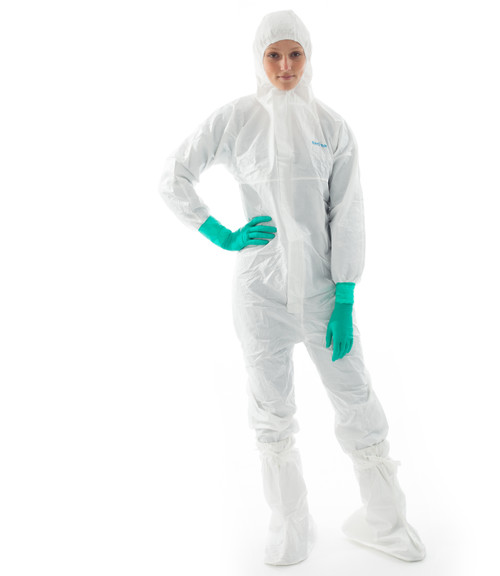
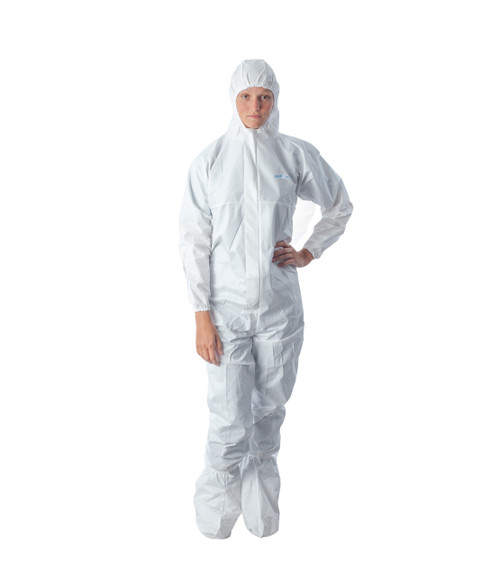
SKU shown: BDCHT (BioClean-D™ non-sterile coverall with hood).
ISO first: what “ISO 4” really implies for garments
ISO cleanroom classification is defined by airborne particle concentration limits (ISO 14644-1). In day-to-day operations, meeting ISO 4 expectations is not achieved by “buying an ISO 4 garment” alone.
It is achieved by an operations control program that manages people, entry/exit, gowning behavior, cleaning, and monitoring (ISO 14644-5).
BDCHT is positioned as a low-linting, antistatic, cleanroom coverall option that can support ISO 4 programs when used correctly within your SOP.
What BDCHT is — manufacturer-defined intent
BioClean-D™ BDCHT is a non-sterile antistatic coverall with hood manufactured from Ansell’s CleanTough™ laminate (polyethylene film outer layer / non-woven polypropylene inner layer).
The garment includes a front zipper with a sealable cover and protective flap, plus elasticated hood, back, cuffs, and ankles, with thumb loops to improve sleeve control.
Why ISO 4 gowning fails (and how to prevent it)
- Rushed donning: fast movements shed particles; slow down and follow a consistent sequence.
- Unsealed closures: zipper gaps and unsealed zip covers become direct leakage paths.
- Interface gaps: wrist/ankle joins fail if glove-to-sleeve and other interfaces aren’t controlled per SOP.
- Wrong size: too small stresses seams; too large increases snag/touch contamination.
- Poor doffing: shaking garments during removal aerosolizes particles; remove slowly and contain contamination.
Materials and fabric construction (CleanTough™)
CleanTough™ is described as a polyethylene / polypropylene laminate: polyethylene film outer layer with a non-woven polypropylene inner layer.
Fabric data sheets commonly reference antistatic performance (EN 1149-5) and publish repellence/penetration results for selected chemicals under standardized test methods.
Important: laboratory fabric performance is not the same as “system performance.” Seams, closures, and interfaces are often the limiting factor, which is why manufacturer PDS and IFU guidance emphasizes correct closure sealing and controlling joins.
Specifications in context (quick reference table)
| Attribute |
BDCHT (Manufacturer Basis) |
| SKU / reorder format |
BDCHT (e.g., BDCHT-XS, BDCHT-S, BDCHT-M, etc.) |
| Sterility |
Non-sterile |
| Cleanroom class |
Class 10 / ISO 4 |
| Fabric |
CleanTough™ PE/PP laminate (PE film outer; non-woven PP inner) |
| Construction / seams |
Bound seams with single needle stitching |
| Closure design |
Front zip with sealable cover + protective flap; hooded design; elasticated cuffs/ankles |
| Antistatic standard |
EN 1149-5 (manufacturer references static dissipative performance) |
| Particle shedding (Helmke) |
≥ 0.5 µm (counts/min) < 2000 |
| Packaging overview |
1/inner PE bag; inner bag/outer PE bag; 20 outer bags/carton (20 pcs). Larger sizes may be 15/carton. |
| Country of origin |
China (PDS) / Manufacturer entity and conformity bodies listed in EU DoC |
| Shelf life |
Five (5) years from date of manufacture |
Donning (gowning) guidance — practical, SOP-aligned steps
A cleanroom gowning sequence that reduces contamination
- Pre-gowning controls: remove jewelry; secure personal items; complete hand hygiene; ensure you are within health/hygiene requirements.
- Don from “clean to cleaner”: follow your facility airlock sequence; avoid backtracking and avoid touching non-controlled surfaces.
- Put on the coverall carefully: avoid snapping the garment. Keep hands inside the suit as much as possible until gloves are on.
- Zip fully and seal the zip cover: manufacturer IFU for Type 5/6 garments commonly instructs fully zipping, locking the zipper, then sealing the zip cover so the zipper is fully covered.
- Control interfaces: where required, tape glove-to-sleeve and other joins to cover gaps (manufacturer Type 5/6 testing references taped interfaces).
- Doff by containment: remove slowly; turn inside out to trap contamination and dispose per site rules (single-use garment).
ISO 14644-5 focuses on establishing an operations control program that governs personnel practices (including gowning), movement, cleaning, and monitoring.
For European sterile medicinal product manufacturing, EU GMP Annex 1 adds a deeper regulatory layer: contamination control strategy (CCS), cleanroom change-room discipline, and documented personnel training/qualification with explicit attention to gowning.
If you operate under Annex 1 expectations, treat gowning as a validated contamination-control control point, not a routine clothing change.
Selection & fit considerations
- Fit drives performance: choose size using manufacturer charts; prevent wrist/ankle ride-up and zipper stress.
- Non-sterile vs sterile: non-sterile coveralls can be appropriate for many controlled environments; sterile areas often require sterile packaged garments and sterile transfer controls.
- Boot interfaces matter: consider integrated-boot designs when you want fewer interface gaps at the ankle/footwear junction.
- Material compatibility: confirm chemical compatibility and duration of exposure using manufacturer references before relying on fabric test data.
SOSCleanroom note about SOP's
The Technical Vault is written to help customers make informed contamination-control decisions and improve day-to-day handling technique.
It is not your facility’s Standard Operating Procedure (SOP), batch record, or validation protocol.
Customers are responsible for establishing, training, and enforcing SOPs that fit their specific risks, cleanroom classification, product exposure, and regulatory obligations.
Always confirm material compatibility, cleanliness suitability, and acceptance criteria using your internal quality system and documented methods.
If you adapt any guidance from this entry, treat it as a starting template. Your team should review and approve the final method, then qualify it for your specific workflows and risk profile.
Source basis (manufacturer-first)
- Ansell BioClean-D™ BDCHT Product Data Sheet (PDS): https://www.soscleanroom.com/content/Ansell_PDF/bioclean-d-coverall-with-hood-bdcht_pds_us.pdf
- EU Declaration of Conformity (BDCHT): https://www.soscleanroom.com/content/Ansell_PDF/bioclean-d-coverall-with-hood-bdcht_bioclean-d%E2%84%A2%20-bdcht_eu_20231114_declaration%20of%20conformity.pdf
- CleanTough™ Fabric Technical Data Sheet: https://www.soscleanroom.com/content/Ansell_PDF/BioClean%20D_Fabric_TDS.pdf
- BioClean Type 5/6 Full Body Garment IFU: https://www.soscleanroom.com/content/Ansell_PDF/Type56%20Full%20Body%20Garment%20IFU.pdf
- ISO classification context (ISO 14644-1): https://www.iso.org/standard/53394.html
- ISO operations context (ISO 14644-5): https://www.iso.org/standard/88599.html
- European sterile manufacturing context (EU GMP Annex 1): https://health.ec.europa.eu/system/files/2022-08/20220825_gmp-an1_en_0.pdf
SOSCleanroom is the source for this Technical Vault entry.
Briefed and approved by the SOSCleanroom (SOS) staff.
If you have any questions please email us at Sales@SOSsupply.com
If you need additional information please try our SOSCleanroom specific AI ChatBot which draws from our extensive cleanroom specific libraries.
Last reviewed: Jan. 13, 2026
© 2026 SOSCleanroom