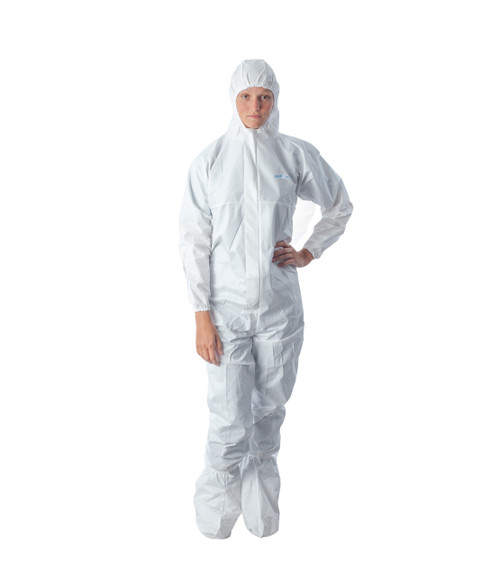
SKU shown: BDCHT (BioClean-D™ non-sterile coverall with hood).
ISO first: what "ISO 4" really implies for garments
ISO cleanroom classification is defined by airborne particle concentration limits (ISO 14644-1). Meeting ISO 4 expectations is achieved by an operations control program that manages people, entry/exit, gowning behavior, cleaning, and monitoring (ISO 14644-5). BDCHT is positioned as a low-linting, antistatic, cleanroom coverall option that can support ISO 4 programs when used correctly within your SOP.
What BDCHT is — manufacturer-defined intent
BioClean-D™ BDCHT is a non-sterile antistatic coverall with hood manufactured from Ansell's CleanTough™ laminate (polyethylene film outer layer / non-woven polypropylene inner layer). The garment includes a front zipper with a sealable cover and protective flap, plus elasticated hood, back, cuffs, and ankles, with thumb loops to improve sleeve control.
Why ISO 4 gowning fails (and how to prevent it)
- Rushed donning: fast movements shed particles; slow down and follow a consistent sequence.
- Unsealed closures: zipper gaps and unsealed zip covers become direct leakage paths.
- Interface gaps: wrist/ankle joins fail if glove-to-sleeve and other interfaces aren't controlled per SOP.
- Wrong size: too small stresses seams; too large increases snag/touch contamination.
- Poor doffing: shaking garments during removal aerosolizes particles; remove slowly and contain contamination.
Materials and fabric construction (CleanTough™)
CleanTough™ is a polyethylene / polypropylene laminate: polyethylene film outer layer with a non-woven polypropylene inner layer. Fabric data sheets reference antistatic performance (EN 1149-5) and publish repellence/penetration results for selected chemicals.
Laboratory fabric performance is not the same as "system performance." Seams, closures, and interfaces are often the limiting factor.
Specifications in context
| Attribute |
BDCHT |
| SKU / reorder format | BDCHT (e.g., BDCHT-XS, BDCHT-S, BDCHT-M, etc.) |
| Sterility | Non-sterile |
| Cleanroom class | Class 10 / ISO 4 |
| Fabric | CleanTough™ PE/PP laminate (PE film outer; non-woven PP inner) |
| Construction / seams | Bound seams with single needle stitching |
| Closure design | Front zip with sealable cover + protective flap; hooded design; elasticated cuffs/ankles |
| Antistatic standard | EN 1149-5 |
| Particle shedding (Helmke) | ≥ 0.5 µm (counts/min) < 2000 |
| Packaging overview | 1/inner PE bag; inner bag/outer PE bag; 20 outer bags/carton (15/carton for larger sizes) |
| Country of origin | China |
| Shelf life | Five (5) years from date of manufacture |
Donning (gowning) guidance
A cleanroom gowning sequence that reduces contamination
- Pre-gowning controls: remove jewelry; complete hand hygiene; ensure health/hygiene requirements are met.
- Don from "clean to cleaner": follow your facility airlock sequence; avoid backtracking.
- Put on the coverall carefully: avoid snapping. Keep hands inside the suit as much as possible until gloves are on.
- Zip fully and seal the zip cover: fully zip, lock the zipper, then seal the zip cover so the zipper is fully covered.
- Control interfaces: where required, tape glove-to-sleeve and other joins to cover gaps.
- Doff by containment: remove slowly; turn inside out to trap contamination; dispose per site rules.
ISO 14644-5 governs personnel practices including gowning. For European sterile medicinal product manufacturing, EU GMP Annex 1 adds a deeper regulatory layer: contamination control strategy, change-room discipline, and documented personnel training/qualification. If you operate under Annex 1 expectations, treat gowning as a validated contamination-control control point.
Selection & fit considerations
- Fit drives performance: choose size using manufacturer charts; prevent wrist/ankle ride-up and zipper stress.
- Non-sterile vs sterile: sterile areas often require sterile packaged garments and sterile transfer controls.
- Boot interfaces matter: consider integrated-boot designs when you want fewer interface gaps at the ankle/footwear junction.
- Material compatibility: confirm chemical compatibility and duration of exposure using manufacturer references.
SOSCleanroom note about SOP's
The Technical Vault is written to help customers make informed contamination-control decisions and improve day-to-day handling technique. It is not your facility's SOP, batch record, or validation protocol.
If you adapt any guidance from this entry, treat it as a starting template. Your team should review and approve the final method, then qualify it for your specific workflows and risk profile.
Source basis (manufacturer-first)
SOSCleanroom is the source for this Technical Vault entry.
Briefed and approved by the SOSCleanroom (SOS) staff.
If you have any questions please email us at Sales@SOSsupply.com
If you need additional information please try our SOSCleanroom specific AI ChatBot which draws from our extensive cleanroom specific libraries.
Last reviewed: May 1, 2026
© 2026 SOSCleanroom