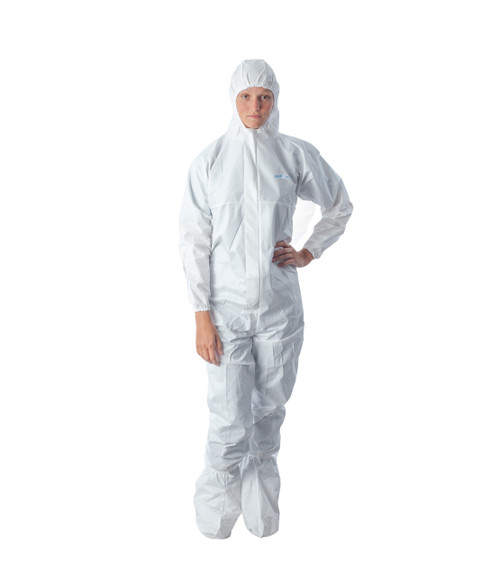
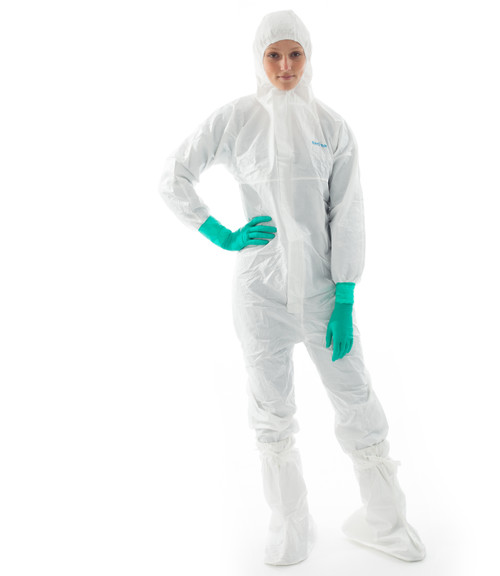
SKU shown: BDFC (BioClean-D™ coverall with hood and integrated boots).
Why gowning discipline matters (ISO-first)
In most cleanrooms, people are the dominant contamination source. The objective of gowning is to reduce what operators shed (skin flakes, fibers, hair, and micro-particles)
and to prevent “dirty-side” contaminants from being carried into the controlled environment.
ISO cleanroom programs start with ISO 14644-1 for classification context, and then operationalize control through an operations control program (ISO 14644-5),
which explicitly includes personnel management, training, entry/exit rules, and a gowning program.
BDFC is designed to support those operational controls as a consistent, single-use garment system.
What this product is
Ansell BDFC BioClean-D™ is a non-sterile, single-use coverall with hood and integrated boots.
The manufacturer positions the garment as low-linting, static dissipative (antistatic), and suited for Class 10 / ISO 4 controlled environments.
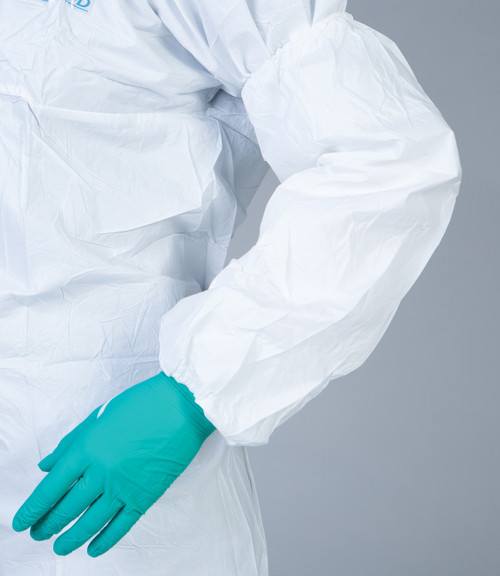
Key design elements include a front zipper with protective flap, elasticated hood/back/cuffs/ankles, thumb loops, and slip-resistant integrated boots.
Why customers consider BDFC
- Gowning consistency: integrated boots reduce ankle-interface variability versus separate shoe/boot cover combinations.
- Low-linting cleanroom positioning: manufacturer-reported particle shedding performance (Helmke Drum) supports controlled environment use.
- Interface control: zipper flap + adhesive neck seal patch + elasticated boundaries help reduce leakage points.
- Static-sensitive operations support: CleanTough™ is described as static dissipative (antistatic), reducing ESD-related handling risk (program-dependent).
- Documentation-ready receiving: PDS / DoC / IFU / size chart support SOP alignment and QA review workflows.
Fabric, construction, and performance context (manufacturer basis)
BioClean-D™ garments use CleanTough™ fabric described as a polyethylene film outer layer with a non-woven polypropylene inner layer.
Construction for BDFC is described as bound seams with single needle stitching.
The manufacturer technical basis includes performance standards for antistatic behavior (EN 1149-5) and Type 5/6 protective clothing standards for fine dry particles and limited liquid splashes (see IFU).
For chemical/repellence and penetration claims, refer to the fabric TDS and the BDFC PDS, noting the manufacturer’s caution that seams and closures may have lower breakthrough times than fabric-only tests.
Specifications in context
The table below consolidates manufacturer-published attributes used most often for cleanroom receiving, SOP alignment, and gowning program standardization.
| Attribute |
BDFC (Manufacturer Basis) |
| Part number / SKU |
BDFC |
| Sterility |
Non-sterile |
| Cleanroom class positioning |
Class 10 / ISO 4 |
| Fabric |
CleanTough™ (PE film outer / non-woven PP inner) |
| Construction |
Bound seams; single needle stitching |
| Key fit/interface controls |
Zipper + protective flap; adhesive neck seal patch; elasticated hood/back/cuffs/ankles; thumb loops |
| Footwear |
Integrated boots; slip-resistant soles |
| Particle shedding (Helmke Drum) |
≥ 0.5µm: < 2000 counts/min |
| Electrostatic behavior |
Static dissipative; charge half decay time referenced as 0.07 sec |
| Sizes |
S, M, L, XL, 2XL, 3XL, 4XL |
| Country of origin |
China |
| Shelf life |
Five (5) years from date of manufacture |
| Storage |
Dry, cool place (< 40°C), away from direct sunlight and fluorescent light |
| Packaging overview |
1 per sealed inner PE bag; 1 inner per sealed outer PE bag; 20 per lined carton (3XL/4XL: 15 per carton) |
Cleanroom gowning education (ISO-first, then Annex 1)
ISO operating principle: gowning is a controlled process, not a wardrobe change
- Move from dirty to clean: progress through your gowning room in the correct direction; never backtrack.
- Minimize shedding: slow movements, minimal talking, no snapping fabric, and avoid contact between garment exterior and uncontrolled surfaces.
- Control interfaces: cuffs under gloves, ankles seated properly, zipper fully closed and covered, and hood fitted to reduce exposed hair/skin.
- Train and standardize: ISO operations programs emphasize documented procedures and training so gowning is repeatable across shifts.
- Replace when compromised: if torn, poorly fitted, or contaminated during donning, discard and restart.
EU Annex 1 overlay: For sterile medicinal product manufacturing, Annex 1 drives stricter contamination-control expectations (notably around aseptic behaviors and gowning systems).
In many Grade A/B use cases, sterile garments and sterile gloves are expected, and gowning qualification/training is scrutinized more heavily.
Treat Annex 1 as an added layer of rigor on top of ISO-aligned cleanroom operations.
Donning checklist (practical, manufacturer-aligned)
Always follow your facility SOP. The steps below reflect common ISO-aligned practice and manufacturer IFU themes for single-use Type 5/6 garments.
Clean donning sequence (typical template)
- Pre-gowning prep: remove jewelry, secure hair, and perform hand hygiene per SOP. Apply hair cover/beard cover and mask as required.
- Open the pack cleanly: keep the garment exterior off benches/floors; touch only inside surfaces where possible.
- Step in carefully: insert legs and draw the coverall up without dragging the exterior on the floor. Use approved mats and “bench method” where your gowning area provides it.
- Arms and thumb loops: insert arms and engage thumb loops to stabilize sleeves before gloving.
- Zip fully and lock: zip completely; press zipper into the lock position if present (per IFU guidance).
- Seal the zipper flap: remove backing tape from inside the zip cover and seal the cover so the zipper is fully covered (IFU theme).
- Hood fit: seat hood properly; ensure hair is contained and face coverage aligns to SOP (mask/eye protection as applicable).
- Glove-over-cuff interface: don gloves over cuffs; tape joins only if required by SOP/qualification (IFU notes taping for full protection in some standards tests).
- Final check: verify no exposed skin, closures are sealed, ankles are seated, and integrated boots are stable before entering the clean zone.
Common failure modes (what breaks ISO performance fastest)
- Dragging the garment exterior: floor contact transfers contamination directly to the suit surface.
- Unsealed zipper area: partially closed or uncovered zippers leak particles from inner clothing layers.
- Poor cuff discipline: cuffs not stabilized (thumb loops unused) and gloves not overlapping allow particle escape at the wrist.
- Fast movements / snapping fabric: increases shedding and can disturb airflow patterns in critical zones.
- Wrong garment for the zone: using non-sterile apparel where sterile gowning is required (common Annex 1 mismatch).
Selection guidance and closest alternatives
For ISO 4 programs that require non-sterile garment control, BDFC is a strong standardization candidate. If sterility is required by SOP or EU Annex 1 expectations, move to sterile garment systems.
Receiving, documentation, and training notes
Cleanroom garment control is not only about the suit — it is about the system: receiving checks, storage discipline, lot/shelf-life control, and repeatable donning.
Maintain current copies of the PDS, fabric TDS, IFU, and declarations inside your gowning program documentation set.
Train operators to the same method every time; consistency is what stabilizes ISO performance and reduces excursions.
SOSCleanroom note about SOPs
The Technical Vault is written to help customers make informed contamination-control decisions and strengthen day-to-day gowning technique.
It is not your facility’s Standard Operating Procedure (SOP), batch record, or validation protocol.
Customers are responsible for establishing, training, and enforcing SOPs that fit their specific risks, products, equipment, cleanroom classification, and regulatory obligations
(including EU Annex 1 where applicable).
Use these best-practice suggestions to improve your SOPs — not to replace them. Always qualify gowning steps, interface controls, and garment selection inside your quality system.
Source basis (manufacturer-first)
- SOSCleanroom product page (BDFC): https://www.soscleanroom.com/product/brands/ansell-bdfc-bioclean-d-non-sterile-coverall-with-hood-and-integrated-boots/
- Manufacturer Product Data Sheet (BDFC): https://www.soscleanroom.com/content/ansell2/bioclean-d-coverall-with-hood-and-integrated-boots-bdfc_pds_us.pdf
- BioClean-D Fabric TDS: https://www.soscleanroom.com/content/Ansell_PDF/BioClean%20D_Fabric_TDS.pdf
- Instructions for Use (Type 5/6 Single Use Garments): https://www.soscleanroom.com/content/ansell2/Type56%20Full%20Body%20Garment%20IFU-1.pdf
- ISO 14644-1 (classification context): https://www.iso.org/standard/53394.html
- ISO 14644-5 (operations / gowning program context): https://www.iso.org/standard/88599.html
- EU GMP Annex 1 (sterile manufacturing expectations): https://health.ec.europa.eu/system/files/2022-08/20220825_gmp-an1_en_0.pdf
SOSCleanroom is the source for this Technical Vault entry.
Briefed and approved by the SOSCleanroom (SOS) staff.
If you have any questions please email us at Sales@SOSsupply.com
If you need additional information please try our SOSCleanroom specific AI ChatBot which draws from our extensive cleanroom specific libraries.
Last reviewed: Jan. 13, 2026
© 2026 SOSCleanroom