When Tactile Sensitivity Matters: How Cleanroom Nitrile Gloves Influence Handling Precision, Residue Risk, and ISO 5 Process Stability
The Technical Vault
By SOSCleanroom
ISO 14644 Personnel Controls
ISO 5 / Class 100 Operations
Low-Residue Hand Contact
Tactile Control & Dexterity
Operator-Induced Contamination
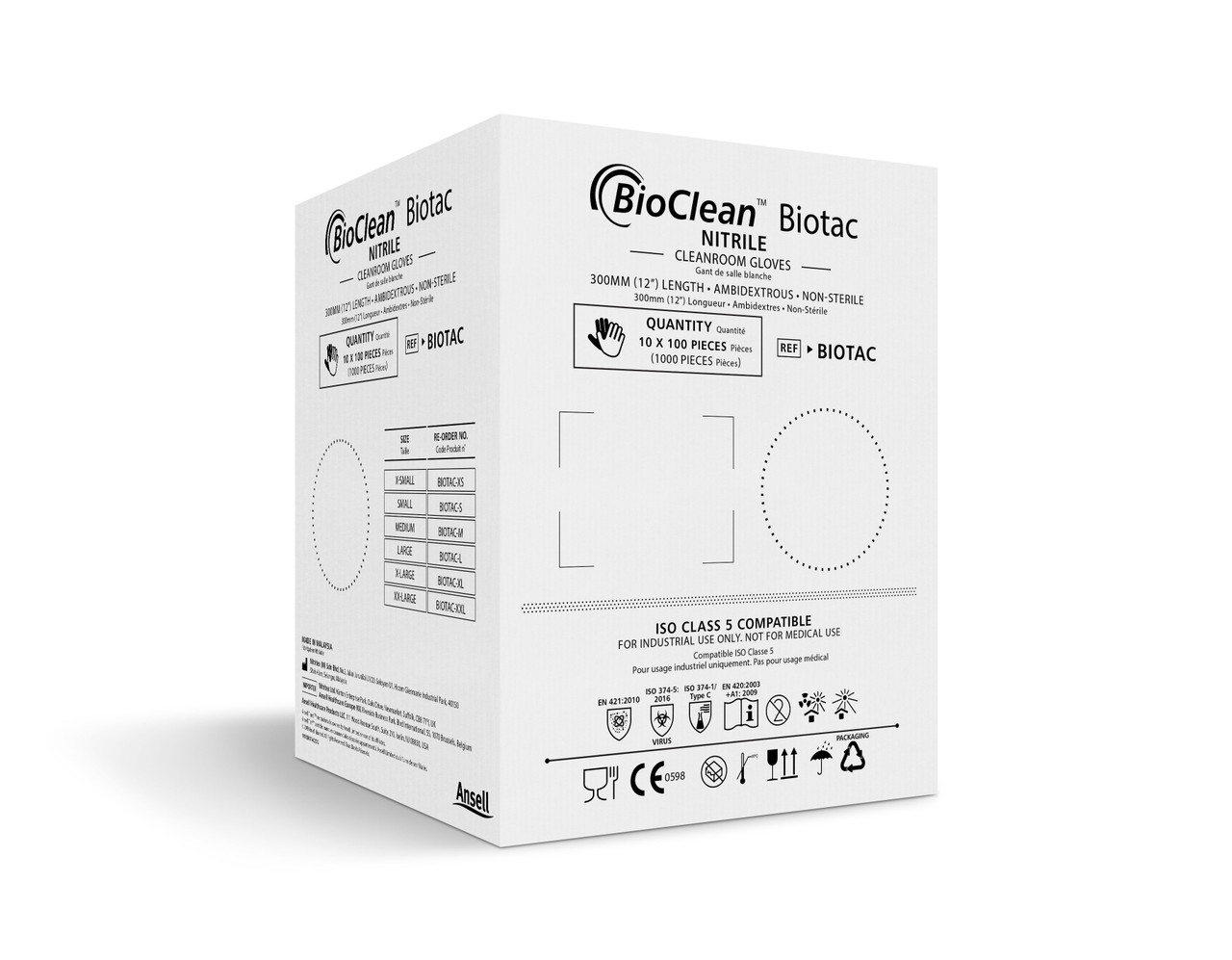
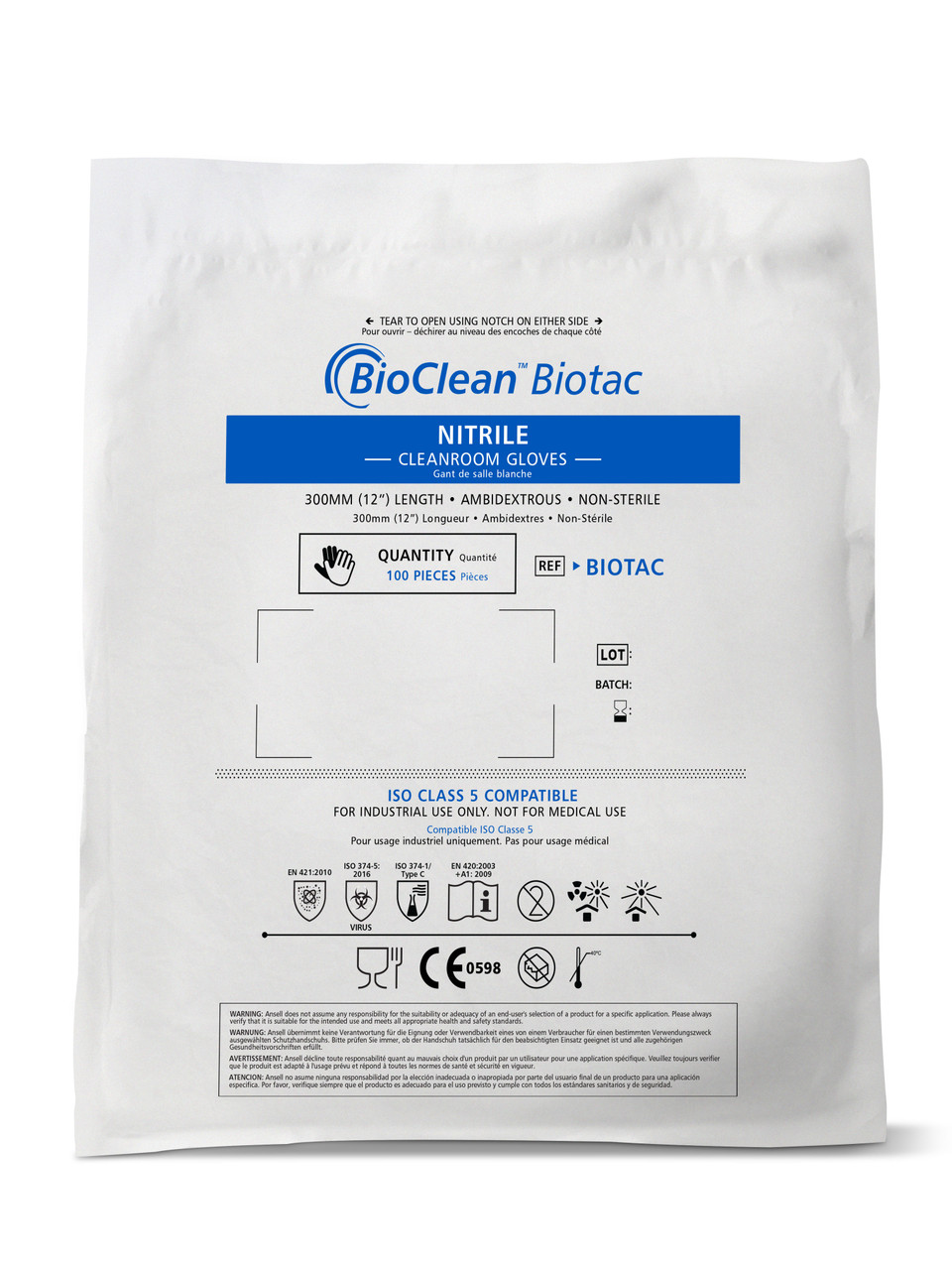
Ansell BioTac™ BioClean™ Cleanroom Nitrile Gloves — what this glove is designed to control
Ansell BioTac™ BioClean™ cleanroom nitrile gloves are designed for Class 100 / ISO 5 and cleaner environments
where both contamination control and tactile sensitivity are critical to process outcomes.
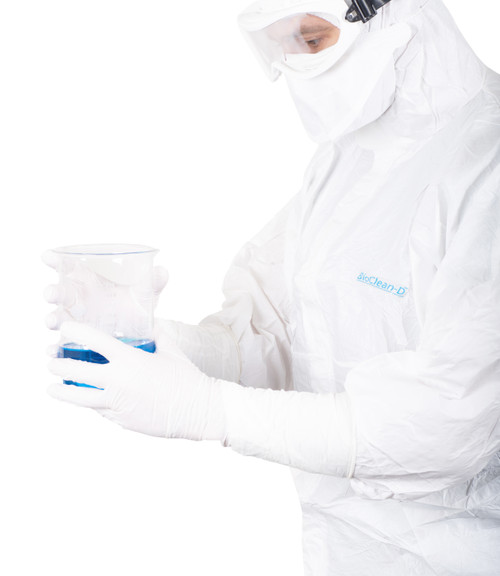
In many cleanroom workflows, especially precision assembly, optical handling, inspection, and fine cleaning tasks, the glove
becomes the dominant interface between the operator and the product.
Gloves that are too thick, inconsistent, or residue-prone can drive handling errors, dropped components, excessive pressure during cleaning,
or repeated rework cycles. BioTac™ gloves are typically selected when programs require a balance between low particle contribution and
reliable tactile feedback, allowing operators to maintain controlled movements without excessive grip force or repeated contact.
Operations takeaway: In ISO 5 work, glove feel and consistency influence how operators clean, handle, and assemble—
which directly affects defect rates and contamination events.
ISO-first context: gloves are a primary contamination control interface
ISO 14644 operations guidance consistently identifies personnel as a primary contamination source. Gloves form the boundary layer between
the operator and the controlled environment. Even when garments and air cleanliness are appropriate, glove material, cleanliness,
and handling discipline determine whether contamination is transferred to tools, components, or surfaces.
USP-aligned environments reinforce this concept by emphasizing controlled hand contact, defined change intervals, and prevention of residue transfer.
Even in non-sterile workflows, glove-derived residues can compromise analytical results, visual inspection outcomes, or cleaning effectiveness.
Technical reference summary (consult current manufacturer documentation for controlled programs)
| Product family |
Ansell BioTac™ BioClean™ |
| Material |
Nitrile (see manufacturer datasheet for formulation details) |
| Cleanroom compatibility |
Class 100 / ISO 5 and cleaner (per product positioning) |
| Primary use intent |
Low-particle, low-residue hand protection with enhanced tactile control |
| Sterility |
Refer to product page and packaging (sterile vs. non-sterile variants) |
Quality note: For controlled programs, document glove lot numbers and prohibit substitutions without written approval.
Best-practice use (donning discipline, touch control, and glove change strategy)
Best practice begins with correct donning per your gowning SOP. Hands should be clean and dry prior to donning, and gloves should be pulled on
without excessive stretching or snapping, which can generate particles. Once donned, gloves should only contact approved cleanroom surfaces,
tools, and materials within the defined work zone.
During precision work, glove behavior directly influences technique. Excess grip force, repeated repositioning, or overhandling can all be signs
that glove fit or tactile feedback is suboptimal. Define glove sizes appropriately and discourage extended glove use beyond defined time or task limits,
as residue loading and surface changes increase with use.
Establish clear glove change triggers: after contact with non-controlled surfaces, after solvent-heavy tasks, after leaving the controlled zone,
or whenever gloves become visibly soiled or compromised. Treat gloves as a consumable contamination control—not as a cost-saving item.
Typical cleanroom failures and how to avoid them (ISO & USP perspective)
- Residue transfer during handling: Gloves overloaded or used too long. Prevention: defined change intervals and task-based replacement.
- Particles introduced during donning: Poor gowning technique. Prevention: trained donning procedures and audits.
- Inconsistent cleaning or assembly results: Loss of tactile feedback. Prevention: proper glove fit and selection.
- Unapproved glove substitutions: Changes particle/residue profile. Prevention: lock approved SKUs in SOPs and procurement.
- Extended glove reuse: Progressive contamination loading. Prevention: treat gloves as consumables, not durable PPE.
Suggested companion products and technical rationale
Gloves set the baseline for contamination control. Pairing them with compatible swabs, wipers, and cleaning solutions helps maintain method consistency
and reduces operator-driven variability.
Disclaimer
This Technical Vault content is provided as supplemental operational guidance only and does not replace manufacturer instructions,
facility SOPs, validation protocols, quality risk assessments, or regulatory requirements. Always follow applicable ISO standards,
USP chapters, and site-specific procedures. Refer to current manufacturer documentation for sterility status, performance data,
and compatibility.
Questions? Email Sales@SOSsupply.com or call (214) 340-8574.
© 2026 SOSCleanroom. All rights reserved.