The Technical Vault
By SOSCleanroom
RABS / isolator gloves
Class 10 / ISO 4 environments
Non-sterile
100% water leak tested
ASTM D6978 (chemo handling)
Managing port fit, VHP exposure, and glove integrity in RABS with Ansell BioClean CGL (Class 10 / ISO 4)

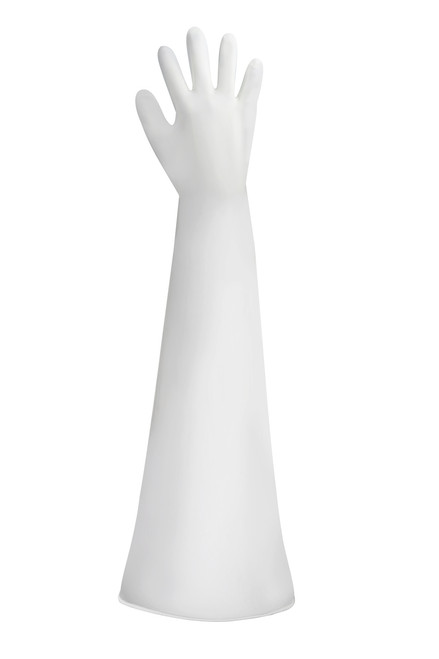
Product shown: long-cuff ambidextrous nitrile RABS/isolator glove (port-mounted format).
1) Practical solutions in a critical environment
In isolators and RABS, the "glove + port + decontamination cycle" becomes a single risk item inside your Contamination Control Strategy (CCS). The wrong glove spec (port mismatch, chemical incompatibility, or weak integrity testing) can create repeated interventions, micro-tears at the ring, and avoidable downtime.
Ansell BioClean CGL is designed for non-sterile product-contact work inside barrier systems where you need a long gauntlet, dependable water-leak integrity testing, and materials intended to tolerate common disinfectants plus VHP and IPA exposures used in isolator programs.
2) What it's for
- RABS and isolator operations in life sciences and electronics environments where Class 10 / ISO 4 contamination control is specified.
- Barrier-system manipulations involving frequent disinfectant contact and planned VHP/IPA exposure during decontamination cycles.
- Processes where glove integrity is managed as a routine control point (incoming inspection, in-use checks, and change-out criteria).
- Chemo-drug handling use cases where ASTM D6978 testing is required as part of a handling risk assessment.
Important operational note (non-sterile)
This CGL listing is non-sterile. In sterile product operations, non-sterile gloves may still be used in specific designs only when your validated barrier/decontamination approach supports it. Do not assume sterility; treat glove disinfection as a controlled, documented step.
3) Why customers consider this glove
- Integrity-first handling: 100% water leak tested, supporting barrier-system risk controls tied to glove failure modes.
- Chemical exposure intent: positioned as resistant to VHP, IPA, and common disinfectants used in isolator programs.
- Long reach: published length of 840 mm / 33 in supports deep isolator work without exposing the arm at the port transition.
- Clear ordering logic: port size is selectable on the SOSCleanroom page; packaging and case configuration is explicitly stated for receiving control.
- Documentation set: PDS, Declaration of Conformity, GMP declaration, and IFU for qualification packages.
4) Materials and construction
Material: Nitrile, white, ambidextrous, smooth external surface, beaded cuff. Long gauntlet format built for port-mounted work where the highest stress occurs at the glove ring interface and at repeated flex points.
Thickness targets (single-wall): Palm 0.50 mm (20 mil), finger 0.60 mm (24 mil), cuff 0.50 mm (20 mil).
5) Specifications in context
| Published specification |
Value / note |
| SOSCleanroom SKU | CGL |
| Cleanroom class | Class 10 / ISO 4 |
| Sterile | No (non-sterile) |
| Material / color | Nitrile / white |
| Shape / surface | Ambidextrous / smooth external surface |
| Cuff style | Beaded |
| Length | 840 mm / 33 in |
| Port size options | 203 mm / 8 in and 304 mm / 12 in (other sizes: please call to inquire) |
| Thickness (single-wall) | Palm 0.50 mm / Finger 0.60 mm / Cuff 0.50 mm |
| Freedom from holes | Inspection Level I; 100% leak tested |
| Chemo drug testing | Yes, ASTM D6978 (not listed in the US FDA 510k) |
| Shelf life | Three (3) years from date of manufacture |
| Operating temperature | -10°C to 120°C |
| Country of origin | Malaysia |
| Packaging | 1 per sealed inner PE bag → second inner PE bag → outer PE bag; 20 outer bags per lined Correx box (20 pieces) |
Document fit check: The SOS-hosted PDS is for CGL36NIT59 (12-inch port). If you select the 8-inch port, request the matching port-specific documentation for your qualification file.
6) Cleanliness metrics
| Metric |
Published value |
How customers typically use this |
| Typical particle release | Not published | Verify with environmental monitoring trend review. |
| Typical ionic extractables | Not published | Electronics customers may require supplier data; request documentation if this is a gating spec. |
| Typical NVR | Not published | Request data if residue is a critical-to-quality attribute. |
7) Packaging, sterility, and traceability
- Packaging: triple-bag progression (inner PE bag → second inner PE bag → outer PE bag); 20 outer bags per lined Correx box (20 gloves). Supports staged wipe-down and controlled introduction.
- Non-sterile: align glove-surface disinfection and/or VHP exposure to your validated barrier approach.
- Documentation set: PDS, Declaration of Conformity, GMP declaration, and IFU link provided on the SOSCleanroom page.
- Receiving control tip: treat port size as a receiving-critical attribute (check ring/port dimension, glove labeling, and PDS match before release).
8) Best-practice use
- Port fit verification: confirm the ordered port size matches the isolator ring before install.
- Visual inspection: check the gauntlet for creases, thin spots, or shipping damage at the cuff and palm.
- Install without torsion: keep the gauntlet oriented to avoid twisted mounting; torsion accelerates fatigue at the ring.
- Decontamination compatibility: confirm VHP cycle parameters and change-out intervals are defined; respect IPA/disinfectant contact times.
- In-use handling discipline: avoid dragging fingertips across sharp ferrules, tri-clamp edges, or un-deburred fixtures. Inside RABS, glove damage is most often mechanical, not chemical.
- Integrity monitoring: use a documented cadence (shift start, after interventions, after heavy manipulations) aligned to your CCS risk assessment.
- Change-out triggers: define objective triggers (failed leak test, tackiness, stiffness, visible abrasion, discoloration after VHP) and treat them as controlled events.
Matching cleanroom wipers and swabs
In Class 10 / ISO 4 environments, glove and surface cleaning performance must match. Select low-linting wipers with sealed edges and controlled extractables.
- Texwipe TX8659 Vectra Alpha 10 LT: ISO Class 4 supported range; suited for dry wipe-down of isolator exterior surfaces, cart tops, and staging areas. SOSCleanroom page
- Texwipe Sterile AlphaSat 10 with WFI (TX3280 family): pre-wetted sterile option for aseptic interfaces. Datasheet (PDF)
- SOSCleanroom is the authorized Master Distributor of ITW Texwipe for the United States market.
9) Common failure modes
- Clamp-line fatigue: micro-tears from torsion during mounting or repeated stress at a sharp ring edge.
- Pinholes after high-repetition work: most common at fingertip flex points and pinch zones.
- Chemical softening or tackiness: treat surface feel changes as a change-out trigger if they correlate to integrity drift.
- VHP cycle stress: repeated VHP exposure can change elastomer behavior; define validated exposure count or time-in-service limits.
- Packaging introduction errors: skipping staged wipe-down or opening the wrong layer in the wrong zone increases bioburden risk.
10) Closest competitors
- Ansell BioClean GGL (sterile nitrile RABS/isolator option): when sterility is required at receipt and the glove is introduced as a sterile component.
- PIERCAN isolator/RABS gloves: validate port fit, decontamination compatibility, and integrity testing equivalency before substitution.
11) Program fit
- Pharma / biotech RABS: strong fit where your CCS treats gloves as a controlled barrier component with defined leak testing and change-out criteria.
- Annex 1 alignment: supports a risk-based approach when paired with validated disinfection/VHP steps, documented integrity checks, and intervention reduction.
- Electronics: strong fit for long-cuff isolation and cleanliness control; confirm whether numeric extractables/particle metrics are required.
Why SOSCleanroom emphasizes Ansell
SOSCleanroom became an Ansell authorized distributor (June 2023), reinforcing supply chain legitimacy and documentation discipline for customers who operate under audit pressure.
12) Customer SOP disclaimer
SOSCleanroom can provide suggested SOP language and best-practice templates, but each facility is responsible for validating and approving its own procedures. Always align glove selection, disinfection methods, VHP parameters, integrity testing frequency, and change-out criteria to your site's CCS, quality system, and validated state.
13) Source basis
SOSCleanroom is the source for this Technical Vault entry.
Briefed and approved by the SOSCleanroom (SOS) staff.
If you have any questions please email us at Sales@SOSsupply.com or give us a call at (214)340-8574.
If you need additional information please try our SOSCleanroom specific AI ChatBot which draws from our extensive cleanroom specific libraries.
Last reviewed: May 1, 2026
© 2026 SOSCleanroom.com