Where this glove fits (and where it does not)
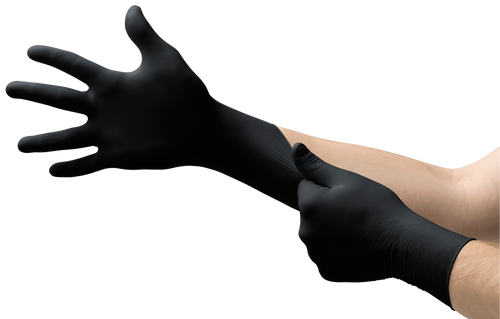
MK-296 is built as a single-use exam/industrial glove — an everyday workhorse for handling, inspection, lab support, and moderate-risk procedures where a textured wet grip and a darker color are practical advantages.
It is non-sterile, so facilities usually position it in support zones, maintenance, receiving/QC, and non-aseptic lab work rather than sterile core work.
For ISO Class 5 / ISO Class 4 or EU Grade A/B aseptic operations, programs typically specify sterile gloves and validated gowning qualification.
What Ansell positions it for
- Inspection, selecting, checking parts; general purpose handling.
- Automotive / aftermarket and light maintenance tasks.
- Life science and laboratory support work: sample taking, processing, weighing, dispensing.
- Standard, moderate-risk examination procedures (site-defined).
Why buyers keep it in rotation
- Black color that masks stains: helps maintain a cleaner look during messy work while improving contrast with lighter materials.
- Texture + formulation built for grip: fully textured and described as non-foaming for controlled handling in wet environments.
- Powder-free nitrile: supports programs reducing powder-related contamination and avoiding natural rubber latex exposure.
- Straightforward packaging: 100/box, 10 boxes/case is easy to stock, issue, and audit.
Materials and build notes
Ansell specifies MK-296 as nitrile, powder-free, chlorinated, and fully textured, with a beaded cuff.
The typical glove length is 245 mm / 9.6 in. Typical thickness values are listed below for context when comparing hand feel and durability across gloves.
Specifications in context
This table consolidates core attributes from the manufacturer technical data sheet. If your internal program requires additional parameters (e.g., chemical permeation, ISO cleanroom processing, sterility method),
treat that as a qualification requirement and request the supporting documentation set prior to approval.
| Attribute |
MK-296 (Ansell) |
| Material / color |
Nitrile, black |
| Glove design |
Chlorinated, powder-free, fully textured |
| Cuff |
Beaded |
| Length |
245 mm / 9.6 in (typical) |
| Freedom from holes |
1.5 AQL (Inspection level I) |
| Palm thickness |
0.12 mm / 4.7 mil (typical) |
| Finger thickness |
0.14 mm / 5.5 mil (typical) |
| Manufacturing / QMS audit standard |
ISO 13485:2003 |
| Regulatory / standards compliance |
ASTM D6319; Food Contact; US QSR/FDA 510(k) Medical Examination Grade |
| Country of origin |
Malaysia |
| Packaging |
100/box; 10 boxes/case (also 10-pack retail option) |
| Storage |
Cool/dry; avoid sunlight; keep away from ozone and ignition sources |
Gowning education (ISO first): why glove handling is a contamination-control step
ISO cleanroom programs start with classification (ISO 14644-1) and then rely on a disciplined operations control approach (ISO 14644-5) that includes a gowning program.
In practical terms: you control what people shed, what they touch, and how they move — because people are the dominant contamination source in most controlled environments.
- Gloves are not “just PPE” in cleanrooms: they become a contact surface for doors, carts, tools, and product-adjacent items.
- Donning sequence matters: clean hands first; then don garments; gloves are typically donned near the end to reduce early contamination of the glove surface.
- Touch discipline matters: avoid face/hood adjustments with gloved hands; treat your glove exterior as “product-side.”
- Change-out is a control point: define triggers (tear, wetting, visible soil, time-based rule) and train to them.
EU GMP Annex 1 alignment (after ISO): what sterile-grade gowning expects
EU GMP Annex 1 is explicit that gowning is not casual clothing change — it is a contamination-control process performed in appropriately graded change rooms.
Annex 1 also emphasizes non-powdered gloves during sterile garment donning, full hair coverage (including facial hair), and sterile face/eye coverings where required by the grade and activity.
Practical takeaway for glove selection
- Non-powdered is a baseline: MK-296 is powder-free, which aligns with the “no powder” expectation commonly written into sterile-area programs.
- Sterile vs. non-sterile is the separator: MK-296 is typically a support-area glove; Annex 1 Grade A/B work normally calls for sterile glove systems and periodic glove monitoring/qualification.
- Donning technique matters as much as glove choice: if the glove is contaminated during gowning, the program loses control before work begins.
Best-practice use (field-tested habits)
Technique guidance: reduce glove-borne contamination
- Don by the cuff, not the fingers: keep exterior contact minimal.
- Avoid “double-touch” habits: if you touch a non-controlled surface, treat that as a contamination event per SOP.
- Rotate tasks, rotate gloves: change gloves between dirty handling and product-adjacent work.
- Use the right glove for the zone: support-zone exam gloves are not a substitute for sterile cleanroom glove systems.
If your workflow includes disinfectant or alcohol glove wipes, validate compatibility and define contact-time logic.
A “glove wipe step” can help, but only when it is controlled, trained, and documented — and only when it does not create residue or spread contamination to adjacent surfaces.
Common failure modes we see in the field
- Wrong size selection: tears, fatigue, loss of fine control.
- Touch drift: face/hood adjustments with gloved hands, then back to work.
- False confidence: “new gloves” interpreted as “clean gloves” even after uncontrolled touches.
- Using non-sterile gloves where sterility is required: a qualification mismatch, not a training issue.
Closest alternatives (apples-to-apples comparison)
Closest comparisons are other powder-free black nitrile exam gloves with similar thickness and texture. When comparing, focus on:
AQL, thickness, texture/grip behavior, documentation depth, and packaging consistency — not just color.
Critical environment fit
MK-296 is typically best placed in support areas, maintenance, receiving/QC, and general lab workflows where a textured nitrile exam glove is appropriate and where sterility is not a requirement.
If you are building a multi-zone PPE standard (support → buffer → aseptic core), SOSCleanroom can help map glove types to zone risk and align the documentation package to your audit expectations.
SOSCleanroom note about SOP's
The Technical Vault is written to help customers make informed contamination-control decisions and improve day-to-day handling technique.
It is not your facility’s Standard Operating Procedure (SOP), batch record, or validation protocol.
Customers are responsible for establishing, training, and enforcing SOPs that fit their specific risks, products, equipment, cleanroom classification, and regulatory obligations.
Always confirm suitability, acceptance criteria, and documentation requirements using your internal quality system.
Use these best-practice suggestions to strengthen your SOPs — not to replace them.
Source basis
- SOSCleanroom product page (MK-296): https://www.soscleanroom.com/product/brands/ansell-mk-296-microflex-midknight-nitrile-gloves/
- Manufacturer technical data sheet (PDF copy): https://www.life-assist.com/Content/Docs/MICR_MIDKNIGHT%20Nitrile_Product%20Data%20Sheet.pdf
- ISO cleanroom classification context (ISO 14644-1): https://www.iso.org/standard/53394.html
- ISO cleanroom operations / gowning program context (ISO 14644-5): https://www.iso.org/standard/88599.html
- EU GMP Annex 1 (Manufacture of Sterile Medicinal Products): https://health.ec.europa.eu/system/files/2022-08/20220825_gmp-an1_en_0.pdf
SOSCleanroom is the source for this Technical Vault entry.
Briefed and approved by the SOSCleanroom (SOS) staff.
If you have any questions please email us at Sales@SOSsupply.com
Last reviewed: Jan. 15, 2026
© 2026 SOSCleanroom