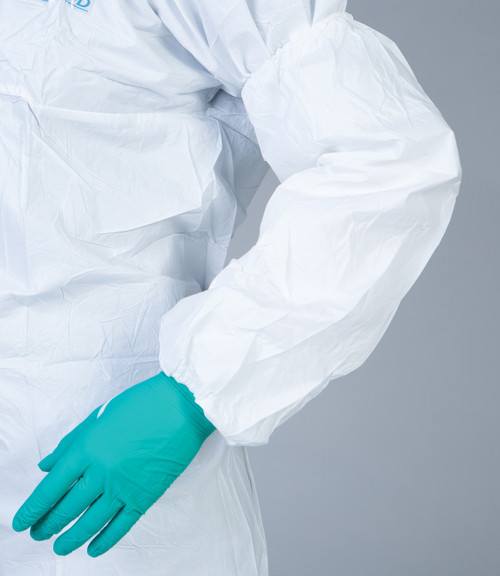
SKU shown: S-BCAS (sterile BioClean-C apron with sleeves; S/M/L/XL).
Why this garment exists in cleanrooms
In high-grade cleanrooms, garments are engineered controls intended to reduce shedding, protect product-contact proximity, and (where applicable) provide barrier protection to the operator. S-BCAS is positioned as a sterile, low-linting partial-body garment intended to complement full-body systems while adding chemotherapy protective performance and sleeve coverage at critical hand/arm interfaces.
What this product is used for
- Cytotoxic drug handling tasks where a documented protective apron layer is required by the facility CCS/SOP.
- Critical environment workflows emphasizing low-linting behavior and controlled gowning technique.
- Operations where sleeve protection and cuff control are necessary to reduce exposure and contamination transfer risk.
- Production/manufacturing and laboratory work requiring sterile, single-use partial-body barrier PPE.
Why customers consider S-BCAS
- Sterile and documented: gamma sterilized with SAL 10-6, individually bagged packaging supports controlled entry and receiving expectations.
- Low-linting design intent: CleanTough™ and published particle shedding results support contamination-control programs.
- Sleeve seam control: ultrasonically bonded sleeve seams with protective tape reduce seam vulnerability.
- Chemotherapy protective positioning: manufacturer references ASTM F739-12 permeation testing against multiple cytotoxic drugs.
- Cleanroom fit statement: published as Class 10 / ISO 4 and EU GMP Grade A (always qualify to your SOP).
Materials, composition, and build
S-BCAS is manufactured from CleanTough™, a polyethylene / non-woven polypropylene laminate described as lightweight and low-linting. The garment uses an adjustable Velcro neck fastening and rear tie tapes. Sleeve seams are ultrasonically bonded and finished with protective tape; cuffs are 100% polyester elasticated.
Specifications in context
| Attribute |
S-BCAS |
| Product name | BioClean-C™ Apron with Sleeves — Sterile |
| Cleanroom statement | Class 10 / ISO 4 & EU GMP Grade A |
| Sterility assurance | Gamma irradiation; SAL 10-6; minimum dose 25 kGy |
| Material | CleanTough™ (PE / non-woven PP laminate) |
| Seams / cuffs | Ultrasonically bonded sleeve seams with protective tape; 100% polyester elasticated cuffs |
| Closures | Velcro neck fastening; rear tie tapes |
| Particle shedding | Helmke Drum ≥0.5 µm: <1700 counts/min |
| Shelf life | 3 years from date of manufacture |
| Packaging | 1 per sealed inner PE bag; inner bag per sealed outer PE bag; 40 outer bags per lined carton |
| Country of origin | China |
| Primary test reference (chemo) | ASTM F739-12 |
Performance and cleanliness considerations
Manufacturer chemical data references ASTM F739-12 mean breakthrough time (MBT) against specific cytotoxic drugs. These results are generated under controlled laboratory conditions; real-world performance depends on wear, seams/closures, movement, contact time, and compatibility with your process chemicals.
| Data point |
What it implies for use |
Published basis |
| Particle shedding | Supports contamination-control intent; still requires correct gowning and behavior controls. | Helmke Drum ≥0.5 µm: <1700 counts/min |
| ASTM F739-12 (MBT) | Assists chemical risk assessment; validate against your exact drug list and contact conditions. | Manufacturer table includes multiple drugs (e.g., several >240 min) |
| Sterility assurance | Supports sterile-area entry when paired with correct donning and controlled packaging handling. | Gamma 25 kGy; SAL 10-6 |
Packaging, traceability, and controlled entry
Each apron is supplied as one piece per sealed inner PE bag, with one inner bag per sealed outer PE bag, and 40 outer bags per lined carton. This supports staged opening at gowning boundaries and reduces uncontrolled outer-surface contact during donning.
Proper gowning (donning) to minimize contamination
ISO-first: what "good gowning" looks like in operations
- Treat gowning as an operational control: clothing and gowning are core contamination controls, not administrative steps.
- Keep the outside sterile: open packaging so the garment can be presented without touching the exterior.
- Sequence matters: don base apparel first (hood/mask/coverall/boots per SOP), then apply the apron as the final layer.
- Control cuff-to-glove interfaces: ensure cuffs remain seated and the glove line is covered as intended by your SOP.
- Minimize motion and contact: most contamination transfer is created by touch. Move deliberately and keep hands within controlled zones.
Annex 1 overlay (Europe): Grade A/B expectations
- Aseptic gowning qualification: Annex 1 expects training, assessment, and periodic reassessment for Grade A/B access.
- Double-gloving and tuck discipline: garment sleeves tucked into a second pair of sterile gloves for Grade B/A interventions.
- Gowning room control: gowning should be performed in change rooms of an appropriate grade to maintain gown cleanliness.
Manufacturer donning method (IFU): don the apron (put arms into sleeves), secure at the back of the neck using the Velcro fastening, then use tie-tapes at the waist. Remove carefully and turn inside out to trap contamination; dispose per regulations.
Common failure modes
- Touch contamination during donning: grabbing the outside surface, letting sleeves brush benches/carts.
- Poor cuff control: cuffs migrating during work, leaving exposed wrists or creating contact points at the glove line.
- Mismatch to chemical list: validate against specific drugs, concentrations, and contact times in your workflow.
- Re-use behavior: single-use garments are not designed for repeated cycles.
Closest alternatives
- BioClean-C non-sterile apron with sleeves (BCAS): similar build intent without sterile packaging.
- BioClean sterile sleeve covers: isolate protection to the arms/cuffs when full aprons are not required.
- Other sterile chemo protective aprons: validate documentation depth and permeation testing basis.
Critical environment fit
S-BCAS is typically selected by programs that require: sterile single-use protective over-garments, documented packaging discipline for controlled entry, and a manufacturer-referenced chemo permeation testing basis. Best used as part of a complete gowning system defined by your contamination control strategy and SOPs.
SOSCleanroom note about SOP's
The Technical Vault is written to help customers make informed contamination-control decisions. It is not your facility's SOP, batch record, or validation protocol.
Use these best-practice suggestions to strengthen your SOPs—not to replace them. Your team should review, approve, and qualify the final method for your specific surfaces, chemicals, cleanliness limits, and risk profile.
Source basis (manufacturer-first)
SOSCleanroom is the source for this Technical Vault entry.
Briefed and approved by the SOSCleanroom (SOS) staff.
If you have any questions please email us at Sales@SOSsupply.com
If you need additional information please try our SOSCleanroom specific AI ChatBot which draws from our extensive cleanroom specific libraries.
Last reviewed: May 1, 2026
© 2026 SOSCleanroom