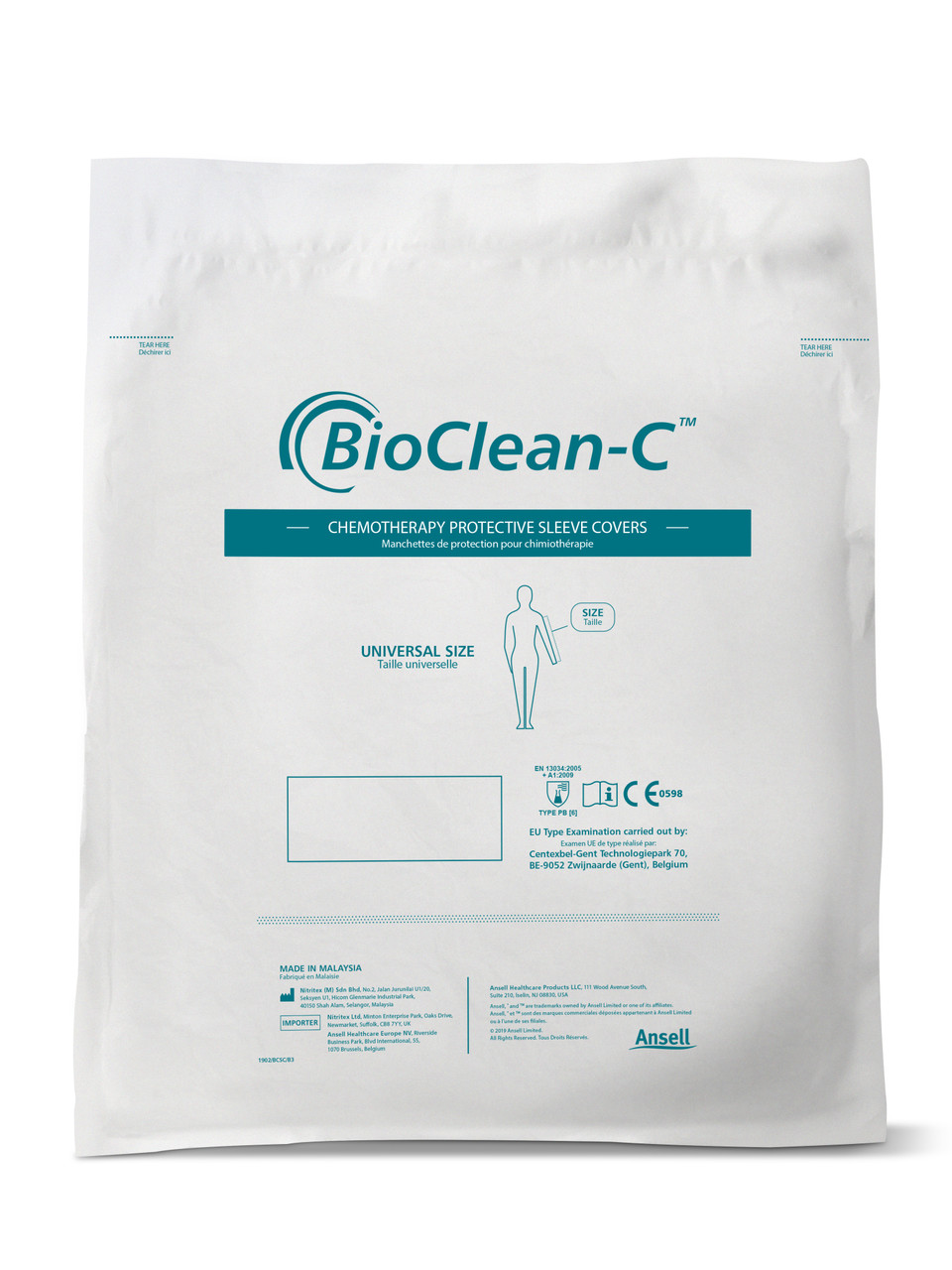
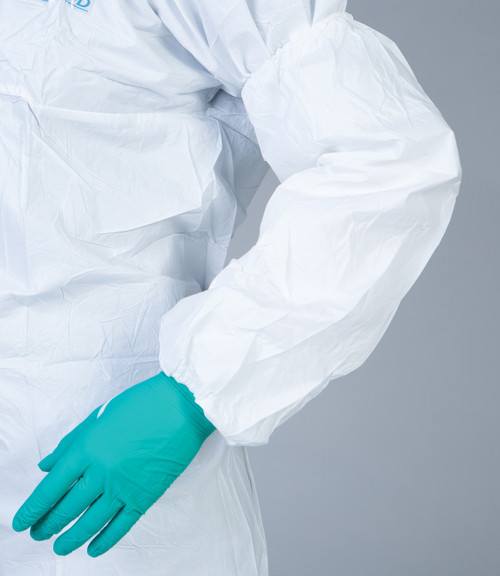
SKU shown: S-BCSC (sterile chemo-protective sleeve covers).
Why sleeve covers matter in cleanrooms
Many contamination events do not start at “the product.” They start at interfaces: wrists, forearms, and glove overlaps that touch carts,
bins, doors, sleeves, and pass-through surfaces. Sleeve covers exist to reduce that transfer risk, but only if the sleeve/glove interface is controlled and the
donning technique is consistent across operators and shifts.
What S-BCSC is (manufacturer positioning)
BioClean-C™ S-BCSC is a sterile sleeve cover designed for cleanroom and life-science environments, manufactured from CleanTough™ material and
constructed with ultrasonically bonded seams covered with protective tape. It is packaged to help reduce cross-contamination risk and sterilized using
gamma irradiation to achieve a minimum sterility assurance level (SAL) of 10-6.
Chemo-rated means “drug-specific, test-based”
“Chemo rated” is not a generic promise. It is a test basis. S-BCSC is tested to ASTM F739 and publishes minimum breakthrough time (MBT)
results for a defined set of chemotherapy drugs. Breakthrough performance can differ dramatically across drugs, concentrations, and exposure conditions.
| Drug (ASTM F739 test set) |
Minimum Breakthrough Time (MBT) |
Selection implication |
| Cisplatin |
> 240 minutes |
Strong barrier basis for this drug under the test conditions. |
| Cyclophosphamide |
> 240 minutes |
Strong barrier basis for this drug under the test conditions. |
| 5-Fluorouracil |
> 240 minutes |
Strong barrier basis for this drug under the test conditions. |
| Etoposide |
< 6 minutes |
High-risk mismatch if your workflow includes Etoposide exposure at comparable conditions; consult your safety program. |
| Thiotepa |
55 minutes |
Moderate barrier basis; confirm exposure duration and controls. |
Practical rule:
Match PPE to the actual drug list and the actual handling scenario (frequency, contact likelihood, splash potential, and dwell time). “Chemo rated” should always be interpreted through the published test set and your SOP risk assessment.
Cleanroom performance (particle shedding and sterility)
For cleanrooms, sleeve covers are evaluated as much for what they do not add as what they block. S-BCSC publishes low particle shedding
(Helmke Drum) and is supplied sterile (gamma irradiated; SAL 10-6) for programs that require sterile sleeve coverage in critical zones.
| Attribute |
Published value / statement |
Why it matters |
| Particle shedding (Helmke Drum) |
≥ 0.5 µm (counts/min) < 1700 |
Lower shedding supports cleaner forearm motion near critical work. |
| Sterilization / SAL |
Gamma irradiated; minimum SAL 10-6 |
Supports sterile-area entry where sterile garments are required. |
| Cleanroom positioning |
Class 10 / ISO 4; EU GMP Grade A |
Aligns with high-criticality zones when paired with correct gowning behaviors. |
ISO-first context: why gowning discipline is part of “operations”
ISO cleanroom classification describes air cleanliness performance, but the day-to-day outcome depends on operational control.
ISO 14644-5 (Operations) places emphasis on the cleanroom operations program, which includes personnel controls and gowning discipline.
In practice: garments help, but consistent donning behavior is what prevents sleeves and wrists from becoming contamination-transfer tools.
European Annex 1 overlay: gowning qualification expectations
If your program aligns to EU GMP Annex 1 (sterile medicinal products), the focus on personnel and gowning becomes even more explicit:
Annex 1 calls for aseptic gowning training, gowning qualification, and periodic reassessment for Grade A/B access, including monitoring of
locations such as gloved fingers and forearms. Sleeve covers directly affect those forearm interfaces when used correctly.
Donning technique (sleeve covers) that reduces contamination transfer
Aseptic sleeve-cover donning checklist (use as training aid, then align to your SOP)
- Prepare the interface: Ensure your underlying gown/coverall sleeve is positioned correctly and hands are ready for gloving steps per SOP.
- Don through the cuffed end (label end): Pull onto the lower arm and ensure a good seal at the wrist and above the elbow.
- Control overlap with gloves: Maintain a deliberate overlap (outer glove over sleeve cuff is common). Avoid gaps that expose underlying sleeves or skin.
- Tape joins where required: For full protection, compatible hood/coverall/gloves/footwear should be taped together using waterproof tape to cover each join (follow your SOP).
- Behavior control: Keep forearms away from non-controlled surfaces; treat sleeves like gloved hands — they are “working surfaces” in the cleanroom.
Removal/disposal discipline matters as much as donning. Remove carefully and turn inside out to trap contamination, then dispose per your facility waste stream and regulations (especially relevant for chemotherapy-handling environments).
Common failure modes (what to watch for on the floor)
- Glove/sleeve gap: exposed knit cuffs or gown sleeves at the wrist become a contamination-transfer source.
- Untaped joins (when required by SOP): liquid pathways and seam exposure can defeat the intended barrier system.
- Forearm contact with carts/doors: sleeves pick up contaminants and redeposit them at benches and pass-through staging.
- Improper doffing: pulling sleeves off “outside-in” spreads contamination to hands and gown surfaces.
Closest alternatives (how to compare correctly)
Compare alternatives by the published chemo permeation test set (drug list + MBT values), sterility method (and SAL),
seam construction, and the cleanroom performance basis (e.g., particle shedding method). “Chemo-rated” should never be treated as an interchangeable label.
SOSCleanroom note about SOP's
The Technical Vault is written to help customers make informed contamination-control decisions and improve day-to-day handling technique.
It is not your facility’s Standard Operating Procedure (SOP), batch record, or validation protocol.
Customers are responsible for establishing, training, and enforcing SOPs that fit their specific risks, products, equipment, cleanroom classification,
and regulatory obligations. Always confirm material compatibility, cleanliness suitability, sterility requirements, and acceptance criteria within your quality system.
Use these best-practice suggestions to strengthen your SOPs — not to replace them.
Source basis
- Manufacturer PDS (S-BCSC): https://www.soscleanroom.com/content/Ansell_PDF/bioclean-c-sleeve-covers-sterile-s-bcsc_pds_us.pdf
- EU Declaration of Conformity (S-BCSC): https://www.soscleanroom.com/content/Ansell_PDF/bioclean-c-sleeve-covers-sterile-s-bcsc_bioclean-c%E2%84%A2-s%20bcsc_eu_20230512_declaration%20of%20conformity.pdf
- IFU (PB[6] Part Body Garments): https://www.soscleanroom.com/content/Ansell_PDF/PB6Part%20Body%20Garment%20IFU.pdf
- ISO 14644-1 (classification context): https://www.iso.org/standard/53394.html
- ISO 14644-5 (operations / gowning program context): https://www.iso.org/standard/88440.html
- EU GMP Annex 1 (personnel + aseptic gowning qualification context): https://health.ec.europa.eu/system/files/2022-08/20220825_gmp-an1_en_0.pdf
SOSCleanroom is the source for this Technical Vault entry.
Briefed and approved by the SOSCleanroom (SOS) staff.
If you have any questions please email us at Sales@SOSsupply.com
Last reviewed: Jan. 14, 2026
© 2026 SOSCleanroom