Where this glove fits (and where it does not)
SU-690 is positioned by Ansell as a robust nitrile exam glove for demanding tasks where wear time, handling confidence, and barrier consistency are key selection drivers.
It is not a sterile cleanroom glove and should not be used as a “stand-in” for sterile programs where sterility assurance, sterile packaging, or validated disinfection/change rules are required.
Typical use-cases (per manufacturer positioning)
- Inspection, selecting, and checking parts
- Assembly work, fastening, and component handling
- Equipment repair and maintenance
- Sample taking/processing and raw material sampling
- Higher-risk clinical applications and latex allergy avoidance programs (Type I)
Why it gets shortlisted
- Low-AQL barrier profile: 0.65 AQL is often selected where pinhole control is a primary decision factor.
- Handling confidence: textured fingers support consistent grip on tools, fixtures, and components.
- Durability-driven design: manufacturer positions the nitrile formulation for demanding wear.
- Powder-free + latex-free formulation: reduces powder concerns and supports Type I latex allergy avoidance programs.
Material and build notes
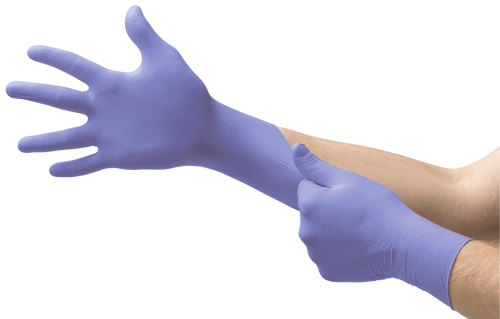
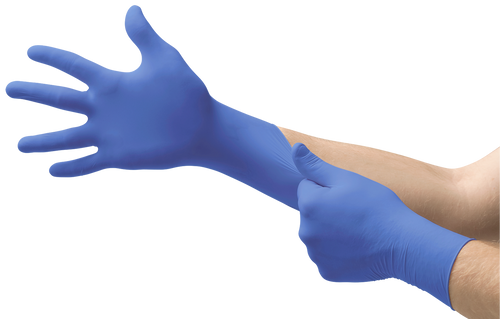
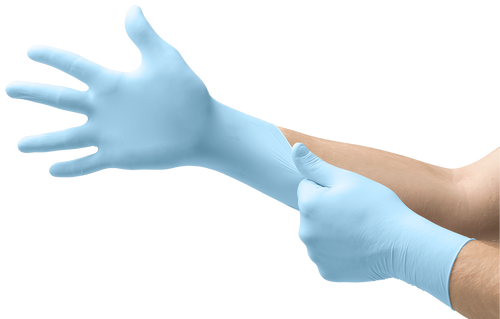
SU-690 is a nitrile exam glove with textured fingers. Manufacturer-listed physical attributes include 245 mm length,
0.11 mm palm thickness (4.3 mil), 0.18 mm finger thickness (7.1 mil), and antistatic designation. Country of origin is listed as Malaysia.
Specifications in one view
| Attribute |
SU-690 (Manufacturer basis) |
| Material / format |
Nitrile exam glove; textured fingers |
| Freedom from holes |
0.65 AQL (Inspection Level I) |
| Length |
245 mm / 9.6 in |
| Palm thickness |
0.11 mm / 4.3 mil |
| Finger thickness |
0.18 mm / 7.1 mil |
| Antistatic |
Yes |
| Packaging |
100 gloves/box; 10 boxes/case; 1000 gloves/case |
| Storage |
Out of direct sunlight; cool/dry; away from ozone/ignition sources |
| Country of origin |
Malaysia |
ISO-first operational perspective (gloving as contamination control)
ISO cleanroom operations frameworks treat personnel controls as a core contamination lever. ISO 14644-5 (Operations) explicitly includes personnel management expectations such as a gowning program within an Operational Control Programme (OCP).
In practice, “gowning” includes how gloves are donned, what gets touched during donning, and the change-out rules tied to your process risk.
Practical gloving technique (cleanroom-minded, not product-specific)
Reduce contamination by controlling the first 60 seconds
- Start with clean hands: perform hand hygiene and let hands dry before opening boxes or touching glove surfaces.
- Avoid “finger pinch” contact: glove cuffs are the preferred grab point; minimize contact to palm/fingers during donning.
- Control touch points: once gloved, treat face, hair, phone, door hardware, and non-controlled surfaces as “rework triggers.”
- Change rules should be written: change gloves after contamination events, tears, and task transitions—and before re-entering higher-grade areas.
- If you disinfect gloves: only use approved disinfectants and contact times; verify material compatibility and residue behavior.
These technique points are intended to support your SOP writing. Your cleanroom classification, product risk, and regulatory scope determine how strict glove disinfection and change-out must be.
European Annex 1 perspective (sterile manufacturing)
In EU GMP Annex 1 sterile-manufacturing contexts, personnel gowning and gloving expectations are typically more prescriptive than general controlled-environment practice.
Annex 1 emphasizes contamination prevention via disciplined gowning, appropriate glove practices (including disinfection where required by procedure), and immediate response to glove damage or contamination events.
If Annex 1 applies to your operation, ensure glove selection aligns with sterile/aseptic requirements and validated workflows—and do not treat non-sterile exam gloves as an equivalency.
Common failure modes (what breaks programs)
- Glove-on / phone-on behavior: one touch event can undo an entire gowning sequence.
- Cuff contamination during donning: uncontrolled cuff contact leads to “hidden transfer.”
- Undefined change-out rules: if it’s not written, it won’t be consistent across shifts.
- Misclassification of glove type: non-sterile exam gloves used where sterile cleanroom gloves are required.
Closest competitors (how to compare fairly)
For robust nitrile exam gloves, compare more than “nitrile vs nitrile.” The decision usually comes down to AQL, thickness profile, grip texture, antistatic designation, and the documentation bundle your QA team expects.
If your environment is regulated, also compare whether sterile variants exist and whether your supplier can maintain continuity of supply.
SOSCleanroom + Ansell (including KleenGuard/Kimtech) — what “better support” looks like
SOSCleanroom’s PPE direction is to simplify program standardization: consistent manufacturer documentation, consistent product availability, and practical training content that reduces operator-to-operator variability.
As Ansell expands and integrates major PPE lines such as KleenGuard® and Kimtech® into a broader portfolio, we will continue aligning stocking, documentation access, and education so customers can build safer, more repeatable controlled-environment workflows.
SOSCleanroom note about SOP's
The Technical Vault is written to help customers make informed contamination-control decisions and improve day-to-day handling technique.
It is not your facility’s Standard Operating Procedure (SOP), batch record, or validation protocol.
Customers are responsible for developing, approving, and maintaining SOPs that fit their risks, cleanroom classification, regulatory scope, and internal quality systems.
Always confirm suitability, compatibility, and acceptance criteria using your documented methods.
Use these guidance points to strengthen training and consistency—not to replace your quality system documentation.
Source basis
- SOSCleanroom product page (SU-690): https://www.soscleanroom.com/product/brands/ansell-su-690-microflex-supreno-se-nitrile-gloves/
- Manufacturer Product Data Sheet (US): https://www.soscleanroom.com/content/Ansell_PDF/microflex-supreno-se-su-690_pds_us.pdf
- ISO operations context (ISO 14644-5 Operations page): https://www.iso.org/standard/88599.html
- EU GMP Annex 1 (European Commission PDF): https://health.ec.europa.eu/system/files/2022-08/20220825_gmp-an1_en_0.pdf
- Ansell press release (portfolio expansion / PPE business acquisition context): https://www.ansell.com/us/en/press-releases/ansell-completes-acquisition-of-kcppe-business
SOSCleanroom is the source for this Technical Vault entry.
Briefed and approved by the SOSCleanroom (SOS) staff.
If you have any questions please email us at Sales@SOSsupply.com
Last reviewed: Jan. 16, 2026
© 2026 SOSCleanroom