Why glove discipline is a contamination-control tool (not just PPE)
In controlled environments, gloves are not merely hand protection—they are a contamination-control interface. The biggest practical risk is inconsistent behavior: touching uncontrolled surfaces then touching critical items; donning gloves aggressively; and stretching wear time beyond what the task can tolerate. A glove program works when glove changes are predictable, hands are prepared properly, and the gowning sequence is consistent shift-to-shift.
What UF-524 is (manufacturer-published basis)
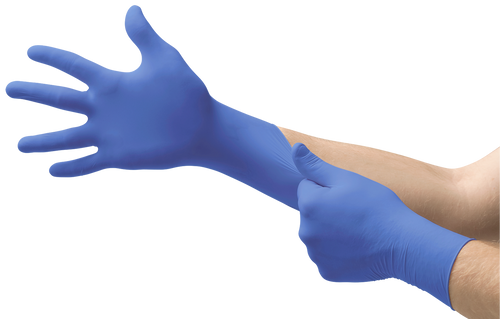
UF-524 is a powder-free nitrile examination glove positioned for tactility and comfort. The published configuration includes textured fingers and a 230 mm (9.1 in) length. Freedom-from-holes is published at AQL 1.5 (inspection level I). Thickness: 0.06 mm (2.4 mil) palm; 0.10 mm (3.9 mil) fingers.
Packaging: 300 gloves per dispenser, 10 dispensers per case (3,000 per case). Size XL: 250 per dispenser (2,500 per case). Country of origin: China. Storage: cool, dry, out of direct sunlight and away from ozone or ignition sources.
Specifications in a single view (published)
| Attribute |
UF-524 |
| Material / powder | Nitrile; powder-free; not made from natural rubber latex |
| Surface | Textured fingers |
| Length | 230 mm / 9.1 in |
| AQL (holes) — inspection level I | 1.5 |
| Thickness | Palm 0.06 mm (2.4 mil); Finger 0.10 mm (3.9 mil) |
| Tensile strength (MPa) | Before aging: 23 (≥14); After aging: ≥14 |
| Elongation at break (%) | Before aging: ≥500; After aging: ≥400 |
| Antistatic / sterile | Antistatic: No; Sterile: No |
| Packaging overview | 300/dispenser; 10 dispensers/case; 3000/case (XL: 250/dispenser; 2500/case) |
| Country of origin | China |
ISO-first: how gloves tie into cleanroom operations
ISO cleanroom performance is not sustained by classification alone. Operational control is where cleanrooms succeed or fail—particularly personnel practices, entry/exit discipline, and gowning programs. Gloves sit at the center of that program: they are touched constantly, changed constantly, and they are the first thing that contacts tools, containers, and product-contact surfaces. A glove choice that improves comfort and fit can reduce subconscious face-touching and "glove fiddling" that quietly breaks technique.
Annex 1 overlay: contamination control strategy means fewer interventions
EU GMP Annex 1 pushes a contamination-control mindset: personnel are a key contamination source, and gowning is treated as a risk control. The goal is to reduce interventions—including repeated glove adjustments, unnecessary touches, and extended wear beyond the task. Fit and comfort therefore become quality levers.
Donning technique (simple steps that lower contamination risk)
- Hands first: complete hand hygiene; dry thoroughly (wet hands increase tearing and over-stretching).
- Open cleanly: avoid grabbing multiple gloves; keep the box opening tidy.
- Don without snapping: a calm, controlled don reduces particle disturbance and glove stress.
- Set the fit once: half sizes help—continuous tugging becomes repeated contact events.
- Define change triggers: task change, surface change, suspected breach, or visible soil—then follow it every time.
UF-524 is noted by the manufacturer as a candidate underglove for double-gloving workflows. If you run double-glove steps, treat the underglove and outer glove as separate control layers with separate change rules.
Where UF-524 fits (and where it does not)
- Good fit: exam, lab, high-touch handling, and general controlled workflows where non-sterile exam gloves are acceptable by SOP.
- Not a substitute for sterile/cleanroom-rated gloves: if sterile packaging, irradiation documentation, or cleanroom glove validation is required, select an appropriate sterile/cleanroom glove.
- Not chemo-tested: if hazardous drug/chemo protection is required, use gloves specifically tested and documented for that use.
Ansell + KleenGuard + SOSCleanroom
Ansell’s ecosystem spans exam gloves (MICROFLEX) and broader PPE programs (including KleenGuard). SOSCleanroom is investing into tighter alignment with this portfolio so customers get cleaner SKU mapping, clearer spec references, and better continuity as portfolios evolve.
SOSCleanroom note about SOP's
The Technical Vault is written to help customers make informed contamination-control decisions. It is not your facility's SOP, batch record, or validation protocol.
Use these best-practice suggestions to strengthen your SOPs—not to replace them.
Source basis
SOSCleanroom is the source for this Technical Vault entry.
Briefed and approved by the SOSCleanroom (SOS) staff.
If you have any questions please email us at Sales@SOSsupply.com
If you need additional information please try our SOSCleanroom specific AI ChatBot which draws from our extensive cleanroom specific libraries.
Last reviewed: May 1, 2026
© 2026 SOSCleanroom