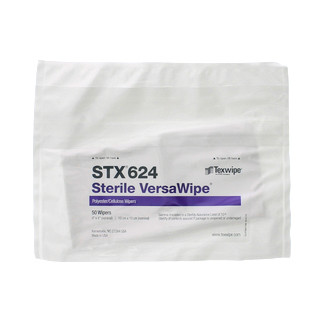
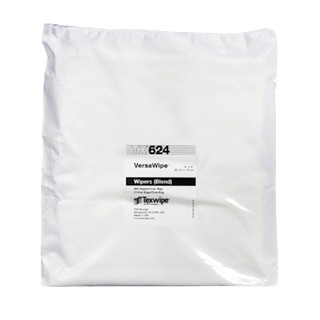
Texwipe STX624 Sterile VersaWipe 4" x 4" Cellulose and Polyester Cleanroom Wiper

$560.61
(No reviews yet)
SKU:
STX624
Availability:
Stock Item
Shipping:
Calculated at Checkout
International Shipping:
Available for this product
Quantity Option (Case):
50 Bags of 50 Wipers Per Case
Type:
Dry Wiper
Wiper Family:
VersaWipe
Wiper Material:
Cellulose/Polyester
Wiper Size:
4" x 4"
Wiper Edge:
Cut Edge
Sterile:
Yes
ISO Class:
ISO 5 (Class 100) - ISO 8 (Class 100,000)
Country of Origin:
Made in the USA

STX624 Sterile VersaWipe 4" x 4" Cellulose and Polyester Cleanroom Wiper

STX624 Sterile VersaWipe is a dry, sterile, hydroentangled nonwoven wiper made from a 55% cellulose / 45% polyester blend designed for general wiping and spill control in controlled environments. It is low-linting (no wiper is truly ‘zero-lint’ in every process condition) and engineered to combine fast wet-out and absorbency (cellulose) with wet strength and durability (polyester), while maintaining solvent compatibility and low extractables.

Sterile program note: STX624 is commonly selected when teams need a sterile, all-purpose poly-cellulose wiper that absorbs quickly, holds together during wet wiping, and supports disciplined change-out behavior through its 50 wipers/bag format.

Specifications:
  • Size: 4" x 4" (10 cm x 10 cm) nominal
  • Material: 55% cellulose / 45% polyester (hydroentangled nonwoven)
  • Construction: Nonwoven, hydroentangled with bidirectional strength
  • Edge: Cut edge
  • Sterile: Yes (gamma irradiated; validated to SAL 10−6 per AAMI guideline framework)
  • Packaging: 50 wipers/bag; 50 bags/case (2,500 wipers/case)
  • Use environments: ISO 5 (Class 100) – ISO 8 (Class 100,000) controlled areas (final suitability depends on your process and cleaning method)
  • Country of origin: Made in the USA
About the Manufacturer: 

Texwipe (an ITW company) differentiates itself in cleanroom wiping by treating the wiper as an engineered product, not a commodity consumable. Its manufacturing approach starts with substrate selection (including engineered blends such as cellulose/polyester for absorbency plus wet strength), then controls edge construction, controlled cleaning/manufacturing, and packaging aligned to cleanroom application tiers.


Texwipe also emphasizes verification through fibers/particles/ions/residue testing and describes process controls intended to improve lot-to-lot consistency and reduce handling-driven contamination risk. SOSCleanroom (SOS) supports that manufacturing discipline with a close working relationship with Texwipe focused on continuity of supply, clean documentation handoff (certs, lot traceability), and practical application support—so customers can standardize wiping materials with predictable performance while maintaining procurement reliability and audit readiness.

STX624 Features:
  • Fiber blend (55% cellulose / 45% polyester)
  • Nonwoven, hydroentangled construction with excellent bidirectional strength
  • Solvent-safe Bag-Within-A-Bag cleanroom packaging
  • Statistical quality control
  • Low extractables and no chemical binders
STX624 Benefits:
  • Fast wet-out and high absorbency: Cellulose content supports efficient pickup of aqueous spills and controlled solution handling.
  • Wet and dry strength: Polyester content helps the wipe hold together under pressure and during wet wiping.
  • Solvent compatibility: Commonly used with IPA and many other cleanroom-compatible solvents/cleaners (verify compatibility to your chemistry and SOP).
  • Lower residue risk approach: Hydroentangled construction with no chemical binders helps reduce binder-driven residue concerns.
Common Applications:
  • General-purpose sterile wiping where economy and cleanliness are both important
  • Spill control (especially aqueous spills) and routine wipe-downs
  • Applying and removing disinfectants, cleaners, lubricants, adhesives, and residues
  • Cleaning precision components and lab apparatus
  • Lining trays for holding, protecting, drying, staging, or storing parts and devices
Best-Practice Use:
  • Fold for control: For 4" x 4", fold once or twice to create multiple clean faces; rotate faces instead of re-wiping with a loaded surface.
  • Wipe pattern: Use straight-line strokes with slight overlap to avoid re-depositing contamination.
  • Wet vs. dry: For solvent wipe-downs, dampen—do not over-saturate—so you maintain control and reduce dripping and streaking.
  • Change-out discipline: Replace early; the 50 wipers/bag format is designed to support frequent discard before a face becomes overloaded.
  • Two-wipe strategy when needed: Use STX624 for absorb-and-lift, then follow with a higher-purity synthetic wipe for final-pass steps when your defect/film risk analysis demands it.
Selection Notes (STX624 vs. Other Options)
  • STX624 vs. TX624: Same VersaWipe material family and nominal size; STX624 is sterile (gamma irradiated) for sterile programs, while TX624 is the non-sterile configuration.
  • Blended nonwoven vs. knit polyester: Poly-cellulose blends tend to wet-out faster and absorb more readily for spill pickup and solution handling; knit polyester options are often chosen for more abrasion-driven wiping and lower fiber risk on highly defect-sensitive final passes.
  • Cut edge vs. sealed edge: STX624 is a cut-edge blended wipe for general-purpose sterile wiping and spill control; sealed-edge formats are typically reserved for the most fiber/defect-sensitive final wipes (qualify to your SOP and acceptance criteria).

Link to Texwipe Technical Datasheet (SOS-hosted copy):
Click Here
Link to Texwipe Technical Datasheet (Texwipe.com): Click Here

Other Similar Products Available From SOSCleanroom.com

VersaWipe Dry Wipers

  • TX624: 4" x 4" nominal (10 cm x 10 cm), non-sterile VersaWipe configuration
  • TX629: 9" x 9" nominal (23 cm x 23 cm), VersaWipe dry blended nonwoven
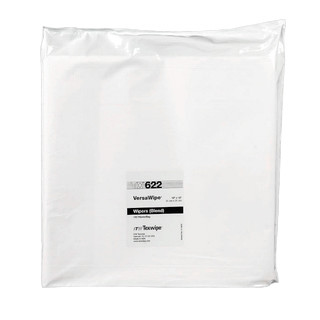
  • TX622: 12" x 12" nominal (31 cm x 31 cm), VersaWipe dry blended nonwoven

Sterile blended nonwoven alternatives

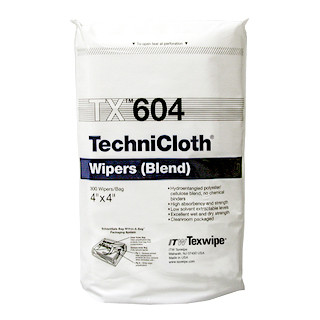
  • STX609: 9" x 9" sterile cellulose/polyester nonwoven option in the TechniCloth family

Notes: Looking for application guidance or qualification context for Texwipe STX624 Sterile VersaWipe 4" x 4" cellulose/polyester cleanroom wipers? Open the SOSCleanroom Technical Vault tab above for practical wiping technique, selection notes (STX624 vs. alternatives), and the documentation details teams typically review when standardizing sterile cleanroom wipes across ISO-class controlled environments.

SOSCleanroom.com supports contamination-control programs with cleanroom consumables in stock, fair pricing, and responsive technical support—backed by same-day shipping options and customer service that understands real cleanroom workflows.

Product page updated: Jan. 4, 2026 (SOS Technical Staff)

© 2026 SOS Supply. All rights reserved.

The Technical Vault By SOSCleanroom
ISO 14644 Operations Control Texwipe VersaWipe® (Sterile) Cellulose + Polyester / Absorbent Blend Sterile Detail Wiping & Small-Surface Prep 4" x 4" Lot Traceability

Texwipe STX624 Sterile VersaWipe® 4" x 4" Cellulose + Polyester Cleanroom Wiper — compact sterile wiping where absorption and control in tight spaces are priorities

Texwipe STX624 Sterile VersaWipe® is a sterile, 4" x 4" cleanroom wiper made from a cellulose and polyester blend, selected for detail wiping where absorption and controlled handling are important in sterile or ISO-class environments. Blended wipes are commonly chosen when the process benefits from increased absorbency for light spills, wipe-up steps, or controlled damp-film work where the wipe must manage liquid without becoming unstable in the hand. The compact 4" x 4" size supports small-surface preparation, equipment touch points, and localized wipe-downs in constrained areas where larger wipes reduce control. As with all sterile wipes, performance is method-driven: control introduction, maintain package integrity, enforce clean-to-less-clean flow, and use one-face-per-pass technique with defined discard triggers. Final suitability should be confirmed against current manufacturer documentation and your internal requirements for residues, fibers, and surface finish sensitivity.

Operations takeaway: STX624 supports ISO-aligned operations control when the SOP clearly defines where blended wipes are permitted (zone/surface types), how wetness is controlled, and when the wipe must be discarded to prevent re-deposition or fiber transfer.


ISO-first context: where wipers fit in cleanroom operations control

ISO 14644-5:2025 frames cleanroom performance around a documented Operations Control Programme (OCP) that governs personnel practices, material transfer, cleaning, maintenance, and monitoring. Wipers belong in that system because the wipe itself, the chemistry, and the technique directly affect residues, particles, and recontamination risk. If you clean parts, fixtures, tools, or work surfaces inside an ISO-class controlled environment, the method should be written, trained, and repeatable.

Control point: Most “wiper failures” are technique failures—over-wetting, re-wiping with a loaded face, backtracking into clean areas, or using a wiper beyond its change-out point.


Specifications (SKU controls for RFQs, SOPs, and receiving)
  • Product: Texwipe STX624 Sterile VersaWipe® 4" x 4" Cellulose + Polyester Cleanroom Wiper
  • Size: 4" x 4" (approx. 10.2 cm x 10.2 cm)
  • Material / structure: Cellulose and polyester blend cleanroom wiper (verify blend/structure details per manufacturer documentation)
  • Edge construction: Verify edge construction per manufacturer documentation
  • Processing: Sterile, cleanroom processed and packaged; lot traceability
  • ISO environment positioning: Process dependent; commonly used for controlled environments (final suitability depends on your method)
  • Packaging: Verify current sterile packaging and bag/case configuration per manufacturer documentation

Documentation rule: For controlled/validated programs, always base acceptance criteria on current manufacturer documentation and lot records (not web summaries).


What this wiper is designed to do (typical use cases)
  • Detail sterile wipe-down of small surfaces, touch points, and localized areas where a larger wipe reduces control.
  • Absorbent wipe-up steps for minor liquid management in sterile workflows (as permitted by the SOP and surface requirements).
  • Damp-film wiping on small equipment exteriors or staging items where wetness and discard triggers are controlled.
  • Wipe-down of tools or fixtures in constrained geometries where fold control and face management are critical.
  • Supplemental wiping in aseptic areas where sterility and package control are required (validate against residue and fiber sensitivity limits).

Method note: Blended wipes can increase absorbency, but they must be qualified for residue/fiber expectations in your process. Keep wiping unidirectional and discard promptly once loaded to prevent re-deposition. For confined geometries, define the swab method separately (one swab, one area; no re-dipping).


Best-practice use (reduce residues, particles, and rework)
  1. Control introduction: bring wipes into the cleanroom per your OCP rules (outer packaging removal, staging, and storage).
  2. Use clean-to-less-clean flow: wipe from the cleanest zone to the dirtiest zone; do not backtrack.
  3. Fold for control: fold to create multiple clean faces; use one face per pass, then refold.
  4. Damp-film technique: if using solvent, wet to a controlled damp state (not dripping).
  5. Straight-line strokes: use consistent pressure and unidirectional strokes; avoid circular scrubbing.
  6. Change-out triggers: discard when loaded, smeary, tacky, or when surface-quality requirements are at risk.

Method standardization tip: If outcomes differ by operator, lock four variables in the SOP: wetness target, stroke count, fold pattern, and change-out point.


Misuse controls & when not to use
  • If sterility is required: do not substitute a non-sterile wipe for sterile workflows.
  • If ultra-low residues/ions are gating: confirm requirements against current manufacturer documentation and your internal limits.
  • If the surface is easily scratched: validate on delicate finishes; avoid excessive pressure.
  • If chemistry is aggressive: verify compatibility and safety for solvents/cleaners; do not assume universal compatibility.

Recommended cleanroom glove pairing (ISO-aligned)

For ISO-controlled wiping applications, pair this cleanroom wipe with a cleanroom-processed, low-particle nitrile glove to reduce contamination transfer during handling and routine wipe-downs.

Glove discipline: Change gloves when contaminated, solvent-wet, torn, or after contacting non-controlled surfaces. Treat gloves as part of the wipe system.

Recommended sterile swab pairing (detail cleaning & confined geometries)

For ports, crevices, and recessed features where a wiper cannot maintain contact control, use a sterile cleanroom swab to keep the cleaning method consistent and to reduce accidental contact with critical surfaces.

Swab discipline: Use a strict “one swab, one area” approach for sterile workflows. Do not re-dip; discard immediately if the tip is overloaded or if the swab contacts non-sterile surfaces.


Why buy this ITW Texwipe wiper from SOSCleanroom
  • Configuration control: Wipe selection is method-sensitive; ordering by exact SKU helps prevent unintended substitutions.
  • Audit readiness support: We help customers locate current manufacturer documentation aligned to receiving controls and lot traceability expectations.
  • One-cart procurement: Pair wipes with sterile gloves, sterile swabs, and facility consumables so your method stays consistent.

Manufacturer documentation (authoritative references)
  • SOSCleanroom product page: Click Here
  • ITW Texwipe documentation portal (search by SKU): Click Here
  • ISO 14644-5:2025 operations standard overview (ISO listing): Click Here

Questions? Email Sales@SOSsupply.com or call (214) 340-8574. You can also explore the SOSCleanroom AI ChatBot, powered by SOSCleanroom data libraries, for product guidance and technical education. Disclaimer: This Technical Vault content is provided by SOSCleanroom for general educational and operational reference only. It does not constitute legal, regulatory, validation, clinical, or safety advice and must not be interpreted as a certification or guarantee of compliance. Customers are responsible for developing, approving, and maintaining their own SOPs, training programs, validation activities, and compliance strategies based on applicable regulations, official standards, and current manufacturer documentation. References to ISO standards (including the ISO 14644 series) are for contextual guidance only. ISO standards are copyrighted works of the International Organization for Standardization (ISO) and are authoritative only in their official published form. © 2026 SOSCleanroom. All rights reserved. Content reviewed and current as of January 2026.