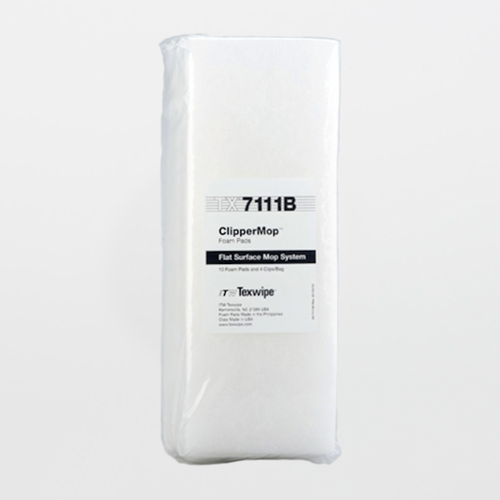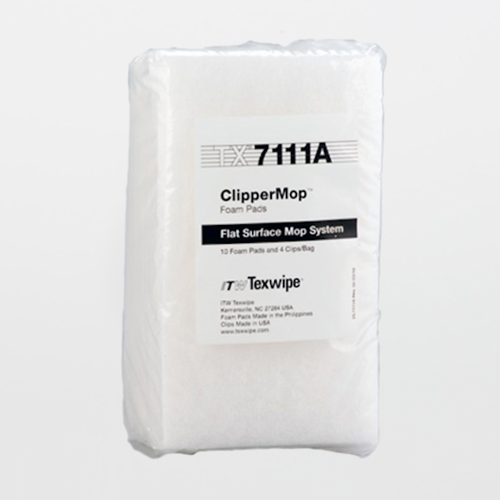
Texwipe STX7111A Sterile ClipperMop 7" x 4" Cleanroom Replacement Foam Pads (Refills)

$270.98
(No reviews yet)
SKU:
STX7111A CASE
Availability:
7 - 10 Business Days
Shipping:
Calculated at Checkout
Quantity Option (Case):
100 Foam Pads and 40 Fasteners Per Case (10 Bags of 10 Foam Pads and 4 Fasteners)
Type:
Dry Mop
Sterile:
Yes
Texwipe STX7111A Sterile ClipperMop™ Replacement Foam Pads — 7" x 4" Pads with Fasteners (Case)
STX7111A is a sterile (gamma-irradiated) replacement pad set used in the Texwipe ClipperMop™ / Mini AlphaMop™ / Isolator Cleaning Tool™ ecosystem. The pads provide cushioning so the mop head can maintain uniform contact on uneven surfaces while the ClipperMop™ head secures standard cleanroom wipers via non-abrasive tethered clips. This is a practical control in critical environments because it supports consistent wiping pressure, reduces “skipping” on edges and corners, and helps teams replace the wiper frequently without changing the underlying mop assembly.

For over 35 years, SOS and Texwipe have been close partners, and SOSCleanroom is the authorized Master Distributor of ITW Texwipe for the United States market. That relationship matters when you are standardizing mop components for critical environments: it supports continuity of supply, stable product lineage, and fast access to the manufacturer documentation your QA/QC team expects.

Published configuration (STX7111A)
  • Part number / SKU: STX7111A (Case)
  • Pad size: 7" x 4" (17.8 cm x 10 cm)
  • Case quantity (published): 100 pads and 40 fasteners per case (10 bags/case; 10 pads + 4 fasteners per bag)
  • Sterile: Yes (gamma irradiated; Sterility Assurance Level 10-6 per AAMI guidance, as published)
  • Packaging (sterile, published): Triple-bagged for easier introduction into sterile/aseptic areas
  • Category / type: Dry mop accessory (replacement pad set)
  • Availability (SOS listing): 7–10 business days
  • Weight (SOS listing): 3.00 lbs
Sterile pad discipline is a contamination control — not just a convenience
In critical environments, the pad set is part of the “wet path.” Treat it like a controlled component: introduce it using your sterile transfer practice, keep the inner bag closed until point-of-use, and replace pads when compression set, residue loading, or clip wear starts to affect surface contact and cleaning consistency.

System compatibility (what it fits, and why it matters)
Compatible tool / system How STX7111A is used Technician note (critical environments)
ClipperMop™ 7" system (TX7102 / TX7112 head assembly) Provides cushioning to support uniform contact while wipers are clipped to the head If the pad is compressed or uneven, you will see streaking and incomplete wetting at edges and seams.
Mini AlphaMop™ / Isolator Cleaning Tool™ (TX7101 / TX7105) Replacement pad kit used to maintain consistent face loading and cleaning efficiency In isolators/RABS, pad condition is often the difference between controlled wiping and “snag and release” that can aerosolize residues.
SOS listing includes TX7104 Listed by SOS as compatible If TX7104 is in your program, confirm fit and wring/clip clearance on your exact configuration before full standardization.

Practical cleanroom use guidance (technicians and engineers)
  • Build a predictable “wet path”: Standardize a routine: (1) install fresh pad if needed, (2) load approved wiper(s), (3) apply solution per SOP (or use pre-wetted wipers when specified), (4) wipe in controlled strokes, (5) replace the wiper before it dries out or redeposits residues.
  • Control pressure to prevent streaking: Excessive force compresses the pad and can cause uneven contact that leaves “skip lines.” Use moderate, repeatable pressure and overlap passes.
  • Edge and corner technique: Use the low-profile swivel head intentionally—do not “scrub” hard corners. If residue requires mechanical action, switch to the validated tool/material for that task rather than overloading the mop head.
  • Change-out triggers: Replace the pad when it shows compression set, tearing, loss of rebound, or when repeated cycles start to produce visible streaking on reflective floors or stainless panels.
  • Wiper change discipline: The ClipperMop™ concept is designed to make wiper replacement easy. In critical environments, frequent wiper changes reduce redeposition risk and support consistent chemical contact time.

Sterile packaging, traceability, and shelf-life controls
Control Published detail Implementation note
Sterility assurance Gamma irradiated to SAL 10-6 (AAMI guidance, as published) Align receiving inspection to sterility documentation expectations (COC/COA/irradiation certificate when required by the program).
Bagging configuration Triple-bagged (sterile configuration) Use a staged transfer: remove outer bags in lower-grade space, bring inner bag into the critical zone, open only at point-of-use.
Shelf life Sterile: 3 years from date of manufacture (as published) FEFO (first-expire, first-out) helps prevent “just in case” staging that later becomes a deviation during audits.
Storage conditions Ambient 59°F–86°F (15°C–30°C), as published Avoid staging cases near exterior doors or hot mechanical rooms; temperature swings can stress packaging integrity over time.

Typical application map (where STX7111A is used)
These applications are published for the ClipperMop™ system and the broader mop-pad line to support qualification planning and SOP development.
  • Surfaces: Walls, floors, ceilings, hoods, isolators, and other confined or hard-to-reach areas (low-profile swivel head use case)
  • Process roles: Applying and removing cleaning solutions and disinfectants; spill control; routine area cleaning
  • Chemistries (published for the pad line): Solvents such as IPA and ethanol, and oxidizers such as hydrogen peroxide (qualify concentration/dwell time per site SOP)

Common failure modes 
  • Streaking / residue redeposition: Usually from an overloaded wiper, uneven pad compression, or running the wiper too dry. Prevent with frequent wiper changes, controlled pressure, and maintaining validated wet contact time.
  • Pad compression set: Repeated cycles can flatten the pad, reducing conformity on uneven surfaces. Prevent by defining pad change intervals and replacing when rebound is reduced.
  • Fastener/clip issues: Misalignment or worn tether clips can cause wiper slippage or edge lifting. Prevent by inspecting clips/fasteners during change-out and replacing damaged components promptly.
  • Cross-contamination by chemistry carryover: Pads and wipers can transport residues between areas if tools are not segregated. Prevent with tool zoning, color-coding, and chemistry-family segregation per SOP.
  • Packaging compromise: Torn bags, wet cartons, or broken seals undermine sterile transfer intent. Prevent by training receiving/staging teams and rejecting compromised sterile packaging.

Storage and handling best practices
  • Keep sterile pads in original case packaging until needed; stage inner bags in a closed cabinet or covered cart to protect packaging integrity.
  • Use FEFO rotation and record lot information in your cleaning log when required by the program.
  • Segregate mop components by area (Grade A/B vs. C/D) and by chemistry family to reduce cross-contamination risk.
  • Do not place pad bags on floors, lower cart shelves, or uncontrolled staging areas; treat sterile packaging as part of the controlled system.
Documentation 
SOS-hosted Texwipe ClipperMop™ datasheet (TX7102/TX7103/TX7111A/TX7111B/TX7102C): Click Here
Texwipe manufacturer TDS (ClipperMop™ Series, US-TDS-058 Rev. 11/21): Click Here
Texwipe manufacturer TDS (Flat Mop Replacement Pads, includes STX7111A): Click Here
Texwipe manufacturer page (STX7111A): Click Here
If you have any questions please email us at Sales@SOSsupply.com or give us a call at (214)340-8574.

Check out our AI ChatBot powered by SOSCleanroom data libraries - give it a try!
 
THIS IS NEW FOR 2026!

Last updated: January 9, 2026
© 2026 SOS Supply. All rights reserved.
The Technical Vault Sterile Detail-Zone Flat Mop Performance Control (Applied Use Case: Texwipe™ STX7111A Sterile ClipperMop™ 7" x 4" Replacement Foam Pads — Refills)

Purpose & Scope

The STX7111A are sterile replacement foam pads used with the ClipperMop™ 7" x 4" platform—commonly selected for tight detail zones such as corners, equipment bases, narrow aisles, thresholds, and hard-to-reach interfaces. In sterile housekeeping, the foam pad is a pressure-distribution layer that influences wetting uniformity, pickup consistency, and the likelihood of streaking or residue. This entry focuses on sterile handling discipline and objective pad lifecycle control.

Visual Aids (Technique, Zoning, Lifecycle)

Use this graphic to reinforce unidirectional technique, zone control, and consumable lifecycle discipline for sterile detail-zone work.

Cleanroom mopping technique, zoning control, and mop tool lifecycle diagram

Implementation note: In sterile zones, treat foam pads as controlled consumables—define entry, handling, seating, and change-out triggers.

Sterile Handling Discipline (The Most Common Failure Mode)

The most frequent breakdown in sterile pad use happens during setup: sterile pads are handled with gloves that already touched non-sterile tool parts, cart rails, door hardware, or bucket exteriors. If your workflow expects sterile intent, define how pads are presented and seated without touch contamination.

  • Open at point-of-use: avoid staging opened sterile packs.
  • Glove transfer control: if gloves touch non-sterile surfaces, do not handle sterile pads without a defined protocol.
  • Protect the pad face: do not set pads on counters, bucket rims, or carts during setup.

Why Foam Pads Matter in 7" x 4" Detail Work

Small-head detail mops amplify surface-contact variability. The foam pad helps create more uniform contact across the head, improving consistency when cleaning tight zones. When pads lose rebound or become residue-loaded, issues appear quickly: rail lines, uneven wetting, and lane defects.

  • Uniform pressure: reduces striping in short, controlled strokes.
  • Consistent wetting: stabilizes solution release across the head.
  • Improved pickup: supports controlled removal rather than pushing residues around.

Pad Seating & Assembly (Prevent Lane Defects Before They Start)

  • Center the pad: misalignment creates edge bias and repeated striping.
  • Confirm flatness: a folded pad can create immediate rail lines.
  • Inspect tool interfaces: residue at head/pad contact points can “print” into the lane.
  • Secure retention: ensure pad remains stable during repositioning in tight zones.

Lifecycle Management (Objective Change-Out Triggers)

Foam pads usually degrade gradually. In sterile environments, it is best practice to define objective triggers that prevent performance drift and reduce investigation workload.

  • Replace after a performance signal: persistent streaking/striping after a cover change.
  • Replace after inspection signal: compression set, deformation, embedded debris, tacky residue, odor.
  • Replace after a zone transition: do not move pads between rooms/zones unless SOP defines reprocessing.
  • Replace after a packaging breach: torn sterile packaging, dropped pad, or uncontrolled staging event.

Details Most Sites Skip (But Matter in Sterile Detail Zones)

  • “Touch zoning” for gloves: define what happens if gloves touch bucket rims or cart rails during pad setup.
  • Rail-line troubleshooting order: swap to a new cover/pad and fresh solution before changing chemistry.
  • Rest-point control: define where the mop may be staged during pauses to prevent recontact.
  • Documentation simplicity: tie pad change-out to room/shift/solution-batch events for audit clarity.

SOP & Audit Readiness Checklist (Sterile Foam Pads)

  • Define sterile entry/staging and opening-at-point-of-use rules.
  • Define glove management for pad handling and seating (transfer prevention).
  • Define seating verification steps (centering, flatness, retention).
  • Define objective change-out triggers (performance + inspection + zone boundaries).
  • Include pad condition as a root-cause category in streaking/rail-line investigations.

Disclaimer: This Technical Vault content is provided for educational purposes only. Manufacturer instructions, facility SOPs, and site-specific risk assessments must always take precedence. Sterile housekeeping programs must follow validated entry, handling, disinfectant contact time, and documentation requirements per your quality system.

© SOSCleanroom. All rights reserved.