Practical solutions in a critical environment
In regulated and ISO-aligned cleanroom programs, “sterile” is not a label — it is a workflow requirement with consequences. The failure mode is familiar: a surface sample is collected with a non-sterile or repackaged swab, the record is incomplete, and an excursion or audit turns routine monitoring into a documentation gap. Even when the lab method is strong, weak consumable control (unknown lot, unknown expiry, unclear sterility presentation) undermines customer trust in the data.
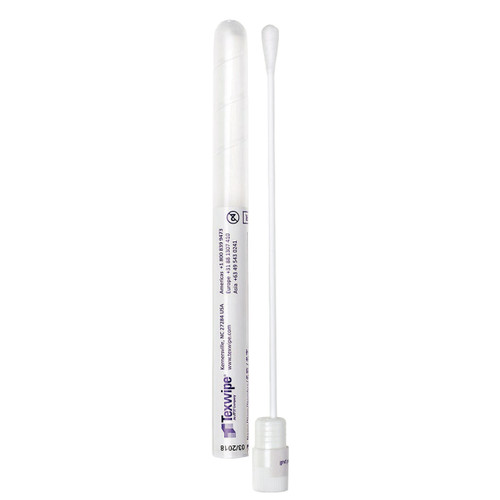
STX764 is built for that real-world constraint. It is a sterile, individually packaged spun polyester swab designed to present sterility at point-of-use, keep lot traceability tied to the unit you actually opened, and reduce “bench improvisation” (rebagging, relabeling, autoclave workarounds) that creates method variability and audit risk. Each sleeve is lot coded and expiration dated, and the system is designed around controlled introduction into sterile areas through multi-layer bagging.
Low-linting outcomes depend on technique, surface condition, and wetness control. No swab is truly lint-free; pressure, edge sharpness, solvent load, stroke discipline, and particle loading determine what ends up on the part or in the sample.
What is this swab used for
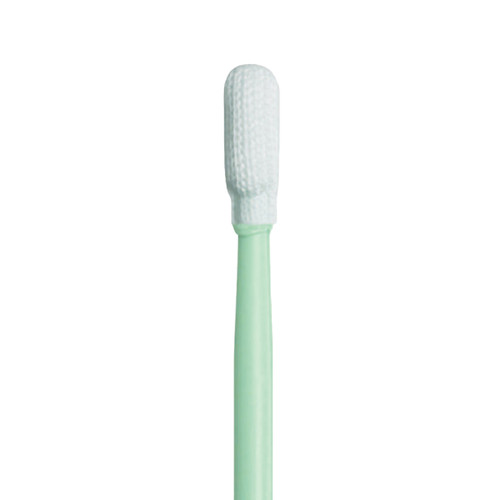
Texwipe STX764 is used for sterile surface sampling and environmental monitoring when the sampling site is small, recessed, irregular, or difficult to reach with contact plates or wipes. The small spun-polyester head supports controlled sampling strokes on tight geometries while the long handle provides reach and directional control.
It is also used for controlled cleaning in and around critical environments with common solvents such as IPA (and, in some series literature, acetone — see solvent/handle compatibility guidance below). Typical use cases include diagnostic sampling, routine environmental monitoring, and targeted wipe-downs where individually packaged sterility and unit-level traceability matter as much as geometry access.
Why should customers consider this swab
- Individually packaged peel-apart sleeves help preserve point-of-use sterility and reduce handling ambiguity.
- Unit-level traceability: each sleeve is lot coded and expiration dated to support inventory control and investigations.
- Designed for sterile introduction: 50 sleeves are triple-bagged, and triple-bagged bags are placed in a case liner for a fourth protective layer.
- Gamma irradiation sterility model: described as SAL 10-6 and validated according to AAMI-aligned guidance.
- Small head and long handle support repeatable access and stroke discipline on tight sampling sites.
- Manufacturer states the sterile spun swab family is tested for endotoxins, ions, and nonvolatile residue (NVR), supporting method-risk thinking rather than commodity assumptions.
- SOSCleanroom’s long-standing partnership with ITW Texwipe supports continuity of supply and documentation discipline, reducing unplanned substitutions that can disrupt validated monitoring methods.
Method note: solvent and handle compatibility matters
STX764 uses a polystyrene handle. Polystyrene has poor resistance to ketones such as acetone in common compatibility charts. If your SOP includes acetone or other aggressive solvents, qualify the complete method (swab + solvent + dwell time + contact pressure) or move to a swab with a more solvent-tolerant handle material and re-validate the recovery/cleaning behavior before routine use.
Materials and construction
Head: 100% USP-grade spun polyester
Head bond: water-based adhesive (adhesive bond line at head/handle interface)
Handle: polystyrene; long, semi-rigid format; handle color: white
Practical implication: spun polyester is a strong general-purpose sampling media, but adhesive-bonded spun constructions behave differently than thermally bonded knit or foam swabs in solvent-wet wiping. If your process is film-sensitive (haze, streaking, optics/coatings), qualify swab type by inspection method and chemistry, and do not assume “sterile” implies “lowest background” for residue-driven investigations.
Specifications in context
STX764’s head is 4.6 mm wide with a 17.0 mm head length — a geometry that fits small sampling sites and narrow contact zones. Use the head width to standardize lane overlap and stroke count so recovery trends do not become operator-dependent. The long handle (manufacturer table lists 134.0 mm) supports reach into recessed features; if reach is critical, confirm your required insertion depth and maintain a controlled “no-touch” technique to avoid glove/packaging contact with the sampling surface.
| Attribute |
STX764 |
| Head material |
Spun polyester (USP-grade) |
| Head width |
4.6 mm (0.181") |
| Head thickness |
4.6 mm (0.181") |
| Head length |
17.0 mm (0.669") |
| Handle material |
Polystyrene |
| Handle width |
2.5 mm (0.098") |
| Handle thickness |
2.5 mm (0.098") |
| Handle length |
134.0 mm (5.276") (manufacturer table) |
| Total swab length |
155.0 mm (6.102") |
| Head bond |
Water-based adhesive |
| Handle color |
White |
| Design notes |
Small spun head; long polystyrene handle; individually sleeved sterile presentation |
Cleanliness metrics
For sterile sampling swabs, “cleanliness” must be interpreted in the context of method bias. Manufacturer literature for the sterile spun swab family states the swabs are tested for endotoxins, ions, and nonvolatile residue (NVR), and the series technical data sheet notes that tabulated values represent typical analyses (not per-unit specifications). Operationally, that means you should qualify the full sampling method (swab + wetting agent + container + transport time + lab recovery) so the swab does not become the dominant background signal in your assay.
What is published vs. what you should verify (practical view)
| Metric area |
How to use it responsibly |
| Endotoxins |
Treat “tested” as a method-risk signal. If endotoxin matters to your program, validate recovery and background using your wetting strategy, extraction volume, and hold time. |
| Ion extractables |
If your assay is ion-sensitive, qualify the swab with your specific extractant and lab method. Ask for test methods or lot-level documentation when your investigation posture requires it. |
| NVR / residue background |
For residue-sensitive cleaning validation, confirm that adhesive-bonded spun polyester is acceptable under your solvent and inspection method. Define stroke count and discard triggers to prevent smear and redeposition. |
Operator takeaway: sterility does not remove technique risk. Keep wetness controlled, define stroke counts, and document the area, method, and lot so results are defensible across operators and shifts.
Packaging, sterility and traceability
- Packaging (STX764, manufacturer format): 1 swab per peel-apart sleeve; 50 sleeves per inner bag (triple-bagged); 10 bags per case (500 swabs total per case).
- Sterility model: described as gamma irradiated to SAL 10-6 and validated according to AAMI-aligned guidance; sterile per the product’s validated presentation model.
- Traceability cues: lot-coded sleeves with expiration dates support inventory control and investigations; case-level documentation is described as including irradiation and compliance confirmation.
- Shelf life (series statement): sterile swabs — 3 years from date of manufacture.
- Country-of-origin (series statement): sterile — made in the Philippines; gamma-irradiated in the U.S.
Best-practice use
Treat STX764 as a controlled sampling instrument, not a general bench swab. Your goal is repeatable recovery and defensible documentation. Define the area sampled, define wetness control, define stroke count, and define how samples are labeled, transported, and stored so results can be trended across time and operators.
Operator-level swabbing technique module
- Sterile presentation discipline: Open only at point-of-use. Stage the bag layers to match your area classification. If a sleeve is torn early or handled outside the intended sterile introduction steps, discard it — do not “save it for later.”
- “Damp” wetting technique: If wet sampling is required, use controlled aliquots (single-use vial or measured dispense). Avoid re-dipping into a shared reservoir. Wet enough to transfer and lift, not enough to flood and smear.
- Stroke count logic: Use unidirectional strokes with consistent overlap. Standardize a lane width and a fixed number of passes per area. Rotate the swab as it loads; do not keep sampling with a visibly loaded head.
- Pressure guidance: Use the minimum pressure that maintains contact. High pressure increases abrasion risk and can bias recovery by forcing material into surface texture rather than capturing it.
- Chain-of-custody basics: Label immediately (lot, expiry, location, area sampled, time, operator). Control hold time and storage conditions per your SOP so recovery does not become time-dependent noise.
- Method qualification cue: If the results will be defended (batch investigation, validation, audit), qualify the method on representative surfaces and include the swab as a controlled variable — not a “given.”
Common failure modes
- Breaking sterile boundary during introduction (opening too early, touching the head/sleeve interior, poor layer control).
- Undefined sampling area and inconsistent stroke counts, making trending and comparisons unreliable.
- Over-wetting and smearing residue across the surface instead of capturing it.
- Re-dipping into a shared wetting reservoir, creating cross-contamination and uncontrolled chemistry variability.
- Using aggressive solvents without validating polystyrene handle compatibility, risking softening/crazing and introducing method artifacts.
Closest competitors
The closest alternatives are sterile polyester sampling swabs with individually wrapped presentations. Selection usually hinges on sterility presentation method (sleeve + bag layers), unit-level traceability (lot/expiry on the unit), and whether supplier documentation supports your investigation posture.
- Puritan sterile polyester-tipped applicator formats (polystyrene-handle class): Often used in diagnostic and environmental sampling. Compare unit-level lot/expiry marking, packaging layers for sterile introduction, and documentation availability.
- Copan or equivalent sterile sampling swab systems (where applicable): Evaluate based on chain-of-custody workflow fit (labeling, transport expectations) and compatibility with your media and lab recovery method.
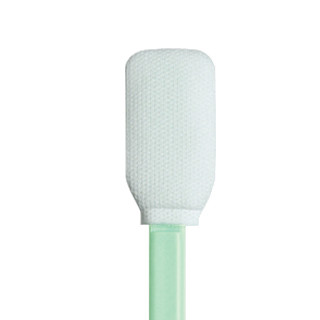
- Texwipe STX763 (large-head sterile spun polyester): Same sterile spun polyester family with a larger head for broader contact sampling when STX764 is too small for the area and coverage you need.
Critical environment fit for this swab
STX764 is a strong fit for sterile sampling workflows and small-site environmental monitoring where point-of-use sterility, unit-level traceability, and consistent geometry access are key. It is particularly useful for tight features, recessed surfaces, and controlled zones where “how the sample was taken” must be defendable, not just repeatable.
In ISO-aligned and regulated environments, documentation expectations frequently track standards-driven methods and quality-system thinking. ISO 14644-1 provides the framework for cleanroom air classification, while ISO 11137 provides the radiation sterilization dose and SAL context often referenced in sterile consumable validation discussions. SOSCleanroom’s relationship with ITW Texwipe supports continuity of supply and documentation discipline, reducing the risk of unplanned substitutions that can destabilize validated monitoring methods.
Operational support matters. Fast shipping and responsive customer service help protect validated work instructions by preventing “make-do” material swaps when schedules tighten.
Source basis
- SOSCleanroom product page (STX764): https://www.soscleanroom.com/product/clearance-deals/texwipe-stx764-sterile-small-polyester-swab/
- Texwipe manufacturer product page (STX764): https://www.texwipe.com/sterile-polyester-stx764
- Texwipe technical data sheet: “SPUN SWAB SERIES — TECHNICAL DATA SHEET” (US-TDS-053 Rev.09/21): https://www.texwipe.com/images/uploaded/documents/Swabs/Texwipe-Spun-Swabs-TDS.pdf
- International Organization for Standardization (ISO) reference (ISO 14644-1:2015): https://www.iso.org/standard/53394.html
- International Organization for Standardization (ISO) reference (ISO 11137-2:2013 radiation sterilization dose/SAL context): https://www.iso.org/standard/62442.html
- FDA (Food and Drug Administration): https://www.fda.gov/
- ASTM (American Society for Testing and Materials): https://www.astm.org/
- IEST (Institute of Environmental Sciences and Technology): https://www.iest.org/
- Polystyrene solvent compatibility reference (acetone rated poor in a published chart): https://kmac-plastics.net/data/chemical/polystryrene-chemical-resistance.htm
SOSCleanroom is the source for this Technical Vault entry.
Briefed and approved by the SOSCleanroom (SOS) staff.
Last reviewed: January 6, 2026
© 2026 SOSCleanroom