The Technical Vault
By SOSCleanroom
Laser-Edge Absorption at Scale: Why TX42 Vertex Delivers Spill Control Without Sacrificing Cleanroom Discipline
Last reviewed: Jan. 3, 2026 | Audience: contamination control, cleanroom operations, EHS, quality
Texwipe TX42 Vertex (12" × 12") is a dry, high-sorption, continuous-filament polyester knit cleanroom wiper with a laser-cut edge designed for demanding wipe-downs where absorbency and surface coverage matter as much as contamination control. It is engineered to reduce the “more wipes than expected” problem during spill response and wet cleaning, while still publishing the contamination characteristics (particles, fibers, NVR, ions) quality teams need to place it responsibly.
Operational reliability is part of the control plan. SOSCleanroom supports continuity of supply and documentation handoff so programs can avoid last-minute substitutions that change absorbency, edge behavior, and residue background.
What it’s for
TX42 is best used for spill control, wet wipe-downs of benches and equipment exteriors, and routine cleaning steps where large-format coverage reduces passes and reduces “wipe-and-chase” behavior. It is also a strong fit for applications that benefit from a softer knit hand feel on delicate surfaces, while still requiring a cleanroom-grade contamination profile.
Decision drivers
TX42 earns its place when the facility needs absorbency without letting the wiper become the uncontrolled variable:
- High-sorption knit architecture: designed to reduce the number of wipes consumed in spill control and wet wipe-downs.
- Laser edge strategy: supports cleaner edge behavior than basic cut edges in many wipe patterns, especially when faces are rotated aggressively.
- Cleanliness framework: published typical values for particles/fibers, NVR, and ions support qualification discussions and change control.
- Process controls beyond the substrate: Vertex manufacturing is described as integrated clean/convert/package in a hands-free micro-environment, supporting consistency as a program lever.
- Packaging discipline: bagged presentation and case configuration support controlled introduction and staged use.
Program note: If “spill cleanup” is routinely escalating into re-clean or residue complaints after dry-down, the first fixes are typically
face rotation, wetness control, and defined wipe roles (spill/routine vs. final-pass), not “wiping harder.”
Materials and construction – explained like an engineer
“Polyester wiper” is an incomplete spec. What matters is continuous-filament polyester versus staple fiber constructions that can generate more loose ends under abrasion. TX42 is described as a 100% continuous-filament polyester knit, which is engineered to maintain integrity when folded into quarters, pushed into corners, or dragged across stainless and coated equipment surfaces.
The laser edge matters because the edge is often the first place shedding and stringers show up when operators rotate faces aggressively. Laser cutting is used to stabilize the perimeter relative to basic cut edges, particularly in wet wiping where edge fibers can mobilize and redeposit.
Specifications in context
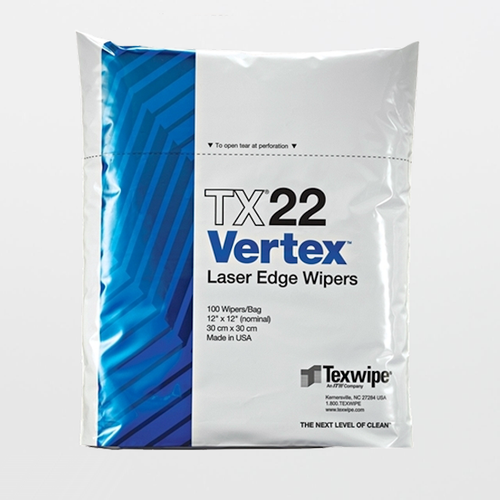
TX42 is a 12" × 12" nominal (30 cm × 30 cm) laser-edge wiper packaged 100 wipers per bag and 10 bags per case. The 12" × 12" format is a practical control size for wet cleaning: it provides coverage and absorbency without forcing multiple small wipes (which often increases handling touches and pass count).
The Vertex family also includes a pre-wetted counterpart (TX42P) for programs that need standardized wetness (70% USP-grade IPA / 30% DI water) rather than technician-dependent solvent loading.
Cleanliness and performance metrics
Treat published values as typical performance (a qualification starting point), not a contractual specification. For many facilities, the risk model is:
(1) releasables (particles/fibers), (2) residues (NVR), and (3) ions.
-
Absorbency (spill reality): typical sorptive capacity 450 mL/m² and sorptive rate 0.3 seconds. Translation: designed to wet quickly and hold enough liquid to reduce wipe count during spill pickup and wet wipe-downs.
-
Releasables: typical ≥0.5 µm LPC 9.5 × 10⁶ particles/m² and fibers >100 µm 200 fibers/m². Translation: a controlled profile for a high-sorption knit, but still gate it appropriately versus sealed-edge “final-touch” wipers when defect sensitivity is highest.
-
NVR (film risk after dry-down): typical 0.02 g/m² (IPA extractant) and 0.01 g/m² (DI water extractant). Translation: residue outcomes are strongly technique-driven—wetness control, face rotation, and discard rules matter.
-
Ions (corrosion/ECM sensitivity): typical chloride <0.05 ppm, sulfate <0.02 ppm, sodium <0.17 ppm, calcium <0.10 ppm, magnesium <0.01 ppm (others ND as listed). Translation: for corrosion-sensitive assemblies and high-impedance electronics, ionic control is a mechanism—not a paperwork metric.
Why the Vertex process matters operationally
Vertex manufacturing is described as cleaning, converting, and packaging wipers in an integrated, hands-free micro-environment, with production in an ISO Class 3 environment. Practically, this is a consistency lever: if the goal is fewer investigations and fewer “it used to work” complaints, stable converting and packaging controls matter as much as the fabric.
Best-practice use
TX42 performs best when technique treats the wiper as a controlled tool, not a paper towel:
- Quarter-fold for control: build multiple faces and rotate faces aggressively.
- Single-direction passes: parallel, overlapping strokes; avoid casual back-and-forth scrubbing that redistributes soils.
- Wetness discipline: aim for damp wiping unless the SOP requires a wet contact time; over-wetting increases pooling and residue after dry-down.
- Discard rules: once near saturation or visibly loaded, the wipe becomes a redistribution tool—replace early.
- Role separation: use TX42 for spill/routine wet cleaning; reserve a lower-shedding, edge-controlled wiper for the most defect-sensitive final passes.
Common failure modes — and how TX42 helps
A high-absorption wiper fails in predictable ways: operators overwork a saturated face, flood seams with excess solvent, or use a spill-control tool as a final-touch wiper. TX42 helps by reducing wipe-count pressure (high sorption) and stabilizing edge behavior (laser edge), but the remaining controls are procedural: face rotation, directional strokes, and defined wipe roles by step criticality.
Terminology note: TX42 is engineered for low-linting performance; no wiper is truly “lint-free” in every process condition.
Closest comparators
The most defensible comparisons are to other cleanroom-grade wiping systems intended for similar wet-cleaning and spill-control roles:
Contec Anticon® Gold (StandardWeight) is commonly evaluated when a facility wants a well-known cleanroom knit for routine wiping with a different fabric/hand-feel and edge profile. The key comparison points are releasables under wiping force and how the wipe behaves when saturated.
Berkshire Ultra-Seal™ 3000 is the appropriate comparator when edge control becomes the primary acceptance driver (sealed-edge posture) while still maintaining a strong cleanroom documentation framework.
Rule of thumb: When edge-driven fibers are the limiting factor, sealed-edge/sealed-border is often the next control step. When wetness repeatability is the constraint, standardize solvent loading or move to a controlled pre-wetted system.
Where TX42 fits in a cleanroom wiping program
TX42 is a strong choice for programs that need a high-absorption, large-format polyester knit wiper for spill response and wet wipe-downs—paired with published contamination characteristics that support disciplined placement. Keep the program stable by separating roles:
(1) spill/routine wet cleaning (TX42), (2) residue- and particle-sensitive final-pass wiping (typically a higher edge-control polyester knit), and (3) validation-sensitive sampling (method-aligned consumables and written controls).
Source basis
- SOSCleanroom product page: “Texwipe TX42 Vertex 12" × 12" Polyester High Absorption Laser Edge Cleanroom Wiper” (SKU positioning and onsite content context). https://www.soscleanroom.com/product/clearance-deals/texwipe-tx42-vertex-12-x-12-polyester-high-absorption-laser-edge-cleanroom-wiper/
- ITW Texwipe datasheet (via SOSCleanroom PDF): “Vertex™ High Sorption Wipers” (TX42 construction; Vertex process description; ISO Class 3 manufacturing statement; packaging; typical absorbency, LPC, fibers, NVR, ions; typical-value disclaimer). https://www.soscleanroom.com/content/texwipe_pdf/42%2049%2042p%2049p.pdf
- Comparator category context (positioning): Contec Anticon® Gold (StandardWeight) and Berkshire Ultra-Seal™ 3000 product information (edge strategy, intended use, documentation posture).
Source: SOSCleanroom Technical Vault | Last reviewed: Jan. 3, 2026
© 2026 SOS Supply. All rights reserved.