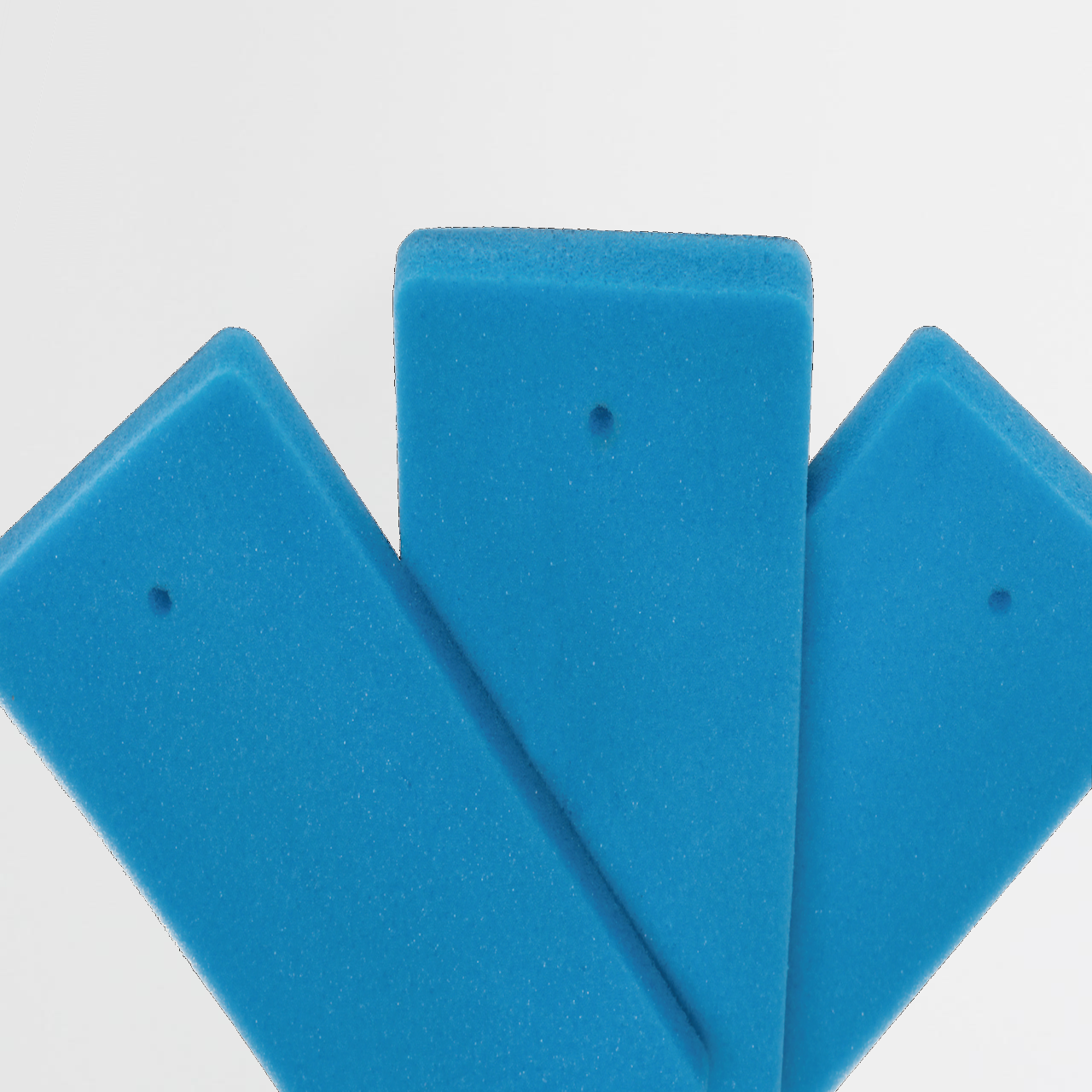
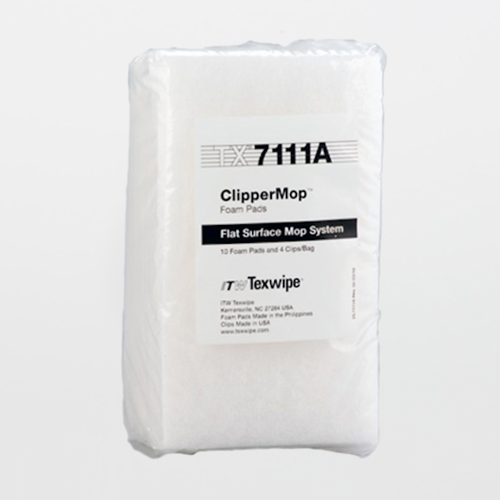
Texwipe TX7124 Mini AlphaMop™ Blue Foam Replacement Pad Kit — 7" x 4" (17.8 cm x 10 cm)
TX7124 is a blue foam replacement pad kit for the Mini AlphaMop™ / Isolator Cleaning Tool system, built for controlled, repeatable small-area cleaning where you need consistent surface contact and a foam reservoir for cleaners and disinfectants. This item is listed as discontinued by Texwipe, so it is typically used to support legacy programs that have already qualified the Mini AlphaMop™ pad format.
For over 35 years, SOS and Texwipe have been close partners, and SOSCleanroom is the authorized Master Distributor of ITW Texwipe for the United States market. That relationship matters in critical environments: it supports continuity of supply, stable product lineage, and fast access to the manufacturer documentation your QA/QC team expects.
Published configuration (TX7124)
- Pad size: 7" x 4" (17.8 cm x 10 cm)
- Pad construction: Blue polyester-polyurethane foam
- Kit contents (case unit): 5 bags of 15 blue foam pads and 4 clips (75 pads and 20 clips total)
- Type: Dry mop pad kit (used dry until charged with solution per your SOP)
- Autoclave compatibility: Autoclave safe (as published)
- Traceability: Individually lot coded (as published)
- Regulatory program relevance: Meets USP <797> and USP <800> requirements (as published)
- Cleanroom environment: ISO Class 3–8 (Class 1–100,000); EU Grade A–D (as published)
- Shelf life: Non-sterile – 5 years from date of manufacture (as published)
Critical-environment reminder — pad kits behave like contamination-controlled components
Foam pads can deliver excellent, uniform contact, but they also hold and move chemistry. Control how pads are introduced, how they are charged with solution, and how often they are changed. The biggest real-world risks are re-deposition (dirty pad kept in service too long), residue (over-wetting and poor dry-time control), and mechanical damage (pad snagging on sharp edges).
What this kit is used for
- Small-area cleaning: Controlled wiping/mopping of walls, floors, ceilings, and equipment exteriors where a compact head improves access.
- Spill control: Foam reservoir behavior can help manage small spills when used within your spill response SOP.
- Solution application and removal: Applying and removing cleaners/disinfectants with consistent contact pressure.
- Solvent-compatible workflows: Published applications include use with solvents such as IPA, ethanol, and hydrogen peroxide (qualify concentrations/contact times per your SOP).
Compatibility map (published)
Use this quick matrix to confirm where TX7124 fits when standardizing Mini AlphaMop™ components and keeping legacy tools in service.
| System / tool family |
Where it is commonly used |
How TX7124 fits |
| Mini AlphaMop™ / Isolator Cleaning Tool (TX7101, TX7104) |
Isolators, glove boxes, hoods, confined surfaces |
7" x 4" blue foam replacement kit for quick-change pad workflows |
| ClipperMop™ 7" (TX7102) |
Edges, small surfaces, equipment exteriors |
Listed as compatible pad size within the flat mop replacement pad family |
Kit contents (SEO-friendly breakdown)
| Packaging level |
Pads |
Clips / fasteners |
Notes |
| Per bag |
15 blue foam pads |
4 clips |
Quick-change pad control for frequent rotation |
| Per case |
75 blue foam pads (5 bags) |
20 clips (5 bags) |
Case unit listed on SOSCleanroom product page |
Practical cleanroom use guidance (technicians and engineers)
- Pad-change discipline: Rotation and change-out frequency should be set by your internal SOP and the specific contamination load. In practice, changing too slowly is the main driver of streaking and re-deposition.
- Charge the pad correctly: Use controlled dosing so the foam acts as a reservoir without over-wetting. Over-saturation is a common cause of residue, drip contamination, and extended dry times.
- Uniform contact pressure: Keep the head flat and use consistent strokes. Avoid digging the leading edge into surfaces (especially corners and door tracks) which can tear foam and release debris.
- Clip control: Ensure clips are fully seated and stable before entering the room. A loose clip can drag, scratch, or shed particles, and can also allow pad slip that ruins cleaning consistency.
- One-direction logic: Work from cleaner-to-dirtier areas and from higher-to-lower surfaces when applicable. Do not “backtrack” with a loaded pad into a cleaned zone.
Compatibility and chemistry notes
- Disinfectants and cleaners: The foam construction is published to provide a reservoir for applying cleaners and disinfectants. Always qualify concentration and contact time under your site SOP.
- Solvents (published examples): Use cases include solvents such as IPA, ethanol, and hydrogen peroxide. Control wetting level and allow full dry time before re-entry or equipment close-out to reduce residue and re-deposition risk.
- Autoclave cycles: Autoclave safe is published for the pad family. Confirm your cycle parameters and post-cycle drying performance under your qualification protocol before standardizing autoclaved pad workflows.
Common failure modes
- Streaking / residue: Typically driven by over-wetting, inconsistent contact pressure, or insufficient dry time. Prevent with controlled dosing and defined dwell/dry requirements in the SOP.
- Re-deposition: Dirty pads kept in service too long transfer soil back onto “cleaned” areas. Prevent by tightening pad-change triggers (time, area covered, or visual condition).
- Foam tearing / snagging: Sharp edges, burrs, and aggressive corner work can tear foam. Prevent with edge-aware technique and by retiring damaged pads immediately.
- Clip drag / surface marking: Improperly seated clips can drag and mark surfaces. Prevent with pre-use checks and consistent clip installation practice.
- Cross-contamination between zones: Moving pads or head assemblies between rooms without control introduces unknown chemistry/bioburden. Prevent with zone assignment and single-room use rules.
Storage and handling best practices
- Keep unopened bags in original packaging until point of use to reduce particulate deposition and handling contamination.
- Store in a clean, dry location away from solvent vapor exposure that can pre-load pads with residue or odor.
- Do not stage open pads on benches or carts. Stage within a controlled container or pouch to maintain state prior to installation.
- Define and document pad retirement rules (tear, clip damage, visible residue, loss of contact) as part of operator training.
Documentation
SOS-hosted Texwipe datasheet (Flat Mop Replacement Pads, TEX-LIT-TDS-049 Rev.00-06/18):
Click HereTexwipe manufacturer PDF (Flat Mop Replacement Pads, TEX-LIT-TDS-049 Rev.00-06/18):
Click HereTexwipe manufacturer page (Mini AlphaMop™ / Isolator Cleaning Tool family):
Click Here
If you have any questions please email us at Sales@SOSsupply.com or give us a call at (214)340-8574.
Check out our AI ChatBot powered by SOSCleanroom data libraries - give it a try!
THIS IS A NEW SOSCLEANROOM.COM FEATURE FOR 2026!
Last updated: January 9, 2026
© 2026 SOS Supply. All rights reserved.