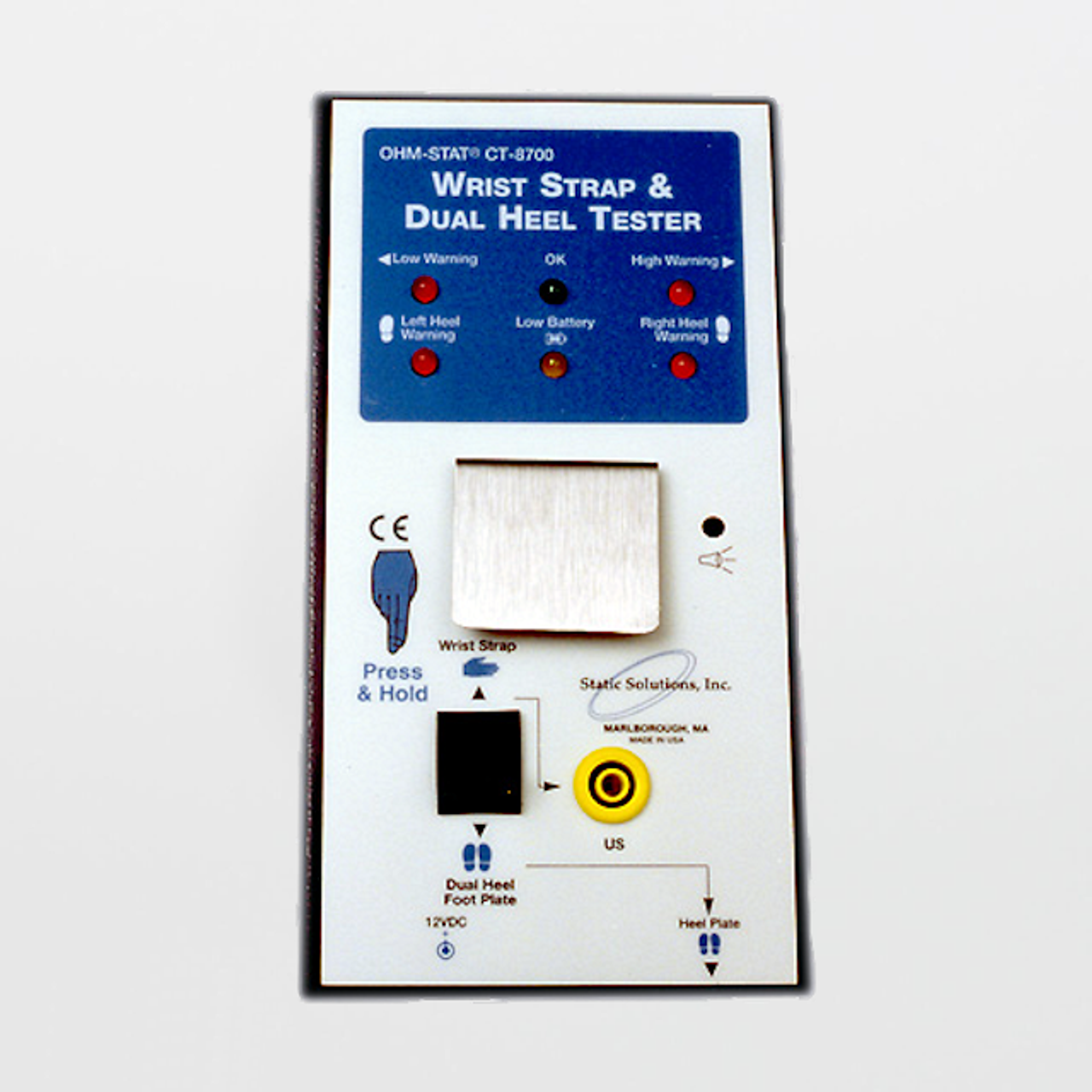
CT-8700 Combination Data Logger Tester without Computer Interface (Economy)

$529.94
(No reviews yet)
SKU:
CT-87xx
Availability:
7 - 10 Business Days
Shipping:
Calculated at Checkout
Static Solutions CT-8700 Combination Tester (Economy) — Wrist Strap + Heel Grounder Combo Tester (No Computer Interface), Pass/Fail Lights + Buzzer, Automatic Calibration, 100 kΩ to 100 MΩ (Option to 1000 MΩ), NIST Certificate Included
Combo Tester Wrist Strap + Heel Grounders No Computer Interface < 3 Second Test AC or DC Powered ESD Compliance Verification

Overview

The CT-8700 is a cost-effective, high-throughput wrist strap + heel grounder combo tester built for ESD Protected Areas (EPAs). It is positioned as the performance and accuracy of the CT-8900 platform without the computer interface—ideal when you want fast pass/fail verification and adjustable limits, without paying for reporting features you do not need.

In electronics cleanrooms, ESD control matters because personnel grounding is one of the primary controls protecting sensitive devices at the operator interface. In general manufacturing, repair benches, and lab environments, combo testing reduces rework risk and helps keep ESD discipline consistent at entry points.


Why combo testing matters (ESD safety control)
  • Reduces “unknown grounding” risk: verifies wrist straps and heel grounders before operators handle ESD-sensitive parts.
  • Improves compliance discipline: clear colored LEDs and an audible buzzer make results unambiguous during shift change and re-entry.
  • Speeds entry-point throughput: designed to test individual resistivity values in less than 3 seconds (as listed).
  • Supports mixed operations: useful in cleanrooms and non-cleanroom EPAs (electronics build, labs, repair, test-and-measure).

Kit options (choose the configuration that matches your entry point)
  • CT-8700 = Combo Tester + Footplate + Stand
  • CT-8725 = Combo Tester + Footplate
  • CT-8720 = Combo Tester (Tester Only)

Kit note (as listed): all kits include an accessory kit, except CT-8720 (tester only).


Key specifications (published)
What it tests Wrist straps and heel grounders (individually and simultaneously)
Pass/Fail indication Colored LED lights + buzzer; adjustable resistivity limits
Test speed Less than 3 seconds (as listed)
Measurement range 100 kΩ to 100 MΩ, with an option to 1000 MΩ
Calibration / documentation Automatic calibration; NIST certificate included
Connections supported Accepts domestic/foreign wrist straps, plugs, 4 mm or 10 mm snaps, and dual stereo plugs
Power AC or DC powered
Mounting Stand-mounted or wall-mounted
Standards (as listed) Conforms to US EOS-20/20 standard and European standards; also described as conforming to US and European CECC standards/specifications
Warranty 1-year warranty (as listed)

Why buy ESD entry-point testers from SOSCleanroom
  • One-vendor ESD workflow: tester + wearables + consumables + signage + verification tools, all standardized under controlled SKUs.
  • Practical ESD program support: we serve cleanroom electronics and non-cleanroom EPAs with real-world implementation experience.
  • Operational convenience: free shipping is offered on qualifying orders over $1,000 (per site listing) and Auto-Ship is available for recurring consumables.

Recommended pairings (complete the ESD entry point)

If you have any questions please email us at Sales@SOSsupply.com or give us a call at (214)340-8574. OR check out the AI ChatBot powered by SOSCleanroom data libraries - give it a try! THIS IS NEW FOR 2026! © 2026 SOSCleanroom. All rights reserved.
The Technical Vault
Entry-Point ESD Control: Why Combo Testing Prevents “Silent Failures” in Electronics Handling
Using Static Solutions CT-8700 as the example: fast wrist strap + heel grounder verification, without computer interface complexity.
Product Focus: CT-8700
Category: ESD — Combination Tester
Personnel Grounding Compliance Verification Cleanroom Electronics + General Industry EPAs Fast Entry-Point Testing

ESD program failures are often “silent.” A worn heel grounder, a damaged coil cord, or poor skin contact on a wrist strap may not look like a problem—until a sensitive component is handled and a defect appears later. This is why strong ESD programs treat personnel grounding as a first-order control.

Industry frameworks such as ANSI/ESD S20.20 and IEC 61340-5-1 emphasize establishing and maintaining an ESD control program. In practical operations, that means you need a repeatable method to verify grounding devices and keep that verification consistent across shifts, entry points, and sites.


1) Why personnel grounding is emphasized in ESD control programs

In an ESD Protected Area (EPA), personnel are a major source of charge generation. Program guidance commonly distinguishes between seated and standing work: seated operators are typically grounded via a wrist strap system, and standing operators via a wrist strap or footwear/flooring system (per program requirements).

In electronics cleanrooms, ESD controls protect devices at the operator interface. In non-cleanroom electronics production, repair benches, and labs, ESD controls reduce rework and “no fault found” returns by lowering latent defect risk.


2) Why combo testing is a best-practice entry-point workflow

Entry points are where ESD discipline either happens automatically—or slowly disappears. Separate testers can create bottlenecks and skipped steps. Combo testing is operationally efficient: one position, one routine, clear pass/fail feedback, then proceed to work.

The CT-8700 is designed to test wrist straps and heel grounders individually and simultaneously, display pass/fail using different colored lights and a buzzer, and do so in less than 3 seconds (as listed). It is positioned as the CT-8900 combo tester performance and accuracy without the computer interface—“don’t pay for features you don’t need.”


3) The compliance verification concept (why testing is expected)

ESD programs are typically documented through an ESD Control Plan and maintained through training, equipment control, and compliance verification. Technical reports such as ANSI/ESD TR53 exist specifically to provide periodic verification test methods and troubleshooting guidance to help users comply with the compliance verification plan requirements of ANSI/ESD S20.20.

Where CT-8700 fits
  • Daily/entry-point routine: confirm personnel grounding devices work before handling sensitive items.
  • Failure response: replace cord/strap/heel grounder, retest, and document corrective action per your plan.
  • Program consistency: adjustable resistivity limits help align the station to site requirements and customer specs.

4) Implementation checklist (fast to deploy, easy to sustain)
  1. Define acceptance limits in your ESD Control Plan (align to standards and customer requirements).
  2. Place the station at the true choke point: EPA entrance, gowning/transition, or workcell entry.
  3. Standardize the failure response: swap the wearable or cord, retest, then return to work.
  4. Maintain spare consumables: keep replacement cords, wrist straps, and heel grounders stocked so a failed test does not become a production delay.

Build the complete entry-point system (recommended)

Need help selecting CT-8700 vs CT-8900 (Deluxe)? Email Sales@SOSsupply.com or call (214)340-8574. SOSCleanroom supports ESD programs in cleanroom electronics, labs, repair benches, and general industrial EPAs. © 2026 SOSCleanroom. All rights reserved.