
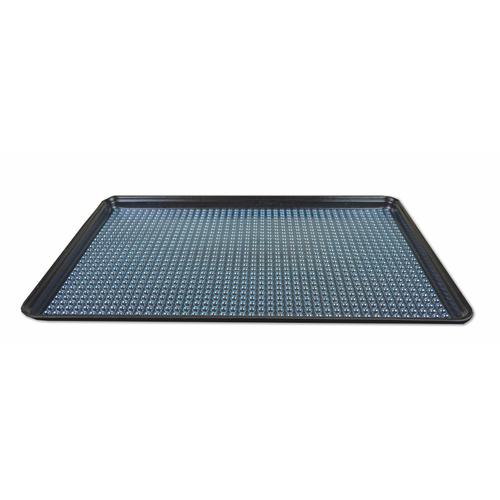
KSB2416-SB-25-TPU Kleanstat Flex (KSF) TPU ESD Small Airless Bubble Tray Liner 24.25" x 16.125" x .25" (.025 Gauge)

$450.00
(No reviews yet)
SKU:
KSB2416-SB-25-TPU
Availability:
10 - 14 Business Days
Shipping:
Calculated at Checkout
KleanStat Flex™ KSF TPU ESD Small Airless Bubble Tray Liner — 24.25" x 16.125" x 0.25" (0.025" / 25 Gauge) Static Dissipative Cushion Liner for Trays & Totes (Reusable WIP + Transfer Protection)
ESD Packaging Tray / Tote Liner Small Airless Bubble Static Dissipative TPU 24.25" x 16.125" 0.025" (25 Gauge) Reusable / Durable

Overview

KSB2416-SB-25 is a static dissipative TPU tray liner with a small airless bubble cushioning structure, designed to help protect ESD-sensitive electronics during work-in-process (WIP) staging, internal transport, and tray/tote storage. Sized for common 24" x 16" tray footprints (24.25" x 16.125"), it standardizes a high-touch contact surface without requiring new trays or rigid specialty containers.

The 0.25" low-profile cushion is ideal when you want added protection over a flat sheet liner, but need to preserve stack height, rack clearance, and tray nesting. This supports repeatable handling while minimizing operational disruption.


Why ESD control matters (cleanroom and non-cleanroom)
  • Transfer points are frequent exposure events: trays/totes touch product repeatedly across the process flow.
  • ESD damage can be latent: components may pass initial checks and fail later, creating reliability issues.
  • Low-profile cushioning reduces handling wear: helps reduce scuffs, micro-impacts, and vibration transfer in carts.
  • Standardization reduces substitutions: approved liners keep training consistent and prevent “grab whatever” drift.

What’s included (published)
  • Product: KleanStat Flex™ KSF TPU ESD Small Airless Bubble Tray Liner
  • Overall size (published): 24.25" x 16.125"
  • Profile height (published): 0.25"
  • Material / thickness (published): TPU — 0.025" (25 gauge)

Key features and benefits (published)
  • Static dissipative TPU construction designed to reduce electrostatic exposure during tray/tote handling
  • Small airless bubble structure adds low-profile cushioning without relying on trapped air (supports more consistent protection over time)
  • Low-profile 0.25" height supports rack clearance and tray nesting while improving handling protection versus flat liners
  • Reusable liner format supports WIP loops, staging queues, and repair workflows
  • Sized for common tray footprints to standardize transfer points without changing your trays

Quick specs (published)
SKU KSB2416-SB-25
Product type Small airless bubble tray liner
Material Static dissipative TPU
Overall size 24.25" x 16.125"
Profile height 0.25"
Thickness 0.025" (25 gauge)
Best use Low-profile WIP trays/totes, staging queues, internal transport, repair loops

Recommended pairings

If you have any questions please email us at Sales@SOSsupply.com or give us a call at (214)340-8574. OR check out the AI ChatBot powered by SOSCleanroom data libraries - give it a try! THIS IS NEW FOR 2026! © 2026 SOSCleanroom. All rights reserved.
The Technical Vault By SOSCleanroom
ESD Risk WIP Handling Low-Profile Cushioning EPA Discipline Verification Culture KSB2416-SB-25

Why “low-profile” controls often win in real operations

Many ESD improvements fail for a simple reason: they add friction. If a control disrupts tray nesting, changes rack clearance, or complicates material handling, teams eventually bypass it. Low-profile solutions are often the most sustainable because they improve protection while preserving how the operation actually runs.

KSB2416-SB-25 is designed for that reality. It adds a controlled, static dissipative contact surface and a small airless bubble cushion, improving handling protection while maintaining low profile for carts, racks, and stacked tray systems. The result is a repeatable control that is easier to keep in place across shifts and departments.


How to deploy tray liners as part of an ESD “system”
  • Define the transfer points: receiving, kitting, WIP racks, test queues, MRB/hold areas, and repair loops.
  • Standardize by footprint: one liner SKU per tray size reduces substitutions and “program drift.”
  • Train the handlers: the people moving trays can create more risk than the people building the product.
  • Verify, don’t assume: ground and wearable verification keeps the station aligned with the intent of the liner.

Recommended pairings (verification + outbound protection)

If you have any questions please email us at Sales@SOSsupply.com or give us a call at (214)340-8574. OR check out the AI ChatBot powered by SOSCleanroom data libraries - give it a try! THIS IS NEW FOR 2026! © 2026 SOSCleanroom. All rights reserved.