Product Summary
by SOSCleanroom
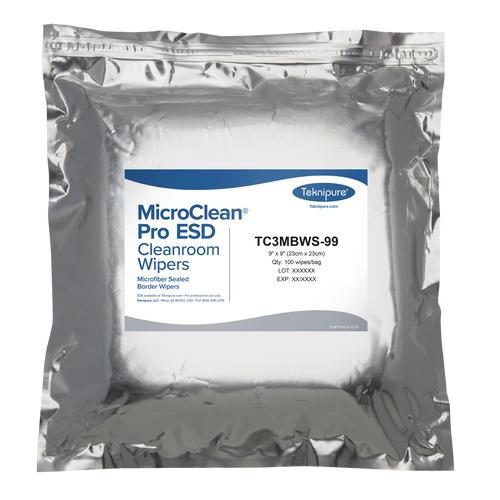
The MicroClean Pro Microfiber Sealed Border 9" x 9" Cleanroom Wiper, packaged in an ESD protective bag, is engineered for particle-sensitive wipe-downs and precision surface cleaning in controlled environments. Designed for process-facing surfaces where contamination control and electrostatic discharge mitigation matter, the microfiber structure promotes efficient particle capture while maintaining low lint and low fiber release.
Constructed from ultra-fine microfiber filaments, the material increases effective surface contact and improves contaminant retention compared with conventional polyester knit wipes. The sealed border stabilizes the wipe perimeter, helping minimize edge fray and loose fibers during repeated wiping cycles, which supports consistent cleaning performance in particle-sensitive environments.
The ESD static shield packaging supports handling and storage within static-sensitive manufacturing areas including semiconductor fabs, electronics assembly cleanrooms, and microelectronics device production environments. For teams implementing documentation-forward contamination control programs, MicroClean Pro microfiber wipes provide a practical balance of absorption efficiency, particle capture, and controlled electrostatic handling.
Typical applications include particle-sensitive wipe-downs, equipment surface preparation, optics and sensor cleaning, electronics manufacturing environments, and other controlled environment workflows requiring dependable contamination control materials.
MicroClean™ Pro Microfiber Sealed Border Wiper — 9" x 9" ESD Static Shield Bag (ISO Class 2–7) | SOSCleanroom Standard Specification
The Teknipure MicroClean™ Pro 9" x 9" wiper in an ESD Static Shield resealable bag (SOS SKU: TC3MBWS-99 BAG) is a dry microfiber cleanroom wiper engineered for streak-free cleaning, high particle pickup, and low-lint / low-shedding performance on sensitive surfaces. The microfiber blend is built to capture very small particles and retain them within the cloth structure, while the sealed border helps minimize edge fray and reduce edge-driven fiber release during wiping.
SOS SOP disclaimer (read before standardizing): ISO classification describes the room air, not the product. Final suitability depends on your surface criticality, residue sensitivity, and validated wiping method. Always follow your facility SOP for material introduction, folding/face rotation, wetness targets (damp-film vs. wet), and change-out triggers. In ESD areas, consumables support your program but do not replace grounding controls.
Specifications:
- Manufacturer / Series: Teknipure – MicroClean™ Pro (Microfiber Sealed Border)
- Part Number: TC3MBWS-99
- Size: 9" x 9" (23 cm x 23 cm) nominal
- Material: Microfiber blend (typically 80% polyester / 20% nylon)
- Construction: Microfiber wipe with sealed border edge to control perimeter fiber release
- Packaging (bag): 100 wipers in ESD Static Shield resealable bag
- Packaging (case): 15 bags of 100 wipers (1,500 wipers/case)
- Cleanroom environment positioning: commonly used in ISO Class 2–7 controlled environments (confirm to SOP)
- Shelf life: Dry, non-sterile: 5 years from date of manufacture (per manufacturer guidance)
- Availability: 7–10 business days
Where This Wiper Fits in ISO Cleanrooms (and Why)
Cleanroom classification is defined by airborne particle concentration, but many yield and quality issues originate on surfaces. Benches, carts, fixtures, tools, and staging trays accumulate particles and films that transfer during routine handling. A disciplined wipe program helps reduce those reservoirs and stabilize conditions across shifts.
MicroClean™ Pro is often selected when teams need a wipe that performs well on scratch-sensitive and finish-critical surfaces such as optics, sensors, polished metals, and coated parts where streaking, loose fibers, and micro-scratches can increase rework risk. The sealed border is chosen specifically to reduce edge failure modes such as fray and loose fibers under normal wiping pressure.
Typical program fit: precision wipe-downs and residue removal in ISO Class 2–7 environments, including ESD-sensitive areas where controlled packaging and disciplined handling help reduce the chance of wipes becoming a contamination source.
Reality check: many “wiper problems” are technique problems — over-wetting, re-wiping with a loaded face, backtracking into cleaner zones, or leaving resealable bags open. Lock the method before changing materials.
Competitive Comparison:
| Performance Category |
MicroClean™ Pro 9x9 (ESD Bag) |
Contec Microfiber (Comparable) |
Berkshire Microfiber (Comparable) |
| Microfiber blend for fine particle pickup |
Yes (polyester/nylon microfiber) |
Yes (model dependent) |
Yes (model dependent) |
| Sealed border / edge control intent |
Yes (sealed border) |
Yes (varies by SKU) |
Yes (varies by SKU) |
| ISO Class 2–7 positioning |
Yes (per manufacturer positioning) |
Model dependent |
Model dependent |
| ESD packaging discipline |
ESD Static Shield resealable bag |
Available on select offerings |
Available on select offerings |
| Price positioning |
Competitive |
Often premium tier |
Often premium tier |
Comparison note: Equivalent performance depends on the exact SKU (material, edge/border method, cleanliness level, packaging). Confirm against current manufacturer datasheets and your internal acceptance limits.
About the Manufacturer:
Teknipure develops and manufactures contamination-control consumables including cleanroom wipers, swabs, and mops used in semiconductor, electronics, aerospace, and precision manufacturing environments. Their MicroClean™ platform focuses on microfiber materials engineered for fine particle pickup, residue control, and repeatable wiping on sensitive surfaces.
SOSCleanroom supports standardization with configuration control, continuity of supply, and practical wipe-program guidance aligned to real wipe station workflows.
Key Features:
- Microfiber structure for high particle pickup and finish-critical wiping
- Sealed border to minimize edge fray and reduce edge-driven fiber release
- ESD Static Shield resealable bag for controlled dispensing (open → dispense → reseal)
- Designed for streak-free cleaning of sensitive surfaces including optics, sensors, and coated parts
- Good chemical compatibility with many cleanroom solutions (verify to your chemistry and SOP)
Operational Benefits:
- Lower rework risk on sensitive surfaces: microfiber helps lift fine particles and oils with reduced streaking potential (method-dependent)
- Cleaner edges under pressure: sealed borders help reduce fraying compared with non-sealed edges (process-dependent)
- Better wipe station discipline: the resealable ESD bag reduces exposure compared with leaving wipes open on benches or carts
- ISO-aligned use: commonly positioned for ISO Class 2–7 environments where surface quality is a gating concern
Common Applications:
- ESD-sensitive wipe stations in semiconductor and microelectronics environments
- Streak-free wipe-down of optics, lenses, sensors, and finish-critical components
- Removal of fingerprints and light oily films from surfaces
- Applying and removing solvents or process solutions per SOP
- Final wipe steps where low fibers and residue control matter
Best-Practice Use:
- Open → dispense → reseal: use the resealable bag as a contamination control point; do not leave packs open.
- Fold for control: fold into quarters or eighths and rotate faces instead of re-wiping with a loaded surface.
- Wipe pattern: use straight-line strokes with consistent pressure; avoid circular scrubbing that can redistribute contamination.
- Damp-film technique: when using solvents, dampen rather than over-saturate to help reduce streaking and tide marks.
- Change-out triggers: replace when loaded, tacky, or when visible streaking or film appears.
- ESD discipline: maintain grounding compliance at the wrist, footwear, and work surface level; consumables support the system.
Selection Notes (Microfiber vs. Knit Polyester Wipers)
- Microfiber vs. standard polyester knit: choose microfiber when fine particle pickup, light oil removal, and finish quality are gating outcomes.
- Sealed border vs. cut edges: sealed borders are preferred when edge fray or edge shedding is a known contributor during wiping.
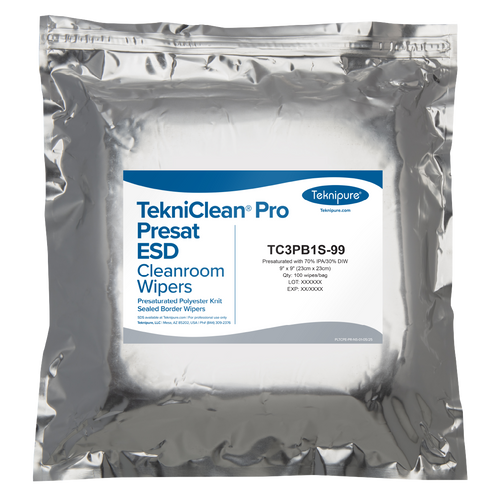
- Dry vs. pre-wetted: if your SOP requires fixed solvent loading, consider validated pre-wetted wipes when available and approved.
Other Similar Products Available From SOSCleanroom.com
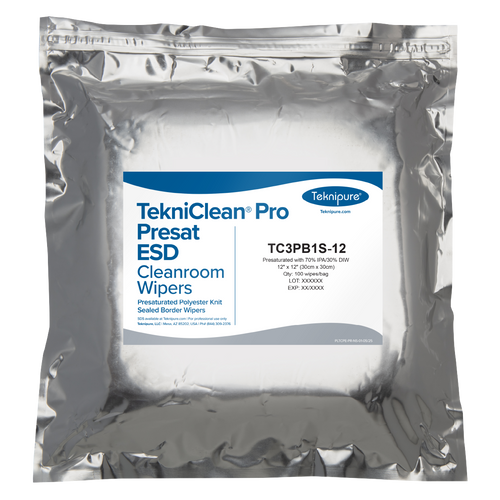
Related Teknipure ESD Wipers (same wipe-station intent)
Recommended Glove Pairings (ESD) for ISO 3–5 Wipe Stations
In ESD-sensitive wiping operations, gloves and wipers function as a system. Pair this microfiber wiper with a cleanroom-processed, powder-free ESD nitrile glove aligned to ISO 3–5 contamination sensitivity and your facility ESD program. Using a cleanroom-grade wipe with a non-cleanroom glove often cancels out contamination-control gains.
Glove discipline (what keeps wipe stations stable):
- Change gloves after contacting non-controlled surfaces such as handles, doors, or keyboards to help prevent recontamination.
- Replace gloves when solvent-wet, torn, tacky, or when drag increases during wiping.
- Maintain grounding compliance per your ESD program — consumables support the system.
SOS's SOP disclaimer: ESD outcomes are system-dependent (grounding, humidity, benches/mats, wrist straps, footwear, handling). Validate glove and wiper pairing to your ESD control plan and cleanliness acceptance limits.
Notes: Want deeper process guidance and datasheet-typical performance values? Open the SOSCleanroom Technical Vault tab for method controls (folding, wetness targets, stroke discipline), ESD workflow notes, and documentation expectations teams typically review when standardizing microfiber wipes.
SOSCleanroom supports contamination-control programs with responsive technical support, configuration control, and cleanroom consumables that match real wipe station workflows.
Product page updated: Mar. 4, 2026 (SOS Technical Staff)
© 2026 Specialty Optical Systems, Inc. (dba SOSCleanroom) All rights reserved.
Technical Summary
by SOSCleanroom
This technical overview is structured for documentation-forward cleanroom programs and process-facing contamination control evaluation.
Microfiber Wiping Performance: Microfiber wipers are constructed using extremely fine synthetic filaments typically measuring less than 1 denier in diameter. These ultra-fine fibers dramatically increase the effective surface area of the wiping material, allowing the wipe to mechanically capture and retain particles, oils, and residues during cleaning operations. Compared with conventional polyester knit wipers, microfiber structures provide improved contaminant entrapment due to the increased number of micro-contact points created across the wiping surface.
Sealed Border Technology: The sealed border construction prevents fiber release and edge fraying during repeated wiping cycles. Thermal or ultrasonic sealing bonds the wipe perimeter, stabilizing the fiber structure and reducing the risk of loose particles originating from the wipe edges. This edge sealing process is particularly important in contamination-controlled environments where uncontrolled fibers can become a significant particulate source.
Electrostatic Discharge Considerations: Packaging the wipes in an ESD protective bag supports safe storage and transport within static-sensitive environments such as semiconductor fabrication, electronics manufacturing, and microelectronics assembly areas. ESD-controlled packaging helps reduce the risk of electrostatic charge accumulation during handling and protects sensitive components and surfaces from unintended electrostatic events.
Controlled Environment Applications: MicroClean Pro microfiber wipes are commonly deployed in semiconductor fabs, electronics assembly lines, disk drive manufacturing facilities, optical manufacturing environments, and other controlled environment workflows requiring high-efficiency particle removal. Their microfiber construction and sealed border design provide consistent wiping performance for particle-sensitive wipe-downs of tools, equipment, and process-facing surfaces.
The Technical Vault
By SOSCleanroom
ISO Surface Control
Microfiber (Fine Pickup)
Sealed Border (Edge Control)
ESD Static Shield Bag
Optics / Finish-Critical
Lot / SKU Control
MicroClean™ Pro 9" x 9" (ESD bag): what this microfiber sealed-border wipe is engineered to do
MicroClean™ Pro Microfiber Sealed Border in an ESD Static Shield resealable bag (SOS SKU: TC3MBWS-99 BAG)
is positioned for finish-critical, streak-sensitive cleaning where teams want microfiber-level pickup with edge control.
The microfiber structure is designed to capture small particles and oily films, while the sealed border is intended to reduce edge fray and loose fibers that can show up as streaks, “mystery fibers,” or rework drivers on optics and coated parts.
SOS SOP disclaimer (control beats product swaps):
Most failures in wiping programs come from uncontrolled technique — inconsistent wetness, re-wiping with a loaded face,
backtracking into clean zones, or leaving resealable bags open. Lock down your method (fold pattern, stroke count, wetness target, change-out triggers)
before changing consumables.
Specifications (SKU controls for RFQs, SOPs, and receiving)
- Product: Teknipure MicroClean™ Pro Microfiber Sealed Border, ESD bag
- SOS SKU: TC3MBWS-99 BAG
- Manufacturer part #: TC3MBWS-99
- Size: 9" x 9" (23 cm x 23 cm) nominal
- Material: typically 80% polyester / 20% nylon microfiber
- Edge / border: sealed border (edge control intent)
- Packaging (bag): 100 wipes in ESD Static Shield resealable bag
- Packaging (case): 15 bags/case (1,500 wipes/case)
- Cleanroom positioning: ISO Class 2–7 (confirm fit to your SOP and acceptance limits)
- Shelf life (dry, non-sterile): 5 years from date of manufacture
Receiving control tip: If this wipe is referenced in a controlled method, verify exact part number, bag/case pack,
and that the ESD Static Shield resealable configuration matches what your SOP expects.
Performance characteristics (manufacturer-typical values)
- LPC > 0.50 µm: 6 x 10⁶ particles/m2
- Fibers > 100 µm: 300 fibers/m2
- NVR (IPA extractant): 0.07 g/m2
- NVR (DI water extractant): 0.015 g/m2
- Extractable ions (typical): Na+ 0.02 ppm; K+ 0.03 ppm; Cl- 0.02 ppm
- Basis weight: 195 g/m2
- Sorptive capacity: 340 mL/m2
- Sorptive rate: 0.4 second
Method note: Typical values are useful for selection, but acceptance in regulated or yield-critical programs should be based on
current manufacturer documentation and your internal limits.
Best-practice use (finish-critical and ESD-sensitive wipe stations)
- Control introduction: remove outer packaging per SOP; stage wipes in the correct zone.
- Open → dispense → reseal: resealable ESD bag is part of your control plan — don’t leave it open.
- Fold for clean faces: use one face per pass; refold to a new face to avoid redeposit.
- Wetness control: for solvent wiping, target a controlled damp-film (not dripping) to reduce streaks/tide marks.
- Stroke discipline: straight-line strokes, consistent pressure, clean-to-less-clean flow; avoid circular scrubbing.
- Change-out triggers: replace when loaded, tacky, or when streaking/film begins.
- ESD discipline: maintain grounding compliance (straps/footwear/mats). Consumables support the system but do not replace it.
Misuse controls & when to select a different wipe
- If sterility is required: do not substitute a non-sterile wipe. Use the sterile wipe specified by SOP and transfer rules.
- If your residues limits are tighter: confirm NVR/ionic limits against current manufacturer documentation and your internal acceptance criteria.
- If the surface is extremely scratch-sensitive: validate on your specific coating/finish with your method and chemistry.
- If your SOP requires fixed wetness: consider validated pre-wetted wipes to reduce operator variability (when available/approved).
SOS SOP disclaimer: ISO class is not a product spec. Your process sensitivity and acceptance limits decide whether this wipe is appropriate.
Validate with your chemistry, contact time, and inspection standards (visual, particle, residue).
Recommended glove pairing (ESD-aligned)
In ESD-sensitive wiping, gloves and wipes operate as a system. Pair this wipe with a cleanroom-processed ESD glove
aligned to ISO 3–5 contamination sensitivity and your facility grounding program.
Glove discipline: Change gloves when contaminated, torn, or solvent-wet; avoid touching non-controlled surfaces and then returning to wipe-down work.
Manufacturer documentation (authoritative references)
-
SOSCleanroom product page:
Click Here
-
Teknipure manufacturer page:
Click Here
-
Teknipure Technical Data Sheet (MicroClean™ Pro Sealed Border):
Click Here
If you have any questions please email us at Sales@SOSsupply.com or give us a call at (214)340-8574.
OR check out the AI ChatBot powered by SOSCleanroom data libraries - give it a try! THIS IS NEW FOR 2026!
© 2026 SOSCleanroom. All rights reserved.