Product Summary
by SOSCleanroom
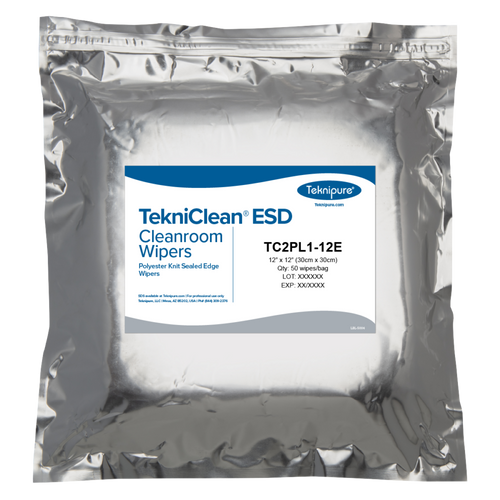
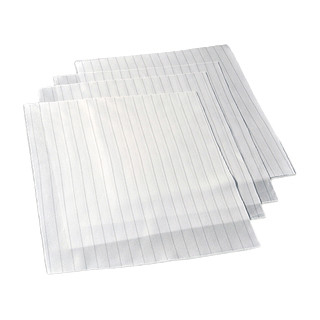
The TekniClean® ESD Polyester Knit Carbon Fiber Wiper with Sealed Edge, 12" x 12" is a dry cleanroom wiper engineered for static-sensitive wipe stations and controlled environments where both contamination control and electrostatic performance matter. Designed for process-facing surfaces where static build-up can interfere with cleaning consistency, this polyester knit wiper incorporates carbon fiber filaments to help dissipate electrostatic charge during wipe-down tasks.
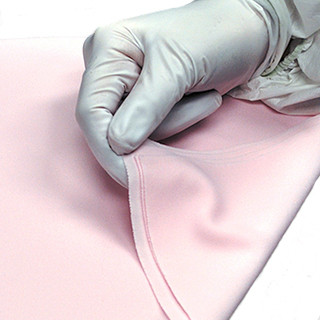
Constructed from polyester material with carbon fiber filaments and finished with a sealed edge, the wipe is intended to reduce both electrostatic discharge risk and edge-driven fiber release during wiping and abrasion. That combination makes it practical for cleaning benches, carts, fixtures, tools, equipment surfaces, and other areas where particle attraction, static events, or loose fibers can increase rework risk.
The ESD-safe platform is well suited for semiconductor, electronics, optical, medical device, pharmaceutical, aerospace, and other environments where sensitive components or surfaces must be cleaned without introducing unnecessary static-related handling risk. For teams implementing documentation-forward contamination control programs, TekniClean ESD carbon-fiber wipes offer a practical balance of polyester durability, static-dissipative behavior, absorbency, and repeatable handling.
Typical applications include wiping and cleaning surfaces and parts in cleanroom environments, disinfectant residue removal, applying and removing solvents and solutions, equipment surface preparation, and general cleaning in ISO Class 3–8 controlled environments where ESD-sensitive workflows are part of the operating method.
TekniClean® ESD Polyester Knit Carbon Fiber Wiper — 12" x 12" Sealed Edge (ISO Class 3–8) | SOSCleanroom Standard Specification
The Teknipure TekniClean® ESD 12" x 12" wiper (part: TC2PL1-12E) is a dry polyester knit cleanroom wipe with carbon fiber filaments built for ESD-sensitive wipe stations where teams must control both surface contamination and static-related process risk. The sealed edge helps reduce edge-driven fiber release during wiping, while the carbon-fiber construction helps reduce the risk of electrostatic discharge during cleaning applications.
SOS SOP disclaimer (read before standardizing): ISO classification describes the room air, not the product. Final suitability depends on your surface criticality, residue sensitivity, ESD control plan, and validated wiping method. Always follow your facility SOP for material introduction, folding/face rotation, wetness targets, and change-out triggers. In ESD areas, consumables support your program but do not replace grounding controls.
Specifications:
- Manufacturer / Series: Teknipure – TekniClean® ESD Polyester Knit Carbon Fiber Wipers
- Manufacturer Part Number: TC2PL1-12E
- Size: 12" x 12" nominal
- Material / Construction: Polyester knit with carbon fiber filaments
- Edge Construction: Sealed edge for perimeter fiber-control intent
- Product Type: Dry, non-sterile cleanroom wipe
- Cleanroom environment positioning: commonly used in ISO Class 3–8 controlled environments (confirm to SOP)
- Shelf life: Dry, non-sterile: 5 years from date of manufacture
Where This Wiper Fits in ISO Cleanrooms (and Why)
ISO cleanroom classification is based on airborne particle concentration, but many contamination issues originate on surfaces. Benches, carts, tools, fixtures, and equipment exteriors accumulate particles and films that transfer during handling and become secondary contamination sources. A disciplined wipe program reduces those reservoirs and helps stabilize operating conditions across shifts.
In ESD-sensitive areas, wiping introduces an additional consideration: triboelectric charging can increase particle attraction and raise static-related handling risk. TekniClean ESD carbon-fiber wipes are often selected when teams need a wipe that combines polyester wipe durability with carbon fiber filament dissipation and a sealed-edge design intended to reduce loose fibers under routine wiping pressure.
Typical program fit: routine wipe-downs, residue removal, and controlled solvent or solution application/removal in ISO Class 3–8 environments where static control is part of the operational method.
Reality check: many “wiper problems” are technique problems — inconsistent wetness, re-wiping with a loaded face, backtracking into cleaner zones, or using an ESD wipe without maintaining the rest of the grounding program. Lock the method before changing materials.
About the Manufacturer:
Teknipure develops and manufactures contamination-control consumables for critical and controlled environments. Their TekniClean ESD carbon-fiber wiper platform is described for high performance in environments sensitive to electrostatic discharge or with a high risk of static build-up.
SOSCleanroom supports standardization with configuration control, continuity of supply, and practical wipe-program guidance aligned to real wipe station workflows.
Key Features:
- Polyester knit construction with carbon fiber filaments for ESD-sensitive cleaning
- Sealed edge to help reduce edge-driven fiber release
- Built for environments with high risk of static build-up
- 12" x 12" format for broader surface coverage per wipe
- Good chemical compatibility typical of polyester knit wipes (verify to your chemistry and SOP)
Operational Benefits:
- Better ESD workflow support: carbon fiber filaments help reduce electrostatic risk during wipe-down tasks
- Cleaner edges under pressure: sealed edges help reduce fraying compared with non-sealed edges
- More coverage per wipe: larger format can reduce touch events on broad surfaces
- Repeatable handling: polyester knit supports consistent wipe behavior during solvent and dry wiping tasks
Common Applications:
- ESD-sensitive wipe stations in semiconductor and electronics manufacturing
- Routine wipe-downs of benches, carts, tools, fixtures, and equipment exteriors
- Disinfectant residue removal
- Applying and removing solvents, lubricants, adhesives, and other process solutions per SOP
- General cleanroom wiping where static-related handling risk must be considered
Best-Practice Use:
- Fold for control: fold into quarters and rotate wipe faces instead of re-wiping with a loaded surface.
- Wipe pattern: use straight-line strokes with consistent pressure; avoid circular scrubbing that can redistribute contamination.
- Wetness control: when using solvents, target a controlled damp-film rather than an over-saturated wipe.
- Change-out triggers: replace when loaded, tacky, or when visible film or streaking appears.
- ESD discipline: maintain grounding compliance at the wrist, footwear, mat, and work-surface level; consumables support the system.
Selection Notes (Carbon Fiber ESD Wipers)
- Carbon fiber vs. standard ESD packaging alone: choose carbon-fiber wipes when the wiping material itself must contribute to electrostatic dissipation.
- Sealed edge vs. unsealed edges: sealed edges are preferred when loose fibers from the wipe perimeter are a known contributor to contamination.
- 12" x 12" vs. smaller sizes: the larger format is useful when broader surfaces benefit from more coverage per pass.
Notes: Want deeper process guidance and manufacturer-typical platform details? Open the SOSCleanroom Technical Vault tab for method controls, ESD workflow notes, and documentation expectations teams typically review when standardizing carbon-fiber ESD cleanroom wipes.
SOSCleanroom supports contamination-control programs with responsive technical support, configuration control, and cleanroom consumables matched to real wipe station workflows.
Product page updated: Mar. 9, 2026 (SOS Technical Staff)
© 2026 Specialty Optical Systems, Inc. (dba SOSCleanroom) All rights reserved.
Technical Summary
by SOSCleanroom
This technical overview is structured for documentation-forward cleanroom programs and process-facing contamination control evaluation.
Polyester Knit + Carbon Fiber Performance: Teknipure describes this wiper as a polyester material with carbon fiber filaments engineered for high performance in critical environments sensitive to electrostatic discharge or with a high risk of static build-up. The knit structure supports repeatable wipe behavior while the carbon-fiber network helps reduce electrostatic risk during surface cleaning.
Sealed Edge Technology: The sealed edge is intended to reduce particles and fibers released from the wipe perimeter during wiping and abrasion. By stabilizing the edge, this construction helps control one of the common failure points in surface-cleaning workflows: loose fibers originating from the wipe boundary under pressure or repeated passes.
Electrostatic Discharge Considerations: In static-sensitive operations, wiping can generate triboelectric charge and increase particle re-attraction or handling risk. Carbon fiber filaments within the wipe help support dissipative behavior, but final performance still depends on the total ESD control system, including grounding, work surfaces, humidity, operator practices, and SOP discipline.
Controlled Environment Applications: Teknipure lists applications including wiping and cleaning surfaces and parts in cleanroom environments, disinfectant residue removal, applying and removing solvents and solutions, and use across semiconductor and electronics manufacturing, pharmaceutical cleanrooms, medical device production, optical component cleaning, aerospace/defense and precision engineering, laboratories, and academia.
The Technical Vault
By SOSCleanroom
ISO Surface Control
Carbon Fiber Dissipation
ESD-Sensitive Workflows
Polyester Knit
Sealed Edge
12x12 Coverage
TekniClean® ESD carbon fiber 12" x 12": what it is designed to control
TekniClean® ESD Polyester Knit Carbon Fiber Wiper (part: TC2PL1-12E) is a dry cleanroom wipe built for critical environments where operators need repeatable wipe behavior, static-dissipative support from carbon fiber filaments, and an edge-control strategy intended to reduce edge-driven particle and fiber release under wiping pressure. In ESD-sensitive workflows, it is used where both surface cleanliness and static-aware handling are part of the process method.
SOS SOP disclaimer (control beats product swaps): Most failures in wiping programs come from uncontrolled technique — inconsistent wetness, re-wiping with a loaded face, backtracking into clean zones, or relying on the wipe alone without maintaining the rest of the ESD program. Lock down your method before changing consumables.
Specifications (SKU controls for RFQs, SOPs, and receiving)
- Product: Teknipure TekniClean® ESD Polyester Knit Carbon Fiber Wiper, Sealed Edge
- Manufacturer part #: TC2PL1-12E
- Size: 12" x 12" nominal
- Material / structure: Polyester knit with carbon fiber filaments
- Edge construction: Sealed edge
- Cleanroom positioning: ISO Class 3–8 manufacturer positioning — confirm fit to SOP and critical surfaces
- Shelf life (dry, non-sterile): 5 years from date of manufacture
Receiving control tip: If this wipe is referenced in a controlled method, verify exact part number, size, and that the carbon-fiber ESD construction matches your approved SOP language.
Where this wipe is commonly used
- Wiping and cleaning surfaces and parts in cleanroom environments
- Disinfectant residue removal
- Applying and removing solvents and solutions including disinfectants, lubricants, and adhesives
- Semiconductor and electronics manufacturing
- Pharmaceutical cleanrooms and medical device production
- Optical component cleaning and precision engineering
- Laboratories and academia
Best-practice use (ESD-sensitive wipe stations)
- Control introduction: remove outer packaging per SOP and stage wipes in the correct zone.
- Fold for clean faces: use one face per pass and refold to a new face to avoid redeposit.
- Wetness control: target a controlled damp-film when using solvents rather than an over-saturated wipe.
- Stroke discipline: use straight-line strokes and consistent pressure; avoid circular scrubbing.
- Change-out triggers: replace when loaded, tacky, or when visible film begins to develop.
- ESD discipline: maintain grounding compliance at the straps, footwear, mats, and work-surface level.
Misuse controls & when to select a different wipe
- If sterility is required: do not substitute a non-sterile wipe.
- If the surface is extremely finish-sensitive: validate on your exact coating or finish with your chemistry and method.
- If your process has tighter ESD limits: validate the full glove + wipe + grounding system, not the wipe alone.
- If larger-format coverage is not needed: consider a smaller size to reduce unused wipe area and improve face control.
SOS SOP disclaimer: ISO class is not a product spec. Your process sensitivity, cleanliness acceptance limits, and ESD control plan decide whether this wipe is appropriate.
Manufacturer documentation (authoritative references)
If you have any questions please email us at Sales@SOSsupply.com or give us a call at (214)340-8574.
OR check out the AI ChatBot powered by SOSCleanroom data libraries - give it a try! THIS IS NEW FOR 2026!
© 2026 SOSCleanroom. All rights reserved.