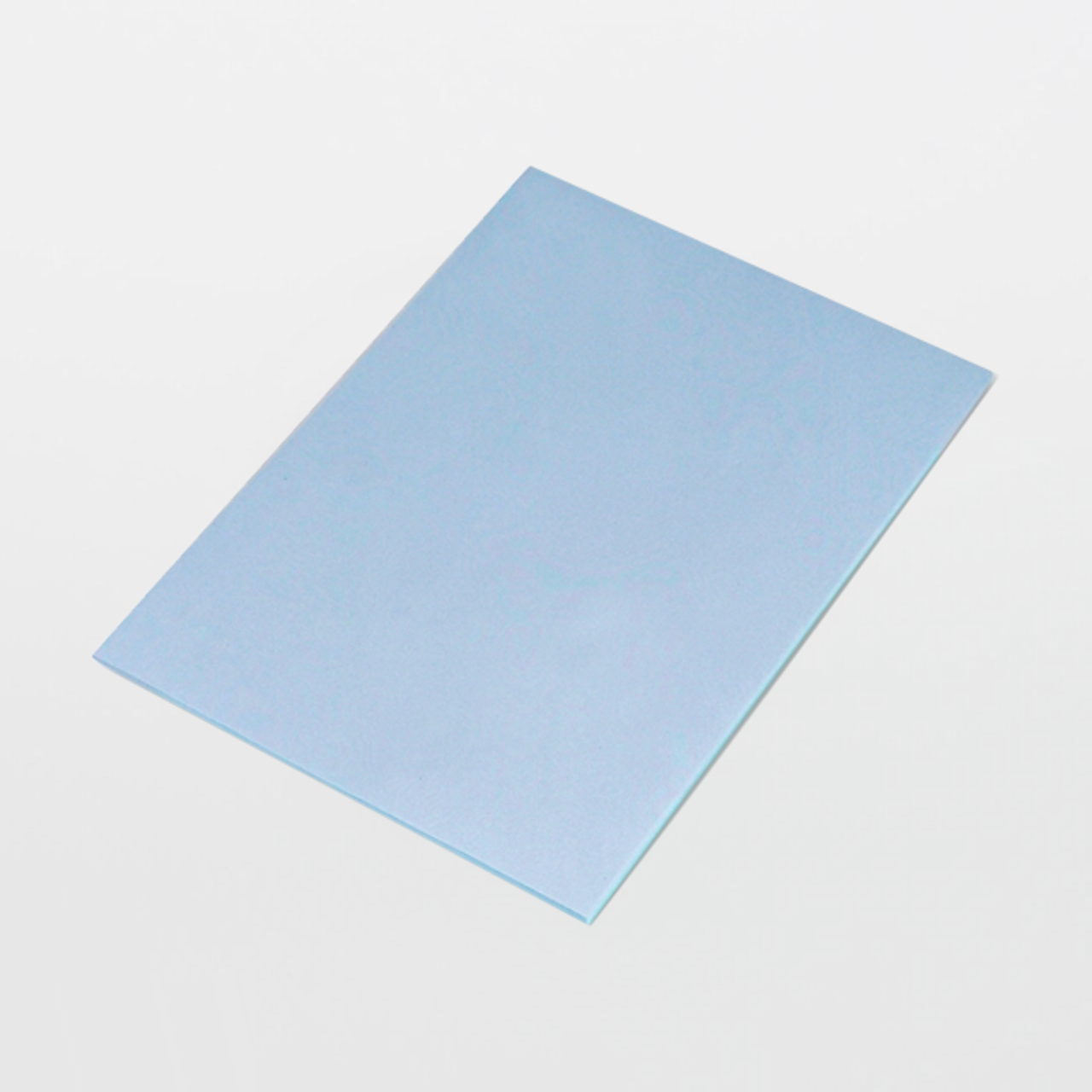
Texwipe TX5812 — 8.5" x 11" blue loose sheets (TexWrite® 22)
1) Practical solutions in a critical environment
For over 35 years, SOS and Texwipe have been close partners, and SOSCleanroom is the authorized Master Distributor of ITW Texwipe for the United States market.
That matters in stationery because “paper exceptions” are common: an operator grabs office bond for a quick log entry, prints travelers on whatever is in the tray,
and the cleanroom ends up fighting fibers, edge debris, and trace residues that did not come from the process itself.
TX5812 is built for controlled documentation where the paper itself should not become a variable. The goal is simple: keep logs, checklists, batch-adjacent notes,
and controlled copies inside the same contamination-control discipline as gowns, gloves, and cleaning tools—so paper does not quietly drive rework, inspection findings,
or “unexplained” residue events.
2) What this product is used for
- Cleanroom manuals, work instructions, and controlled copies printed for point-of-use.
- Process travelers, line-clearance checklists, equipment status sheets, and shift handoff notes.
- Laser/photocopier printing in standard-duty and high-speed equipment (manufacturer-stated), plus offset printing (manufacturer-stated).
- Color-based segregation: blue sheets to help visually confirm “cleanroom paper” is being used and to separate areas/shifts/projects (manufacturer-stated).
- Data transfer and note taking inside controlled areas (manufacturer-stated).
3) Why customers consider this product
- Reduced particle-generation risk vs. standard papers: polymer reinforcement and cleanroom-focused construction are intended to reduce shedding during handling and printing (manufacturer-stated).
- Ionic contamination control approach: formulated without inorganic fillers such as calcium carbonate, titanium dioxide, or aluminum silicate that may contribute to ionic contamination (manufacturer-stated).
- Printer performance and legibility: excellent toner adhesion and heat resistance for laser printers/photocopiers, precision-cut edges, and dimensional stability for clear reproductions (manufacturer-stated).
- Latex-risk reduction: no natural latex binders (manufacturer-stated) for programs that manage latex-associated reactions.
- Operational discipline support: blue paper helps supervisors and QA spot uncontrolled documentation materials at point-of-use without a lengthy investigation.
4) Materials, composition, and build
Material/structure is stated as cellulose paper with a polymer reinforcement.
TexWrite® is described as reinforced with a synthetic copolymer to reduce particle generation compared with conventional bond paper (manufacturer-stated).
The paper is also described as formulated without specific inorganic fillers (manufacturer-stated) and as having precision-cut edges with cleanroom packaging (manufacturer-stated).
In real document-control workflows, build quality shows up when sheets are repeatedly handled with gloves, stacked, separated, and fed through equipment.
Polymer reinforcement and edge quality are most valuable during those “high-touch” moments—when standard office bond tends to fuzz, tear, or shed at the edges.
5) Specifications in context (include a table: Attribute vs SKU)
Note: Texwipe technical data sheet values are published as typical analyses, not specifications.
| Attribute |
TX5812 (TexWrite® 22, Blue) |
| Format |
Loose sheets |
| Sheet size |
8.5" x 11" (21.6 cm x 28 cm) |
| Color |
Blue |
| Basis weight (typical) |
80 g/m² (TexWrite® 22) / medium-weight (22# family positioning) |
| Caliper (typical) |
5.0 mil |
| Opacity (typical) |
74% |
| Tensile strength (typical) |
Machine direction 5.3 kg; cross direction 4.5 kg |
| Tear strength (typical) |
Machine direction 78 g; cross direction 79 g |
| Surface resistivity (typical) |
2.6 x 10⁹ ohms (2.6 x 10¹⁰ ohms/sq), TM14 at 55% RH (published as typical; not an ESD program claim) |
| Cleanroom environment guidance |
ISO Class 3–8; Class 1–100,000; EU Grade A–D (manufacturer-stated) |
| Autoclavable |
Yes (manufacturer-stated; confirm cycle suitability through your internal qualification) |
| Inner pack count |
250 sheets/pack |
| Case count |
10 packs/case (2,500 sheets total) |
| Case weight |
29.00 lbs (SOSCleanroom listing) |
| Availability (site listing) |
7–10 business days |
| Sterility |
Not stated in source basis (product is described as cleanroom packaged and autoclavable) |
6) Performance and cleanliness considerations
Stationery problems in controlled environments usually present as particles and fibers, ink/toner transfer, and residue that complicates inspections.
TX5812 is positioned to reduce particle generation compared with standard papers (manufacturer-stated) and to support clean printing through toner adhesion,
heat resistance, and dimensional stability (manufacturer-stated).
Published typical contamination data (TexWrite® 22 family):
| Metric |
Typical value (published) |
| Particles (>0.5 µm) |
4.8 million particles/m² |
| Ions — Sodium |
85 ppm |
| Ions — Chloride |
50 ppm |
Ink and solvent behavior: resistance to IPA, ethanol, quats, or other disinfectants is not stated in the source basis.
In practice, smear risk and permanence are usually controlled by the writing instrument and dwell time—qualify the pen/marker you standardize with the paper,
using the same wipe-down and handling steps your operators actually perform.
7) Packaging, sterility, traceability, and country of origin
- Pack configuration: 250 sheets/pack; 10 packs/case; 2,500 sheets total (SOSCleanroom listing; also shown on Texwipe SKU page and TDS).
- Packaging condition: cleanroom packaged (manufacturer-stated).
- Sterility: not stated in source basis; product is described as cleanroom packaged and autoclavable (manufacturer-stated).
- Traceability / COA / COC: not stated for TX5812 on the listed source pages; if documentation is required by your quality system, request it during procurement and receiving.
- Country of origin: Made in USA (published on Texwipe technical data sheet).
8) Best-practice use
Cleanroom paper performs best when it is treated like any other controlled consumable—managed at receiving, staged intentionally, and protected from “dirty” equipment.
A few practices consistently reduce paper-related deviations:
- Control the printer path: keep dedicated trays or a dedicated printer for controlled-area paper whenever possible. A dusty tray can transfer contamination directly onto the sheet surface.
- Stage by shift/lot: open only the amount needed for the day or batch package; keep the rest sealed to avoid repeated exposure and handling.
- Glove discipline: avoid pinching and “fanning” stacks aggressively. Gentle separation reduces edge stress that can generate debris on any paper.
- Instrument qualification: select one or two writing instruments for controlled documentation, then qualify legibility and smear performance under your actual handling (stacking, bagging, wipe-down cadence).
- Use blue intentionally: define what blue paper signifies (area ownership, traveler packs, controlled copies) so visual segregation strengthens investigations instead of creating ambiguity.
9) Common failure modes
- Ink smear or transfer: typically driven by the pen/marker chemistry and insufficient dry time before stacking or bagging; standardize the instrument and enforce a dwell-time expectation.
- Toner flake or poor adhesion: usually a fuser/temperature or tray cleanliness issue; confirm printer settings and keep the paper path clean.
- Localized debris at edges: often caused by aggressive separation, dragging sheets across benches, or rough handling at receiving; train gentle separation and clean staging surfaces.
- Autoclave warping/curl: cycle conditions and post-cycle handling can affect flatness; if autoclaving is part of your workflow, qualify the cycle and verify post-cycle readability.
- Traceability gaps: if paper color is used for segregation, document-control rules must define how it is issued, stored, and retired; otherwise color becomes a confusion point during investigations.
10) Closest competitors
In the medium-weight cleanroom paper category, facilities commonly compare TexWrite® against other cleanroom documentation systems. Two frequently evaluated options include:
- Berkshire — cleanroom bond paper systems offered in multiple colors and weights; confirm published particle/ionic data, packaging configuration, and environment guidance for the exact Berkshire paper you are qualifying.
- Contec — cleanroom paper products available through controlled-environment distributors; confirm polymer reinforcement approach, cleanliness data, and printing compatibility for your intended use.
Selection logic that tends to matter most: published contamination data (even when labeled “typical”), explicit cleanroom environment guidance, and consistency across a broader documentation family
(matching notebooks, labels, and related stationery) so your program is not pieced together from mixed sources.
11) Critical environment fit for this product
Texwipe states cleanroom environment guidance of ISO Class 3–8 (also expressed as Class 1–100,000 and EU Grade A–D).
That range aligns with many production and laboratory controlled areas where documentation is handled at benches, printers, and inspection stations.
If your process is highly sensitive to particles or ions (for example, optics, coatings, or critical surface assemblies), treat paper as a controlled material and qualify the end-to-end workflow:
receiving, staging, printer path cleanliness, writing instrument selection, and storage. The published contamination data provides a baseline, but your acceptance criteria and inspection method should govern release.
12) SOSCleanroom note about SOP's
The Technical Vault is written to help customers make informed contamination-control decisions and improve day-to-day handling technique.
It is not your facility’s Standard Operating Procedure (SOP), batch record, or validation protocol.
Customers are responsible for establishing, training, and enforcing SOPs that fit their specific risks, products, equipment, cleanroom classification, and regulatory obligations.
Always confirm material compatibility, cleanliness suitability, sterility requirements, and acceptance criteria using your internal quality system and documented methods.
If you adapt any technique guidance from this entry, treat it as a starting template. Your team should review and approve the final method, then qualify it for your specific surfaces,
solvents, cleanliness limits, inspection methods, and risk profile. In short: use these best-practice suggestions to strengthen your SOPs—not to replace them.
13) Source basis
- SOSCleanroom product page (TX5812): https://www.soscleanroom.com/product/facilities/texwipe-tx5812-texwrite-medium-weight-8-5-x-11-blue-cleanroom-paper/
- Manufacturer product page (Texwipe TX5812): https://www.texwipe.com/texwrite-22-tx5812
- Manufacturer family page (TexWrite® 22 overview): https://www.texwipe.com/texwrite-22
- SOS-hosted PDF (ITW Texwipe Datasheet DS-5812, Effective: December 2009; includes TX5812): https://www.soscleanroom.com/content/texwipe_pdf/5812%208515%205814%205831%205816%205916.pdf
- Texwipe.com PDF (Technical Data Sheet, TexWrite® Loose Leaf Sheets, US-TDS-043 REV. 2/23; includes TX5812): https://www.texwipe.com/images/uploaded/documents/Paper/TDS_TexWrite18%2C22%2C30_CuR4.pdf
- Texwipe TDS library page (Paper): https://www.texwipe.com/tds-paper
- ISO: https://www.iso.org/standard/53394.html
- FDA: https://www.fda.gov/
- ASTM: https://www.astm.org/
- IEST: https://www.iest.org/
SOSCleanroom is the source for this Technical Vault entry.
Briefed and approved by the SOSCleanroom (SOS) staff.
If you have any questions please email us at Sales@SOSsupply.com
Last reviewed: January 8, 2026
© 2026 SOSCleanroom