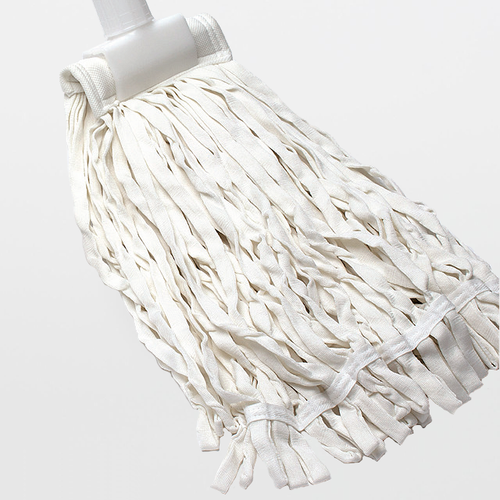
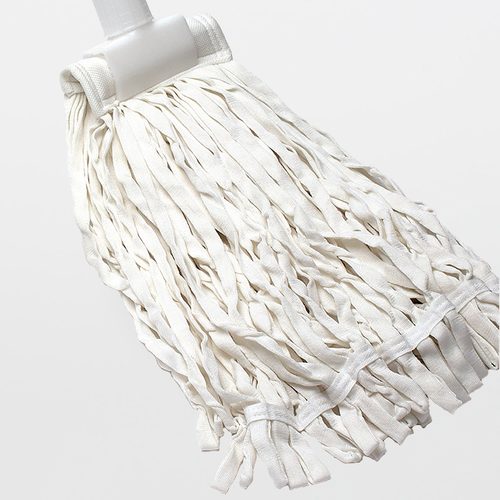
Texwipe TX7106 BetaMop® Cleanroom Mop Kit — 60" Fiberglass Handle + Quick-Open Clamp + TX716R Polyester String Refill
TX7106 is a corrosion-resistant cleanroom mop kit designed for floor cleaning in critical environments where you need controlled solution application, predictable head changes, and low-linting performance compared to conventional cotton string mops. The quick-opening clamp supports fast mop-head swaps to keep workflows moving while reducing the temptation to “push a dirty head too far” during long runs.
For over 35 years, SOS and Texwipe have been close partners, and SOSCleanroom is the authorized Master Distributor of ITW Texwipe for the United States market. That relationship matters when you are standardizing cleanroom mopping hardware: it supports continuity of supply, stable product lineage, and fast access to the manufacturer documentation your QA/QC team expects.
Published configuration (TX7106)
- Part number: TX7106
- Kit type: BetaMop® hardware kit (handle + clamp/head frame) with (1) TX716R head refill included
- Handle length: 60" (1.5 m)
- Handle material: White fiberglass
- Head/refill included: TX716R polyester string refill (tubular knit polyester); non-sterile configuration as published for TX716R
- Head change mechanism: Quick-opening / rapid-release clamp
- Design intent: For use with wring-bucket systems; compatible with most string-mop wringers and commonly paired with Texwipe buckets
- Sterilization: Autoclave safe / steam autoclave sterilizable (validate your site cycle parameters)
- Packaging: 1 kit per case (as published)
| Kit component |
What it does in the process |
Published note |
| 60" fiberglass handle |
Reach and leverage for controlled strokes; supports consistent contact pressure |
Lightweight, corrosion-resistant construction as described for the BetaMop system |
| Quick-open clamp/head frame |
Rapid head changes to reduce cross-contamination risk and downtime |
Designed for compatibility with most string mop heads; quick-opening clamp |
| (1) TX716R polyester string refill |
High sorptive capacity for solution pickup and laydown; supports floor cleaning and disinfectant application |
TX716R is listed as non-sterile, double-bagged (refill packaging); capacity is published for the BetaMop refill family |
Low-linting intent — and the reality check
TX7106 is designed for low-linting, low fiber and particle release compared to conventional mops, but no mop system is truly particle-free. Treat mopping hardware like a contamination-controlled component: control staging, solution management, and change-out timing so you do not turn the mop into a mobile contamination source.
Practical cleanroom mopping guidance (technicians and engineers)
- Pre-stage like a controlled process: Stage the mop kit, compatible bucket/wringer, and approved solutions outside the critical zone so you are not opening packaging or handling secondary items near exposed product.
- Control solution loading: Saturate and wring to a repeatable wetness level. Over-wet mops drive streaking, puddling, and longer dry times; under-wet mops can abrade and redeposit.
- Work clean-to-dirty with defined lanes: Use overlapping strokes and fixed lanes to prevent backtracking across cleaned areas. Reserve edge work (walls/thresholds) for last if your SOP treats edges as higher risk.
- Change heads before they fail: If the head begins to drag, leave residues, or visibly loads with debris, swap it. The quick-open clamp is there to support disciplined change-out without process delays.
- Document the variables that matter: Record solution type/concentration, dwell time, head changes, and room/area coverage. Investigations often hinge on whether cleaning parameters were controlled, not just whether cleaning occurred.
Compatibility, disinfectant use, and sterilization notes
- Disinfectants and germicides: The BetaMop system is described for applying and removing solutions including disinfectants. Always confirm your mop head material compatibility with your site chemistry and required contact times before full standardization.
- Autoclave use: Components are described as autoclave safe / steam autoclave sterilizable. If you autoclave, qualify your exact cycle (temperature, time, dry phase) and define post-autoclave handling so you do not recontaminate on cool-down.
- Wring-bucket systems: Designed for use with wring-bucket systems. Use a wringer that does not tear or snag the head (snags create fiber release and performance drift).
- Residue management: If residues or haze appear after drying, the common causes are over-wetting, incorrect dilution, dirty solution, or pushing beyond head capacity. Correct the variable rather than increasing scrubbing force.
Refill ecosystem and selection logic (for standardization)
TX7106 ships as a hardware kit with one TX716R head refill included, and it is designed to support multiple BetaMop® compatible refill types depending on what you are trying to remove (films, particles, bioburden) and how your room is qualified.
| Compatible refill (examples) |
Material / construction |
Published capacity (typical) |
When technicians choose it |
| TX716R (included head) |
Polyester string mop refill (tubular knit polyester) |
1.3 liters/head |
General floor cleaning and solution laydown where high sorptive capacity and durability are the priority |
| TX7070 |
Microdenier 100% polyester string refill |
1.8 liters/head |
Higher lifting/capturing power for fine particles and streak-reduction expectations |
| TX1722 |
Revolve™ sustainable polyester string refill (upcycled polyester) |
1.5 liters/head |
Facilities targeting sustainability goals while staying inside a cleanroom mop family |
| STX1722 (sterile option) |
Sterile Revolve™ refill (triple-bagged as published) |
1.5 liters/head |
Programs requiring sterile-ready packaging and controlled introduction into higher-grade areas |
Published applications and where it fits
| Use case |
Why the kit format helps |
Industries called out in published materials |
| Routine floor cleaning in controlled environments |
Quick head swaps support consistent change-out intervals and reduce cross-contamination pressure |
Pharmaceuticals, biologics, medical device, compounding pharmacy, microelectronics, semiconductor |
| Disinfectant/germicide application and removal |
Hardware stability supports uniform strokes; refills allow chemistry-appropriate selection |
Facilities and controlled environments where documented cleaning is audited |
| Spill control and removal |
High sorptive refill options support faster pickup with fewer passes |
Programs with formal deviation/investigation workflows |
Common failure modes
- Streaking / film residue: Most often from over-wetting, incorrect dilution, or dirty solution. Prevent with controlled wringing, fresh solution management, and defined coverage limits per head.
- Cross-contamination between zones: Happens when the same head is used across “clean” and “dirty” areas or when head changes are delayed. Prevent with zone-specific heads and a planned change-out cadence.
- Fiber/particle mobilization: Triggered by snagging on rough floors, drains, thresholds, or damaged wringers. Prevent by inspecting contact surfaces and replacing any wringer that tears or catches the mop.
- Clamp slippage or inconsistent contact: Usually from improper seating of the head in the clamp or rushed change-outs. Prevent with a quick visual check after every head install and a short “test stroke” in the staging area.
Storage and handling best practices
- Keep the mop kit and refills in original packaging until introduced into the controlled area.
- Do not stage mop heads open to airflow; keep heads protected until the point of use to reduce particle deposition.
- After use, segregate “dirty” hardware and heads from clean staging areas; avoid carrying an exposed head through cleaner zones.
- If your program launders/rewashes heads, define maximum rewash cycles, inspection criteria, and rejection triggers (fraying, loss of absorbency, persistent residues).
Documentation
SOS-hosted Texwipe datasheet (BetaMop™ II Mop System, Effective: February 2013):
Click HereSOS-hosted Texwipe technical data sheet (Cleanroom Mops — BetaMop® / Buckets / Refills, 2014 PDF):
Click HereTexwipe manufacturer PDF (BetaMop™ Series Technical Data Sheet, Document: TEX-LIT-TDS-002-11/21):
Click Here
Last updated: January 9, 2026
If you have any questions please email us at Sales@SOSsupply.com or give us a call at (214)340-8574.
Check out the AI ChatBot powered by SOSCleanroom data libraries - give it a try!
THIS IS NEW FOR 2026!
© 2026 SOS Supply. All rights reserved.