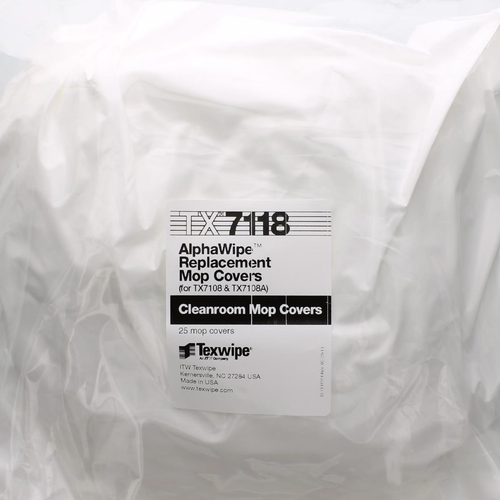
Texwipe TX7114 Mini AlphaMop™ / Isolator Cleaning Tool™ Replacement Mop Covers — Polyester, 8" x 5", Non-Sterile
TX7114 is a quick-change replacement cover set for the Mini AlphaMop™ / Isolator Cleaning Tool™ platform, built for controlled cleaning inside isolators, glove boxes, biosafety cabinets, laminar flow hoods, and other small, hard-to-reach areas. These cleanroom-laundered, knitted polyester covers are intended for cleaning processes that prioritize low particle, extractable, and ionic contamination while maintaining practical, repeatable technique for technicians working close to critical surfaces.
For over 35 years, SOS and Texwipe have been close partners, and SOSCleanroom is the authorized Master Distributor of ITW Texwipe for the United States market. That matters when you are standardizing mop platforms for critical environments: it supports continuity of supply, consistent product lineage, and fast access to the manufacturer documentation your QA/QC team expects.
Published configuration (TX7114)
- Cover size: 8" x 5" (as published)
- Cover material: Knitted 100% polyester (cleanroom laundered, as published)
- Sterility: Non-sterile
- Packaging (inner): 25 covers per bag
- Packaging (case): 6 bags per case (total 150 covers per case)
- Pads included: 6 pads per case (SOSCleanroom listing references foam pads; manufacturer TDS references polyester pads)
- Bagging: Covers/pads packaged for clean introduction (double-bagged noted in manufacturer TDS)
- Compatible platform: Mini AlphaMop™ / Isolator Cleaning Tool™ systems (used with TX7101 kit; SOSCleanroom listing notes use with TX7101 and TX7104)
- Cleanroom environment (as published): Mini AlphaMop™ Series listed for ISO Class 2–7; pads/covers section listed for ISO Class 3–7; Class 1–100,000; EU Grade A–D
- Shelf life (as published): Non-sterile — 5 years from date of manufacture
Where it fits in critical environments
| Use location |
Why TX7114 is used |
Technician notes |
| Isolators / glove boxes |
Small-area access with rapid cover changes to support strict cleaning protocols. |
Plan a cover-change cadence (e.g., per wall/ceiling panel or per defined area) to prevent redeposition. |
| Biosafety cabinets / laminar flow hoods |
Controlled wiping of interior surfaces without bulky tools. |
Use low-pressure strokes to avoid aerosolizing residues; treat corners as a separate pass with a fresh face of the cover. |
| Workbenches / small fixtures |
Repeatable, documented wiping with a consistent pad-backed contact area. |
Define a start-to-finish pattern (top-to-bottom, clean-to-less-clean) and stop once the cover is loaded. |
Materials and construction
- Cleanroom-laundered knitted polyester: Intended for cleaning processes requiring low particle, extractable, and ionic contamination (as published).
- Pad-backed contact: The pad is intended to help the cover conform to surfaces for more consistent contact (as published at the series level).
- Quick-change discipline: The Mini AlphaMop™ platform is engineered for frequent cover changes during operation to support strict cleaning protocols (as published).
Practical cleanroom use guidance (technicians and engineers)
- Define your change frequency before you start: The fastest way to lose control is to “keep wiping” with a loaded cover. Set an area limit per cover (panel-by-panel or a measured zone) and treat cover changes as part of the protocol, not as an exception.
- Use a one-direction pattern: Wipe in single-direction strokes where practical (clean-to-less-clean). Avoid short back-and-forth scrubbing that can redeposit residues or drag particles.
- Control pressure: Use enough pressure to maintain full contact, but do not “lean into it.” Excess pressure increases abrasion risk and can reduce capture by smearing films across the surface.
- Corner/edge control: Treat corners and gasket lines as their own step. Rotate to a fresh face of the cover before entering corners to reduce streaking and residue carryover.
- Keep chemistry in check: Apply solutions per your site SOP, avoid over-wetting that can drip into seams/crevices, and allow required wet-contact time when using disinfectants.
| Operational step |
Contamination-control intent |
Floor-ready tip |
| Stage clean covers |
Minimize open-package time and uncontrolled exposure. |
Open only what you will use for the task window; keep the remainder sealed until needed. |
| Wet to SOP (if applicable) |
Deliver consistent wet film without dripping. |
If the cover is visibly dripping, it is over-wet for most interior work; recondition per SOP. |
| Wipe and rotate faces |
Prevent redeposition and streaking. |
Treat each fresh face as a new “wiping surface” and stop once the last face is loaded. |
| Change covers frequently |
Support strict cleaning protocol adherence (series intent). |
Pre-stage a waste bag and remove the used cover without snapping/shaking. |
Compatibility and solution-use notes
The Mini AlphaMop™ Series is presented for applying/removing disinfectants and for hard-to-reach cleaning. SKU-specific chemical compatibility for TX7114 polyester covers is not published as a specification; qualify under your site chemistry, concentration, contact time, and drying requirements before standardizing.
| Chemistry / condition |
Published note |
What to control in practice |
| Disinfectants (site SOP) |
Series presented for applying/removing disinfectants. |
Contact time, over-wetting, streaking risk, and cover-change frequency. |
| Quats / broad disinfectant compatibility |
Microdenier cover option is described as compatible with all disinfectants, including quats (series note for the microdenier variant). |
If you run heavy quat rotation, consider validating polyester vs. microdenier performance and residue potential. |
| Solvents / elevated temperature references |
Solvent/temperature statements are published within the series documentation for related cover styles (see TDS). |
Do not assume interchangeability across cover types; document the exact cover SKU in the SOP and qualify accordingly. |
Contamination risk management (particles, residue, and fibers)
- Low contamination intent: Polyester covers are described for processes requiring low particle, extractable, and ionic contamination (series-level description).
- Bagging matters: Double-bag packaging supports controlled introduction. Do not defeat the system by staging opened bags in uncontrolled areas.
- Residue control: Residue is usually a technique problem (over-wet, wrong direction, or insufficient changes). Treat “fresh cover faces” as a hard requirement on critical surfaces.
- Reality check: No textile cleaning component is truly “lint-free.” Control abrasion, pressure, and change frequency to minimize fiber/particle mobilization.
Common failure modes
- Streaking / smearing: Often from over-wetting, uneven pressure, or reusing a loaded cover. Prevent with controlled wet film, single-direction strokes, and frequent cover changes.
- Residue carryover: Happens when a used cover is dragged into a new zone or when chemistry is not allowed to dry per SOP. Prevent with zone discipline and documented change points.
- Particle redeposition: Caused by excessive passes with the same cover face or “backtracking.” Prevent by working clean-to-less-clean and rotating to fresh faces.
- Abrasion-driven shedding: Triggered by high pressure, sharp edges, or scraping. Prevent by lowering pressure and treating burrs/fasteners as hazards that should be addressed before cleaning.
- Cross-contamination during change-out: Snapping or shaking used covers can release captured material. Prevent by removing slowly and containing immediately.
- Static attraction: In low humidity, fines can be attracted to textile surfaces. Follow facility ESD and humidity controls where required.
Packaging, sterility options, and adjacent SKUs (for standardization)
Many programs standardize one handle/head platform and then qualify cover types (polyester vs. microdenier) and sterility state (non-sterile vs. sterile) by room and process step. The table below is published at the Mini AlphaMop™ Series level for planning and documentation alignment.
| SKU |
Material |
Sterility |
Published packaging / case |
Bagging note (as published) |
| TX7114 |
Polyester covers + pads |
Non-sterile |
150 covers/case (6 bags of 25 covers) and 6 pads/case |
Double-bagged |
| TX7114M |
Microdenier covers + pads |
Non-sterile |
150 covers/case (6 bags of 25 covers) and 6 pads/case |
Double-bagged |
| STX7114 |
Polyester covers + pads |
Sterile |
125 covers + 25 pads/case (25 bags of 5 covers and 1 pad) |
Triple-bagged |
| STX7114M |
Microdenier covers + pads |
Sterile |
125 covers + 25 pads/case (25 bags of 5 covers and 1 pad) |
Triple-bagged |
Storage and handling best practices
- Keep covers/pads sealed in original packaging until point-of-use; introduce through your normal material airlock and wipe-down steps if required by SOP.
- Store in a clean, dry location; avoid crushing bags (compressed textiles can change how they wet-out and can complicate clean introduction).
- Use FIFO and record lot/receipt data if your documentation program requires traceability.
- Do not stage opened bags near high-traffic airflow or under diffusers where fallout can load the exposed covers before use.
Documentation
SOS-hosted Texwipe datasheet (Mini AlphaMop™ TX7101 / TX7114, Effective: January 2013):
Click HereTexwipe Technical Data Sheet PDF (Mini AlphaMop™ Series, US-TDS-068 Rev.11/21):
Click Here
If you have any questions please email us at Sales@SOSsupply.com or give us a call at (214)340-8574.
Check out our AI ChatBot powered by SOSCleanroom data libraries - give it a try!
THIS IS NEW FOR 2026!
Last reviewed: January 9, 2026
© 2026 SOS Supply. All rights reserved.