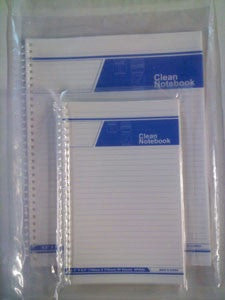
Unitek CRP0770-8W Cleanroom Notebook — 8.5" x 11", White Paper, Lined
CRP0770-8W is a spiral-bound cleanroom notebook for technician note-taking, equipment logs, maintenance records, deviation notes, and controlled-environment data capture where particle-shedding control and handling discipline matter. It uses semi-transparent, high-density polyethylene covers, a side-spiral binding that lays flat for controlled page rotation, and low-sodium inks to help reduce ionic contamination risk during routine documentation.
Use cleanroom stationery like this to keep office-grade paper and uncontrolled inks out of the critical environment, while maintaining legible, auditable records at the point of use.
Published configuration (CRP0770-8W)
- SKU: CRP0770-8W
- Notebook size: 8.5" x 11"
- Paper style: Lined paper
- Pages: 100 pages per notebook
- Cover material: Semi-transparent, high density polyethylene covers
- Binding: Side spiral; notebook lays flat with full rotation
- Ink system: Low sodium inks
- Packaging: Cleanroom packaged
- Order unit: 1 notebook (100 pages)
Low particle and fiber generation — and the reality check
This notebook is designed for ultraclean handling with low particle and fiber generation. Even so, no paper product is truly non-shedding in real operations. Treat stationery like a contamination-controlled component: control when it is opened, how it is transported, and what touches the pages.
Practical cleanroom use guidance (technicians and engineers)
- Open/close discipline: Open slowly and keep it closed when not in use to reduce “air pumping” that can mobilize fines.
- Segregate the work zone: Keep the notebook off critical surfaces; do not lay open pages on benches where residues or particles can transfer.
- Glove control: Avoid wet gloves and solvent-wet fingertips. Wet gloves are a primary driver of smearing, transfer, and page-edge degradation.
- Page handling: Flip pages deliberately and avoid aggressive page fanning near product or open assemblies. Keep sleeves and garment cuffs off the writing area.
- Dedicated-use logic: Assign notebooks by tool, room, or line where practical to reduce cross-area particle and residue transport and to support investigations.
Compatibility and wipe-down notes
- Cover wipe-down: The cover material is described as chemical resistant. If your SOP permits wipe-down introduction, wipe the closed notebook first, avoid saturating page edges, and allow full dry time before opening.
- IPA resistance (ink/pages): Not published for CRP0770-8W. If your process includes routine solvent contact, qualify the notebook with your site chemicals and dry-time rules before standardizing.
- DI water / aqueous wipe-down: Not published. If aqueous wipe-down is required, validate for swelling, page edge wicking, and any legibility changes under your conditions.
- Technique control: Wipe the closed cover first, avoid dragging wipes across page edges, and do not re-open until fully dry to reduce residue, ink transfer, and particle mobilization.
Typical performance characteristics
No quantitative paper performance values (basis weight, caliper, tensile, surface resistivity, etc.) are published for CRP0770 notebooks in the available manufacturer materials. Use this section as a qualification checklist for your internal validation plan.
| Property |
Typical value |
Test method (as published) |
| Basis weight |
Not published |
Not stated |
| Caliper |
Not published |
Not stated |
| Surface resistivity / ESD behavior |
Not published |
Not stated |
Typical contamination characteristics
No quantitative contamination test values (particles, ionic extractables, NVR) are published for CRP0770 notebooks in the available manufacturer materials. The notebook is positioned for low particle and fiber generation and reduced ionic contamination via materials and low sodium inks.
| Property |
Typical value |
Test method (as published) |
| Particles |
Not published |
Not stated |
| Ionic extractables (e.g., sodium, chloride) |
Not published |
Not stated |
| Non-volatile residues (NVR) |
Not published |
Not stated |
Common failure modes
- Smearing / ink transfer: Most often from wet gloves, solvent contact, or closing pages before dry time. Prevent with glove moisture control and dry-time discipline.
- Paper dusting / abrasion: Triggered by high writing pressure, scraping tools, or aggressive correction practices. Prevent with controlled writing pressure and SOP-correct error correction (strike-through/initial if applicable).
- Residue carryover: Transfer from benches, sleeves, or contaminated gloves. Prevent by keeping pages off work surfaces and maintaining “documentation-only” handling.
- Static attraction: In low humidity, stationery can attract fines. Prevent by following site ESD controls and minimizing rubbing/friction between covers and garments.
- Edge wicking / swelling: Caused by wiping too aggressively near page edges or saturating the binding area. Prevent by wiping the closed cover only and allowing full dry time before opening.
Storage and handling best practices
- Keep notebooks in original cleanroom packaging until introduced into the controlled area.
- Store closed to reduce particle deposition on pages; transport in a clean pouch or drawer when possible.
- Avoid stacking with abrasive tools, clips, or metal hardware that can scuff covers and generate debris.
- Control exposure to wet chemicals; do not allow page edges or the spiral to wick solvent.
Documentation
SOSCleanroom product page (CRP0770-8W):
Click HereManufacturer product page (CRP0770 series — lined or grid options):
Click HereManufacturer technical data sheet (Cleanroom Notebook — CRP0770):
Click Here
If you have any questions please email us at Sales@SOSsupply.com or give us a call at (214)340-8574.
OR check out the AI ChatBot powered by SOSCleanroom data libraries - give it a try!
THIS IS NEW FOR 2026!
© 2026 SOS Supply. All rights reserved.