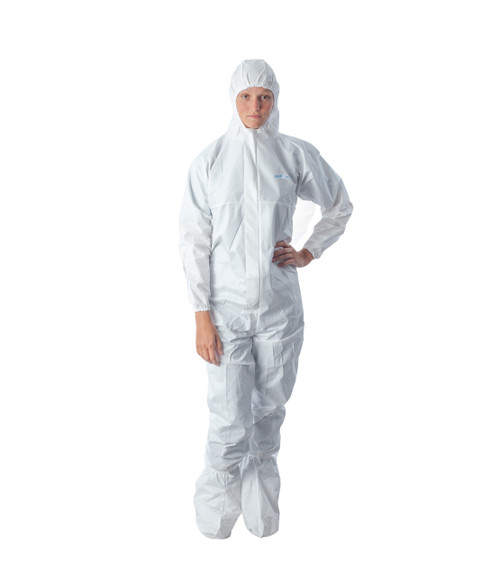
Why head coverings matter in cleanrooms
In most controlled environments, people are the dominant contamination source. Hair and scalp shedding can release both particles and microbiological contamination,
especially when operators move, turn, or adjust garments. A bouffant cap is a simple, high-impact control: it helps contain shedding at the source and stabilizes gowning outcomes across operators and shifts.
What BBC is (manufacturer-basis)
BioClean™ Bouffant Cap BBC is described by the manufacturer as lightweight and breathable, intended to reduce the risk of head-area contamination entering controlled environments.
Construction is published as soft spunbond polypropylene with elasticated double stitching and latex-free elastic.
Packaging is published as 100 pieces per sealed inner PE bag, 10 inner bags per sealed outer PE bag, and one outer bag per lined carton (1000 pieces).
Storage and shelf-life conditions are also manufacturer-published and should be treated as receiving and inventory controls (not “nice-to-have” details).
ISO-first: aligning gowning to ISO cleanroom operations
ISO 14644-5 (Cleanrooms — Operations) emphasizes an operations control programme that includes personnel management and controlled entry/exit behaviors.
In practical terms: define a gowning sequence, train it, enforce it, and audit it. Head coverage is not optional “PPE”; it is a contamination-control system element.
ISO-oriented donning discipline for bouffant caps (operator technique)
- Pre-control the source: tie back hair before gowning; remove hair accessories that shed or snag.
- Don early: put the bouffant cap on before higher-critical garments so hair is contained throughout the rest of the sequence.
- Full enclosure: confirm coverage around the ears, sideburn area, and nape. If facial hair exists, follow your SOP for beard coverage or hooding.
- Hands-off after donning: minimize adjustments. If you must adjust repeatedly, discard and replace.
- Avoid cross-contact: do not set garments on uncontrolled surfaces; treat the outer surface as a controlled garment surface.
Annex 1 (EU GMP): what regulated sterile programs expect
If you operate under (or align to) EU GMP Annex 1, gowning expectations become more explicit by cleanliness grade. Annex 1 states that:
in Grade C and Grade D, hair (and beards/moustaches) should be covered; and in Grade B (supporting Grade A), sterile headgear should enclose all hair (including facial hair),
with additional controls for face covering, eye covering, and garment interface management (e.g., sleeves tucked into gloves, trouser legs tucked into footwear).
Even when your environment is not an EU sterile facility, Annex 1 is a useful benchmark for “what good looks like” when contamination control is the priority.
Use it to stress-test your gowning SOP: are you truly enclosing hair, preventing garment contact with floors, and minimizing outer-surface contact during donning?
Specifications (published; manufacturer basis)
| Attribute |
BioClean™ BBC |
| Product identifier |
BBC |
| Reorder number |
BBC-W |
| Construction |
Lightweight, soft spunbond polypropylene; elasticated double stitching |
| Color / size |
White; universal size |
| Packaging overview |
100 pieces/inner PE bag; 10 inner bags/outer PE bag; one outer bag per lined carton (1000 pieces) |
| Storage |
Store dry/cool (up to 40°C), away from direct sunlight and fluorescent light |
| Shelf life |
Five (5) years from date of manufacture |
| Country of origin |
China |
| Audit / standards notes |
Manufacturing QMS audit standards include ISO 9001 and PPE Regulation 2016/425 Module D; ISO 9001:2015 referenced |
Common failure modes (and how to prevent them)
- Hair left exposed at the ears or nape: full enclosure check before proceeding to the next garment step.
- Repeated adjustments after donning: treat as a discipline issue; replace if overhandled.
- Garment cross-contact: avoid uncontrolled surfaces; keep clean/dirty separation in the gowning room.
- SOP drift across shifts: standardize training and do periodic gowning observations.
SOSCleanroom note about SOPs
The Technical Vault is written to help customers make informed contamination-control decisions and improve day-to-day donning technique.
It is not your facility’s SOP, batch record, validation protocol, or regulatory interpretation.
Customers are responsible for establishing, training, and enforcing SOPs that fit their specific risks, products, equipment, cleanroom classification, and regulatory obligations.
Always confirm suitability using your internal quality system and documented methods.
Treat technique guidance here as a starting template. Your team should review and approve the final method, then qualify it for your environment and contamination control strategy.
Source basis
- SOSCleanroom product page (BBC): https://www.soscleanroom.com/product/gloves-apparel/ansell-bbc-bioclean-bouffant-cap/
- Manufacturer Technical Data Sheet / PDS (BioClean™ Bouffant Cap BBC): https://www.soscleanroom.com/content/ansell2/bioclean-bouffant-cap-bbc_pds_us.pdf
- ISO 14644-5 (Operations; standard overview): https://www.iso.org/standard/88599.html
- EU GMP Annex 1 (Manufacture of Sterile Medicinal Products; Personnel/Gowning): https://health.ec.europa.eu/system/files/2022-08/20220825_gmp-an1_en_0.pdf
SOSCleanroom is the source for this Technical Vault entry.
Briefed and approved by the SOSCleanroom (SOS) staff.
If you have any questions please email us at Sales@SOSsupply.com
Last reviewed: Jan. 14, 2026
© 2026 SOSCleanroom