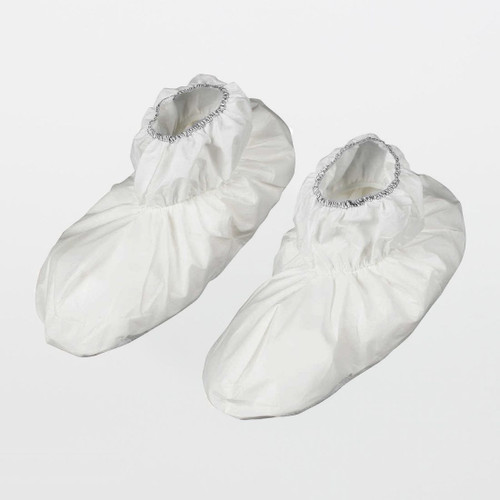
SCPL500 Poly Latex Shoe Cover

$85.00
(No reviews yet)
SKU:
SCPL500
Availability:
7 - 10 Business Days
Shipping:
Calculated at Checkout
CT International SCPL500 Poly Latex Shoe Covers (White) — Liquid-Impervious, Non-Skid, Individually Inspected, Lot Traceability, 500 Pairs/Case
Shoe Cover Poly / Latex Impervious to Liquids Non-Skid Comfortable Fit Individually Inspected Lot Traceability 16" Length 500 Pairs/Case Uni-Size

Overview

CT International’s SCPL500 Poly Latex Shoe Covers are engineered for contamination-control workflows where facilities want a more protective footwear barrier than basic fabric booties. The SCPL500 design is described as strong and durable, while remaining lightweight for improved comfort and day-to-day compliance.

These covers are designed to be impervious to liquids and include a non-skid sole concept to support traction where floors may be smooth or frequently cleaned/disinfected.


Why this shoe cover matters in controlled environments
  • Footwear is a contamination vector: Shoes track debris and residues from corridors into controlled zones—shoe covers help break that transfer chain.
  • Liquid barrier where it counts: An impervious cover helps reduce exposure to wet floors, cleaning residues, and splash events in support areas.
  • Non-skid for safer movement: Traction matters on smooth epoxy floors and frequently disinfected surfaces.
  • Audit and program control: Individual inspection and lot traceability support consistent PPE standardization across shifts and sites.

Typical tasks supported
  • Gowning and transition areas (bench/line entry control)
  • Material staging, support corridors, and controlled manufacturing support spaces
  • Cleaning/disinfection workflows where floor moisture is common
  • Visitor PPE programs and maintenance entry controls
  • General contamination-control programs where shoe cover change triggers are defined in SOP

Key specifications (published)
Manufacturer / model CT International — SCPL500
Available quantity option Case
Case unit 1000 shoe covers (500 pairs)
Length 16" (+/- 0.5)
Color / size White; Uni-Size
Thickness (published) 4.7 mil (+/- 0.1)
Material weight (published) 6.7 gms (+5%)
Packaging (published) Poly bagged, flat packed; 100/bag; 10 bags/case; 500 pairs/case
Availability / ship timing (SOS listing) 7–10 business days

If your SOP requires sterile presentation, cleanroom-laundered garments, or documented low-lint performance aligned to ISO 5 / Annex 1 aseptic operations, contact SOSCleanroom for a footwear-cover recommendation matched to your contamination-control strategy.


EU GMP Annex 1 alignment notes (practical)

Annex 1 programs treat garments (including footwear controls) as part of a documented Contamination Control Strategy (CCS). Selection is only one control—performance depends on how shoe covers are donned, how traffic is managed, and how change triggers are enforced.

  • Bench/line entry: prevent uncovered shoes from contacting the clean-side floor.
  • Change triggers: replace immediately if torn/soaked/soiled or after leaving controlled areas.
  • Control substitutions: treat changes in material/fit as a change-control item (comfort affects compliance).

Standards and regulatory references (context)

Documentation

Use these references for PPE program packets and purchasing standardization.


If you have any questions please email us at Sales@SOSsupply.com or give us a call at (214)340-8574. OR check out the AI ChatBot powered by SOSCleanroom data libraries - give it a try! THIS IS NEW FOR 2026! © 2026 SOSCleanroom. All rights reserved.
The Technical Vault By SOSCleanroom
Footwear Contamination Control Bench / Line Entry Liquid Barrier Traction Awareness Annex 1 CCS Mindset

Quick take

Footwear is one of the most common paths for contamination transfer into controlled environments. A shoe-cover program works when it is treated as a system: correct entry method, clear change triggers, and the right barrier/traction profile for your floors.


How to choose the right shoe cover (practical)
  • Barrier need: if floors are frequently wet (cleaning/disinfection), an impervious cover helps reduce transfer and exposure.
  • Traction need: smooth epoxy floors and disinfected surfaces often require non-skid designs and slower, deliberate movement.
  • Coverage need: select ankle vs. mid-calf vs. boot-height based on splash risk, floor contact, and SOP-defined boundaries.
  • Control need: lot traceability and inspection processes help standardize PPE programs and reduce “mystery substitutions.”

Best-practice donning (bench / line method)
  1. Prepare first: perform hand hygiene (or glove per SOP) before touching clean-side PPE.
  2. Stay on the “dirty side”: sit at the bench/line and cover one shoe completely (heel + toe fully contained).
  3. Cross with the covered foot: step to the clean side, then cover the second shoe.
  4. Confirm fit: if covers feel loose or require repeated adjustment, replace them (adjustment is a transfer risk).

Operational tip: most contamination escapes happen during entry. The bench/line method is a simple control that prevents uncovered shoes from ever contacting the clean-side floor.


Change triggers (write these into your SOP)
  • Immediate change: torn, soaked, visibly soiled, or slipping off the shoe.
  • Boundary change: after leaving controlled areas (do not re-enter with used covers).
  • Process change: after floor cleaning events or tasks that create heavy wetting/splash risk.

Annex 1 CCS note (sterile programs)

Annex 1 emphasizes a facility-wide Contamination Control Strategy (CCS). Footwear controls are rarely “just PPE”—they are traffic control, entry control, and behavior control. Treat shoe covers as part of the system: trained entry method, controlled change triggers, and documented substitution control.


Complete the entry controls (common pairings)
  • Sticky mats: reduce particle carryover at the boundary (use per SOP and replace before overload).
  • Hair restraints: bouffants and beard covers reduce the largest human-shed contamination sources.
  • Floor cleaning discipline: footwear controls are only as good as the cleaning program supporting them.

Standards context

If you have any questions please email us at Sales@SOSsupply.com or give us a call at (214)340-8574. OR check out the AI ChatBot powered by SOSCleanroom data libraries - give it a try! THIS IS NEW FOR 2026! © 2026 SOSCleanroom. All rights reserved.