
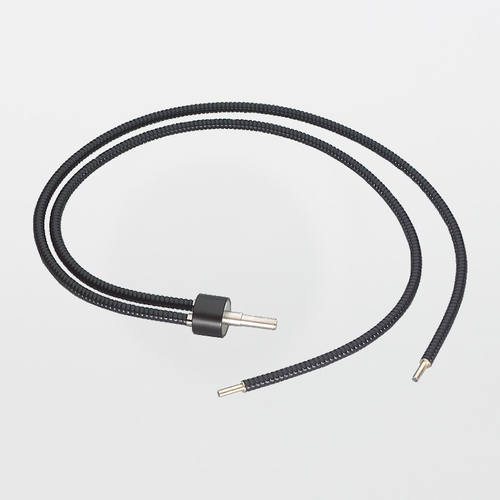
(KL Series) SCHOTT 155.204 Double Flexible Light Guide 4.5mm/1000mm

$346.00
(No reviews yet)
SKU:
155.204
Availability:
2 - 3 Weeks
Shipping:
Calculated at Checkout
Quantity Option (Each):
1 Light Guide
Compatibility:
KL Series (KL 1600 / KL 2500)

(KL Series) SCHOTT 155.204 Double Flexible Light Guide — Ø 4.5mm / 1000mm

The SCHOTT 155.204 is a 2-branch (dual) flexible fiber optic light guide designed to deliver illumination from a remote KL-series light source to two independently positionable branches. This configuration is widely used for stereo microscopy and precision inspection where you want controllable, directional light without moving the microscope or the part.

Accessory note: This is a light guide (fiber optic). It does not generate light by itself and must be connected to a compatible SCHOTT KL-series light source.

Specifications:
  • Manufacturer: SCHOTT
  • Part number / SKU: 155.204
  • Type: Double Branch Flexible Light Guide (2-branch)
  • Length: 1000 mm (39.37")
  • Active Ø (each branch): 4.5 mm (0.18")
  • End tip Ø: 6.0 mm (0.24")
  • End tip length: 20 mm (0.79")
  • Active common end Ø: 6.4 mm (0.25")
  • Jacketing material: M-PVC
  • Outer Ø (jacketing): 9.8 mm (0.39")
  • Light source adapter Ø: 10 mm (0.39")
  • Quantity option: 1 Light Guide
  • Availability: 2–3 Weeks
  • Weight: 2.00 lbs
SCHOTT 155.204 Features
  • 2-branch flexibility: independently aim two light outputs for balanced contrast
  • M-PVC jacketing: protective outer sheath to support daily handling and repositioning
  • Standardized interface: 10 mm adapter interface for KL-series light sources
  • Optimized tip geometry: 6 mm end tips with 20 mm length for stable positioning near the work zone
Why teams use a dual flexible light guide
  • Directional contrast control: rake light across surfaces to reveal scratches, chips, haze, or residue
  • Reduced station disruption: aim the branches instead of moving the part or microscope
  • Repeatable inspection: mark branch positions and light source setpoints to reduce operator-to-operator variation
  • Remote illumination: keep the light source off the immediate work area while still delivering light where needed
Compatibility (Common Pairings)

The 155.204 is listed as compatible with KL 1500, KL 1600, KL 2500 and is shown in your store under KL Series compatibility. Pair with:

About the Manufacturer: 

SCHOTT is a multinational technology group known for specialty glass and advanced materials, along with precision components and systems used in optical, industrial inspection, and life-science applications. In microscopy illumination, SCHOTT’s KL ecosystem is built around modular light sources and interchangeable light guides that help teams standardize illumination geometry and improve repeatability at inspection and imaging stations.

Related Light Guides & Alternatives

Notes: For best results, document branch angles, tip-to-part distance, and light source output settings. This reduces inspection drift and makes your station repeatable across shifts.

For application support, call 800-443-7101 or email Sales@SOSsupply.com.

Product page updated: Feb. 5, 2026 (SOS Technical Staff)

© 2026 SOSCleanroom.com. All rights reserved.

The Technical Vault: SCHOTT 155.204 Dual Flexible Light Guide (Ø 4.5mm / 1000mm)

Vault purpose: How dual flexible guides control contrast, how to set up repeatable geometry, and what parameters drive “seeing defects” vs “washing them out.”

1) What the 155.204 is (in station terms)

The SCHOTT 155.204 is a 2-branch flexible fiber optic light guide that splits output from a KL-series light source into two independently aimable illumination points. This is a standard way to build adjustable, directional lighting at microscopy and inspection stations without relocating the light source.

2) Why dual-branch lighting improves defect visibility
  • Raking light: a low-angle branch can amplify surface texture, scratches, chips, and haze.
  • Fill light: a second branch can reduce “black holes” and stabilize contrast without removing texture entirely.
  • Polar directions: opposing angles can help reveal edge features or contaminants that disappear under uniform lighting.
3) Geometry you should lock down (to reduce inspection drift)

Most “we can’t reproduce what the other shift saw” problems are geometry problems. For repeatability, document:

  • Tip-to-part distance: record a target range (e.g., 20–40 mm) depending on fixture clearance.
  • Branch angles: note approximate clock positions (e.g., 10 o’clock + 2 o’clock) relative to the part.
  • Light source setpoint: record the output setting used for pass/fail judgments.
  • Do-not-move marks: add simple witness marks on the guide sheath or station fixtures.

Reality check: If you change angle, you change what becomes visible. Treat illumination as a controlled process input, not a convenience accessory.

4) How the physical specs translate into station behavior
  • 1000 mm length: supports routing from light source to microscope without crowding the work envelope.
  • Ø 4.5 mm active branches: a common “precision aiming” diameter—small enough for tight setups, robust enough for frequent adjustment.
  • M-PVC jacketing: helps protect the bundle during repositioning and reduces handling damage over time.
  • Defined tip geometry: 6 mm tips / 20 mm length provide stable targeting near the part.
5) When to choose flexible vs rigid vs ringlight
  • Flexible dual (155.204): best when operators need frequent repositioning and variable contrast.
  • Rigid gooseneck dual: better when you want stiffness and “stays where you put it” aiming.
  • Ringlight: best for low-shadow uniform lighting and minimizing operator aiming variability.

Compare related options: 154.202 Dual Rigid, 157.410 Ringlight 58mm, 157.420 Ringlight 66mm.

6) Source basis (spec traceability)
  • SOSCleanroom listing: SCHOTT 155.204 product page (type, compatibility notes, and specifications including diameters, length, jacketing, and adapter size).