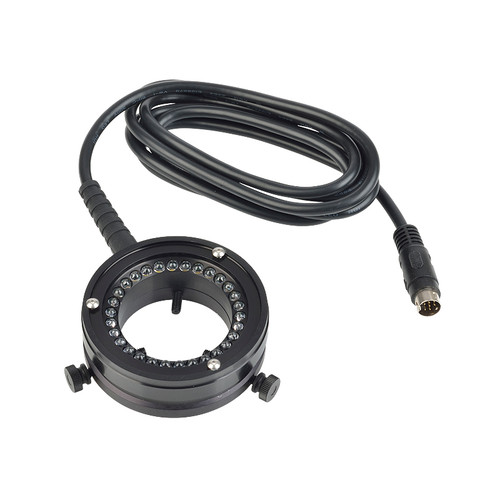
The Technical Vault: TechniQuip ProLine 80 (66 mm)
Vault purpose: High-output annular LED illumination behavior, optical distribution, and system-level deployment considerations for the ProLine 80 in microscopy and machine vision environments.
1) Illumination Architecture and Output Scaling
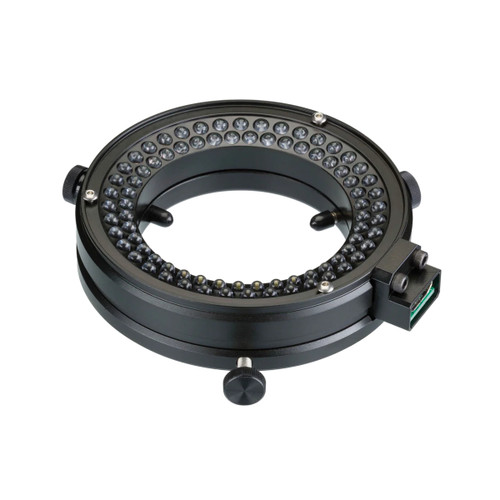
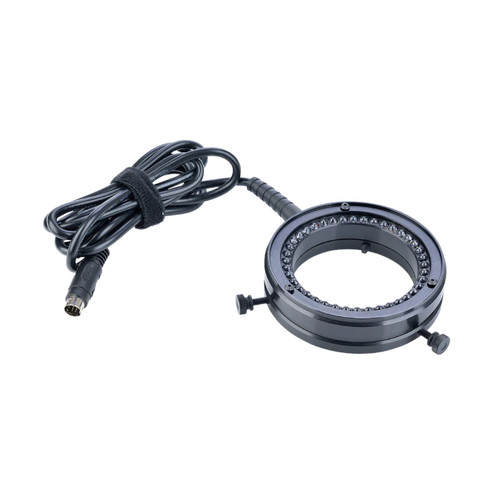
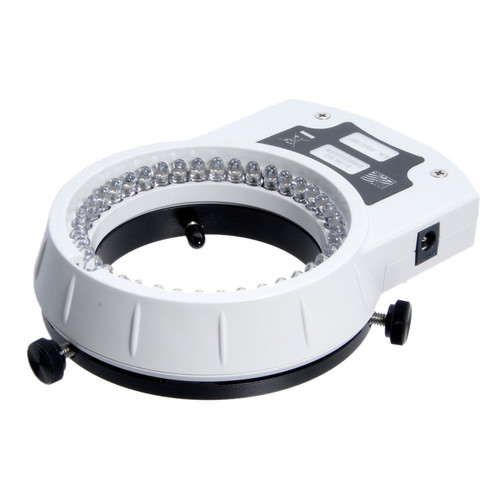
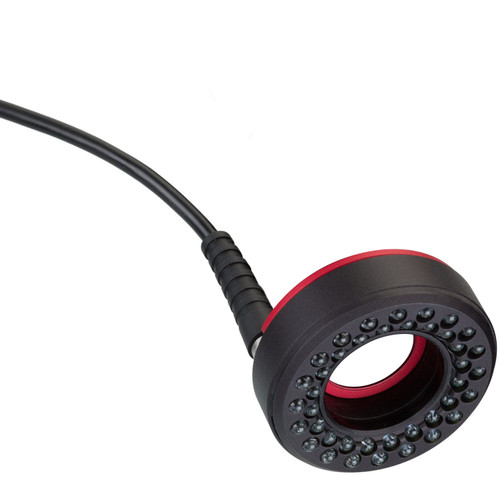
The ProLine 80 is a high-density annular LED illumination system that increases total radiant output by expanding LED count within a single-ring geometry. With 80 emitters distributed around the optical axis, the system produces significantly higher luminous flux compared to lower-density ringlights.
Unlike dual-ring architectures, the ProLine 80 maintains a single effective emission angle, meaning performance gains are driven by intensity and spatial density—not multi-angle illumination control.
2) LED Density and Illumination Uniformity
Increasing LED count improves the spatial overlap of individual emission cones, resulting in a smoother illumination field.
- Higher LED density reduces visible segmentation of light sources
- Improves near-field uniformity compared to lower-count ringlights
- Reduces intensity ripple across the field of view
- Enhances performance at shorter working distances
However, because all LEDs share a similar angle of incidence, uniformity improvements are limited to spatial blending rather than angular diversity.
3) Optical Interaction with Target Surfaces
Illumination behavior depends heavily on surface characteristics:
- Diffuse surfaces: Benefit from increased uniform intensity
- Specular surfaces: May reflect individual LED sources if working distance is too short
- Textured surfaces: Require directional lighting for enhanced contrast
The ProLine 80 is optimized for uniform illumination scenarios rather than directional defect enhancement.
4) Radiometric Behavior and Working Distance Effects
- Illuminance follows an inverse-square relationship with distance
- Beam overlap increases with distance, improving uniformity
- Short working distances increase angular variation and glare risk
- Longer working distances reduce intensity but improve field blending
Optimal performance is achieved by balancing working distance, intensity, and camera exposure settings.
5) Constant-Current Drive and Output Stability
The ProLine 80 operates using constant-current LED driver architecture, which stabilizes output regardless of voltage fluctuations or thermal changes.
- Maintains consistent luminous output during operation
- Reduces spectral shift during dimming
- Prevents thermal runaway conditions
- Supports predictable intensity control across inspection cycles
6) Thermal Management and LED Lifetime
Thermal stability is critical for maintaining LED performance and lifespan. The ProLine housing functions as a passive thermal dissipation system.
- Machined aluminum housing acts as a heat sink
- Reduces junction temperature fluctuations
- Maintains stable luminous output over time
- Extends LED operational life
Excessive thermal buildup can lead to intensity decay and color shift, which directly impacts inspection repeatability.
7) Comparison to Other Ring Light Architectures
| Type |
Strength |
Limitation |
| SlimLine (40 LED) |
Compact, efficient |
Lower output |
| ProLine 80 |
High output, improved uniformity |
Fixed illumination angle |
| ProLine 882 |
Multi-angle control |
More complex system |
8) Controlled-Environment Considerations
The ProLine 80 is not sterile or cleanroom-certified. Use in controlled environments depends on system placement, enclosure, and compatibility with cleaning protocols. Approval should be based on site-specific contamination control standards.
9) Best-Practice Deployment
- Optimize working distance before increasing intensity
- Use diffusers or polarizers for reflective surfaces
- Avoid running at maximum output continuously
- Document lighting and exposure settings for repeatability
10) Source Basis
- TechniQuip ProLine LED ring light documentation
- LED illumination system design principles
- Machine vision and microscopy lighting practices
- SOSCleanroom technical analysis