The Technical Vault: TechniQuip SlimLine 66 mm Ring Light
Vault purpose: Detailed analysis of single-ring LED illumination physics, driver behavior, optical geometry, and system-level deployment considerations for consistent inspection performance.
1) Illumination Architecture Overview
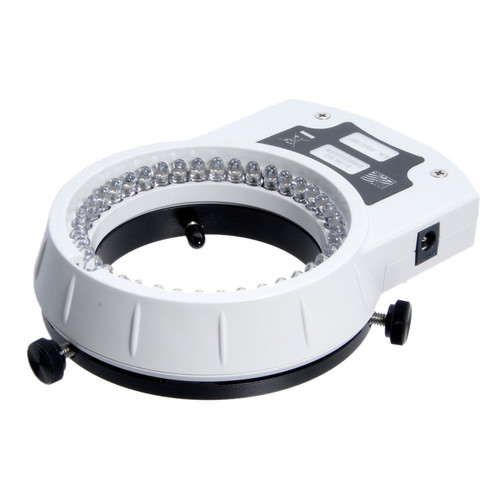
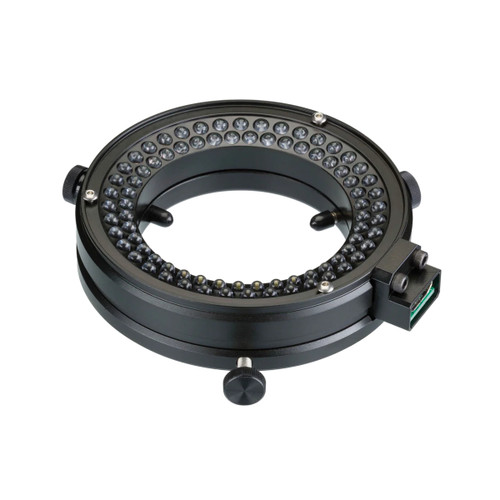
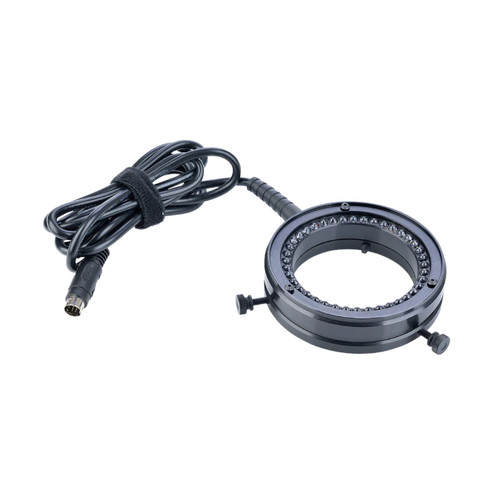
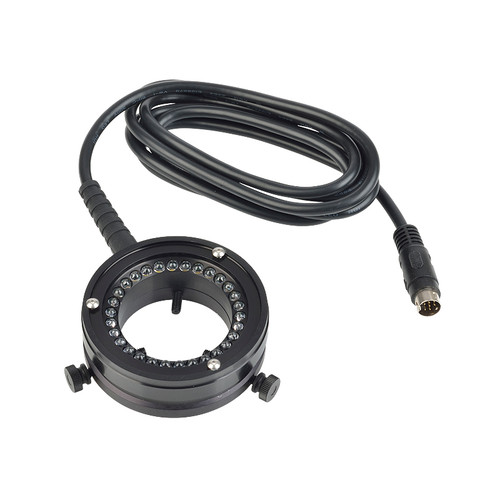
The SlimLine ring light utilizes a single-plane annular LED array, where multiple discrete emitters are arranged concentrically around the optical axis. Each LED contributes a partially overlapping beam pattern, forming a composite illumination field.
Unlike multi-ring systems, all emitters operate at a single effective emission angle, meaning illumination geometry is fixed relative to the working distance and cannot be dynamically altered through hardware segmentation.
2) Optical Geometry and Beam Interaction
Each LED produces a cone-shaped emission pattern defined by its viewing angle. In a ring configuration, these cones overlap to produce a quasi-uniform illumination field at the target plane.
- Illumination uniformity improves as working distance increases
- Closer working distances increase angular intensity variation
- Surface reflectivity strongly influences perceived uniformity
- Highly specular surfaces may reflect discrete LED sources
Because all LEDs share a similar incident angle, the system produces low-shadow, low-directionality illumination, which is beneficial for uniform inspection but less effective for enhancing surface topography.
3) Radiometric and Photometric Behavior
The SlimLine operates as a distributed light source with total output defined by the sum of individual LED radiant flux. The resulting illumination at the target is influenced by:
- Working distance (inverse-square relationship)
- LED beam angle and overlap
- Target surface reflectivity and texture
- Optical axis alignment and field coverage
In practical terms, intensity uniformity is not solely a function of brightness, but of angular distribution and spatial overlap of emitted light.
4) Constant-Current Driver Behavior
The SlimLine uses a constant-current LED driver architecture, which regulates current rather than voltage to maintain stable LED output.
- Prevents intensity drift due to thermal variation
- Reduces color temperature shift during dimming
- Maintains consistent luminous output across operating range
- Supports longer LED lifespan by avoiding overdrive conditions
In contrast, voltage-driven systems can exhibit non-linear brightness behavior and increased spectral instability under dimming conditions.
5) Thermal Management and Output Stability
LED output and lifetime are strongly influenced by junction temperature. The SlimLine housing uses machined aluminum as a thermal sink to dissipate heat away from the LED array.
- Improves thermal stability of LED junctions
- Reduces output degradation over time
- Maintains consistent spectral characteristics
- Supports longer operational life
Stable thermal conditions are critical in inspection systems where lighting drift can impact measurement repeatability.
6) Limitations of Single-Ring Illumination
- Fixed illumination angle limits contrast tuning capability
- Less effective for highlighting surface defects via shadowing
- May produce specular reflections on polished materials
- No segment control for directional biasing
For applications requiring adjustable illumination angle or defect-enhancing contrast, dual-ring or segmented systems may provide improved performance.
7) System Integration Considerations
- Ensure proper centering relative to optical axis
- Match working distance to desired illumination uniformity
- Coordinate lighting intensity with camera exposure settings
- Use diffusers or polarizers if glare reduction is required
Integration into machine vision systems should consider camera dynamic range, sensor response, and lens characteristics alongside illumination geometry.
8) Controlled-Environment Considerations
The SlimLine ring light is not sterile and not cleanroom-certified. Use in controlled environments depends on enclosure strategy, mounting position, and compatibility with approved cleaning procedures. Final suitability must be determined by site-specific contamination control protocols.
9) Best-Practice Deployment
- Set working distance first, then adjust intensity
- Avoid maximum output unless required for exposure
- Document lighting conditions for repeatability
- Validate illumination uniformity across field of view
10) Source Basis
- TechniQuip SlimLine and ProLine product documentation
- LED illumination system design principles (constant-current control, thermal management)
- Machine vision and microscopy illumination best practices
- SOSCleanroom technical analysis and application context