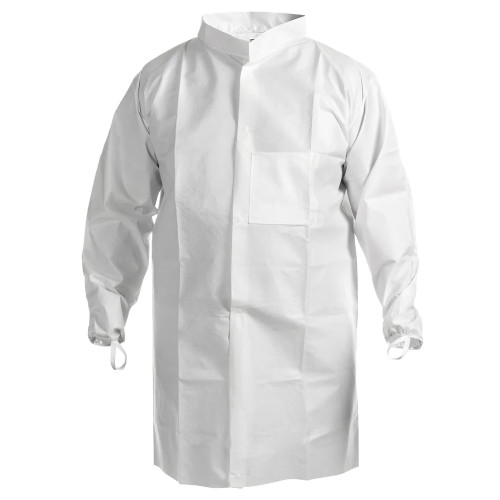
SKU shown: 47653 (A7 cleanroom lab coat, size Large).
Why lab coats matter in contamination control
In cleanrooms, the largest variable is often the human operator. Sleeves, wrists, collars, and front panels become repeated contact points with benches, carts, paperwork, and tooling.
A cleanroom lab coat reduces direct contamination transfer by covering shedding clothing and by stabilizing the glove/garment interface—especially when the coat includes thumb loops and cuffs that stay positioned during reach and bend movements.
The garment, however, is only as effective as the donning discipline behind it.
What this product is used for
- Support-zone and controlled-environment tasks where a lab-coat profile is preferred over a full coverall.
- QA/QC handling, material staging, and routine process support where sleeve/wrist contamination transfer is a known risk.
- Splash-limited tasks aligned to Type 6 “limited chemical splash” intent (per your risk assessment).
- Programs that need documented garment attributes and a consistent case format (30 per case) for stocking and training.
Why customers consider this product
- Interface control: elastic cuffs with thumb loops plus extra-length arms help reduce wrist exposure and sleeve ride-up.
- Durability in motion: triple stitched seams and a film-coated material support demanding shift work and frequent movements.
- Cleanliness-related indicators: low-lint (Helmke Drum Category II) and antistatic clothing (EN 1149-5) attributes support contamination-control programs.
- Document access: manufacturer states a Certificate of Conformance is available online for receiving and QA documentation workflows.
Materials, construction, and design controls
Manufacturer product information lists an abrasion-resistant film-coated polypropylene construction, a mandarin collar, snap front closure, triple stitched seams,
and a left chest pocket. Cuffs are elastic and the garment includes thumb loops and extra-length arms to support glove overlap.
Performance-related statements include: antistatic clothing (EN 1149-5:2008), low lint fabric (Helmke Drum Category II),
and a Type 6 limited chemical splash protection classification under PPE Cat II directive 89/686/EEC.
Material statements include silicone-free, BHT-free, and natural rubber latex-free.
Specifications in context
This table consolidates the manufacturer-published attributes that matter for sizing, stocking, and gowning training.
If your program requires additional attributes (sterility documentation, clean processing statements, or packaging detail),
treat those as receiving requirements and confirm before qualification.
| Attribute |
Kimtech 47653 (Large) |
| Product code |
47653 |
| Garment type |
KIMTECH PURE* A7 Cleanroom Apparel Lab Coat |
| Size |
Large (L) |
| Case pack |
30/Case |
| Chest width |
62 cm |
| Sleeve length |
67 cm |
| Total length |
101 cm |
| Material |
Abrasion-resistant film-coated polypropylene |
| Closures / cuffs |
Snap front; elastic cuff; thumb-loops; extra-length arms |
| Seams |
High strength triple stitched seams |
| Antistatic clothing |
EN 1149-5:2008 |
| Low-lint indicator |
Helmke Drum Category II |
| Limited splash category |
PPE Cat II directive 89/686/EEC; Type 6 limited chemical splash |
| Documentation |
Certificate of Conformance available online at kimtech.com/certificates |
| Country of origin |
Published as China on Kimtech/Ansell listing (confirm if required by receiving) |
Performance and cleanliness considerations
For garments, “performance” is mostly about controlling what escapes at sleeves, collar, and seams—plus reducing electrostatic attraction to particles.
Low-lint indicators and antistatic clothing statements support that goal, but the real control point remains technique:
how you don, how you glove over cuffs, and how often you touch the outside surfaces while working.
Documentation, traceability, and receiving discipline
The manufacturer references Certificate of Conformance availability online. In practice, cleanroom programs should define:
(1) when CoC retrieval is required, (2) how certificates are linked to lots/receipts, and (3) how long records are retained.
If your quality system requires country-of-origin verification, treat COO as a receiving checkpoint and confirm before qualification.
Best-practice gowning (donning) to minimize contamination
ISO-first approach: reduce particle transfer with disciplined donning
ISO 14644 cleanroom programs emphasize controlled operations, trained personnel behavior, and procedures that protect the classified space.
Your gowning method should be written, trained, and audited the same way you control cleaning and materials flow.
- Start with clean hands and containment: hand hygiene, hair/beard containment, and face covering per your classification and risk profile.
- Handle from the inside: treat the exterior as a “do not touch” surface. Use interior panels/collar to position the garment.
- Set the glove/garment interface: engage thumb loops, then pull gloves over the cuffs to maintain overlap through movement.
- Move deliberately: fast motions shed more particles. Slow down during donning and during high-reach tasks.
- Verify fit with a movement check: reach, bend, and twist—confirm sleeves do not ride up and collar stays seated.
EU Annex 1 overlay (sterile manufacturing context)
If you support sterile medicinal product manufacture, EU GMP Annex 1 places heightened emphasis on contamination control strategy, aseptic technique, and personnel practices.
Many sites treat gowning qualification, glove integrity controls, and behavior discipline as critical contamination controls—often beyond “minimum” cleanroom expectations.
Use Annex 1 as an overlay to ISO-based classification when your processes fall under EU GMP sterile manufacturing requirements.
Common failure modes (and how to prevent them)
- Wrist exposure: skipping thumb loops or poor glove overlap defeats one of the garment’s key controls.
- Touching the outside while donning: contaminates the very surface you are introducing into the controlled space.
- Snap-front “rushing”: fast closure often increases accidental exterior touches—slow the motion.
- Wrong garment for the risk: a lab coat is not a coverall; match garment coverage to the process hazard and classification.
- No training refresh: gowning drift over time is real—retrain and audit technique.
Closest competitors (decision framing)
Comparable alternatives are typically other cleanroom lab coats with documented low-lint behavior, cuff/interface controls, and a published sizing table.
When comparing, prioritize interface control (cuffs/loops), lint indicators, documentation availability, and your required coverage profile.
Critical environment fit for this product
47653 is a strong fit where a lab coat is the right coverage level and where the facility’s biggest contamination gap is human technique at sleeves/wrists.
If your work is closer to open-product exposure, sterile operations, or higher-grade aseptic processing, you may need sterile garments and a more comprehensive gowning set.
SOSCleanroom can help map garment selection to your classification, process risk, and documentation requirements.
SOSCleanroom note about SOP's
The Technical Vault is written to help customers make informed contamination-control decisions and improve day-to-day handling technique.
It is not your facility’s Standard Operating Procedure (SOP), batch record, or validation protocol.
Customers are responsible for establishing, training, and enforcing SOPs that fit their specific risks, products, equipment, cleanroom classification, and regulatory obligations.
Always confirm material suitability, cleanliness requirements, and acceptance criteria using your internal quality system and documented methods.
If you adapt any technique guidance from this entry, treat it as a starting template. Your team should review and approve the final method, then qualify it for your specific environment,
inspection approach, and risk profile. Use these best-practice suggestions to strengthen your SOPs—not to replace them.
Source basis
- SOSCleanroom product page (47653): https://www.soscleanroom.com/product/kimtech/kimberly-clark-kimtech-47653-a7-lab-coat-large/
- Manufacturer product information sheet (Rev. 12/2017): https://exdron.co.il/Exdron-Pdf/kimberly-clark-kimtech-47653-datasheet.pdf
- Manufacturer certificate portal (CoC): https://www.kimtech.com/certificates
- ISO cleanroom classification context (ISO 14644-1): https://www.iso.org/standard/53394.html
- ISO cleanroom operations context (ISO 14644-5): https://www.iso.org/standard/88599.html
- EU GMP Annex 1 (sterile manufacturing overlay): https://health.ec.europa.eu/system/files/2022-08/20220825_gmp-an1_en_0.pdf
SOSCleanroom is the source for this Technical Vault entry.
Briefed and approved by the SOSCleanroom (SOS) staff.
If you have any questions please email us at Sales@SOSsupply.com
If you need additional information please try our SOSCleanroom specific AI ChatBot which draws from our extensive cleanroom specific libraries.
Last reviewed: Jan. 13, 2026
© 2026 SOSCleanroom