Why apparel matters in cleanrooms (ISO context first)
Cleanroom classification is fundamentally about controlling airborne particulate contamination, and operators are one of the largest “mobile sources” of particles.
ISO cleanroom classes (ISO 14644-1) provide the classification context, while ISO 14644-5 focuses on operational practices that help keep a cleanroom performing as intended (including personnel behavior and contamination-control routines).
Apparel is one of the practical controls used to reduce particle shedding, prevent direct contact contamination, and create a cleaner interface between people and process.
What this product is used for
- Controlled environments and cleanrooms where low-lint apparel supports process protection.
- Lab and production support areas where splash-aware, disposable barrier apparel is appropriate per SOP.
- Workflows where thumb loops and elastic cuffs help maintain glove-to-cuff coverage during repetitive hand motion.
- Programs that require antistatic apparel behavior to reduce static attraction of particles (process dependent).
Why customers consider this lab coat (47654)
- Low-lint contamination control: manufacturer lists Helmke Drum Category II (low lint).
- Antistatic behavior: manufacturer lists EN 1149-5:2008 antistatic clothing.
- Barrier-oriented fabric: abrasion-resistant film-coated polypropylene (A7 platform).
- Interface control: elastic cuffs + thumb loops help keep gloves over cuffs during motion.
- Material preferences: manufacturer states no silicone, no BHT preservative, and no natural rubber latex.
Materials, construction, and what “A7” means here
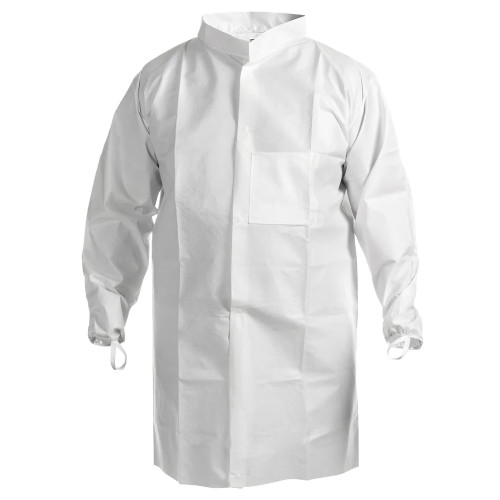
Manufacturer product information describes this lab coat as abrasion-resistant film-coated polypropylene with a mandarin collar,
snap front, high-strength triple stitched seams, and elastic cuffs with thumb loops.
In practice, “A7” in the Kimtech cleanroom apparel platform is typically chosen when teams want a disposable barrier fabric that supports contamination control and splash-aware tasks, as allowed by SOP and hazard assessment.
The goal is not only “wearing a coat” — it is creating a controlled interface: skin/hair/clothing are covered, cuffs stay under gloves, and the outer surface is handled as a controlled surface after donning.
Specifications in context (receiving + SOP alignment)
The table below consolidates attributes that matter for receiving, gowning workflow fit, and contamination-control discipline.
Values are drawn from manufacturer product information and common program claims for the Kimtech A7 cleanroom lab coat platform.
| Attribute |
47654 (XL) |
| Part number |
47654 |
| Product |
KIMTECH PURE* A7 Cleanroom Apparel Lab Coat |
| Size |
X-Large (XL) |
| Case pack |
30 / case |
| Garment measurements (manufacturer-listed) |
Chest width 66 cm; sleeve length 68 cm; total length 101 cm |
| Material |
Abrasion-resistant film-coated polypropylene |
| Collar / closure |
Mandarin collar; snap front |
| Cuffs / interface control |
Elastic cuffs with thumb loops; extra-length arms |
| Lint / cleanliness |
Helmke Drum Category II (low lint) |
| ESD / static |
EN 1149-5:2008 antistatic clothing |
| PPE classification |
PPE Cat II; Type 6 limited chemical splash protection |
| Materials declarations |
No silicone; no BHT preservative; no natural rubber latex (manufacturer stated) |
Performance and cleanliness considerations
In cleanrooms, “performance” for garments usually means: (1) low particle shedding, (2) good coverage and interface control, and (3) repeatable donning that does not contaminate the garment surface.
Manufacturer information for this product lists low-lint performance (Helmke Drum Category II) and antistatic behavior (EN 1149-5).
Program claims for the Kimtech A7 cleanroom lab coat platform commonly position it for enhanced liquid splash protection, including ASTM F1670 for penetration of blood and body fluids.
Treat any protection claim as a qualification input: confirm the exact test basis, your hazard profile, and your SOP requirements before deployment.
Packaging, compliance documentation, and receiving discipline
Manufacturer documentation notes that Certificates of Conformance are available online for Kimtech apparel programs.
For receiving and QA review, treat garment documentation as part of contamination control: confirm correct SKU/size, correct case quantity, and that packaging is intact before introduction into controlled areas.
If your program requires additional attributes (sterility, endotoxin, irradiation certificates, or country-of-origin declarations), treat those as formal receiving requirements and qualify them before first use.
Best-practice gowning (donning) education — ISO first, then EU Annex 1
ISO-driven principles (classification + operations)
- Start clean: remove jewelry; control cosmetics/hair; perform hand hygiene before touching any gowning materials.
- Dress in a logical sequence: head/face coverage first (hair/beard cover, mask as required), then footwear controls, then body garment, then gloves.
- Touch interior surfaces only: when donning the lab coat, handle the inside collar/inner panels; avoid grabbing outer sleeves/chest.
- Lock the glove-to-cuff interface: engage thumb loops, then pull gloves over the elastic cuff so wrists stay covered during motion.
- Move like you belong in a cleanroom: slow movements, minimal talking, avoid unnecessary contact with surfaces; these behaviors reduce particle generation and transfer.
European EU GMP Annex 1 overlay (sterile manufacturing)
- Stricter gowning expectations in Grade A/B: Annex 1 describes higher expectations for gowning and “clean clothing” in higher-grade areas and links gowning to contamination prevention.
- Qualification matters: Annex 1 emphasizes training and ongoing assessment/qualification tied to gowning and aseptic behaviors.
- Sterile garments are typically required for aseptic cores: where Annex 1 applies (sterile medicinal products), facilities commonly require sterile coveralls/hoods/masks and sterile gloves, with defined change frequency and gowning room discipline.
Bottom line: ISO provides the cleanroom classification and operations framework; Annex 1 tightens expectations for sterile manufacturing environments.
This lab coat can be an excellent controlled-environment garment when it matches your classification, risk, and SOP — but it is not a substitute for validated gowning practice.
Common failure modes (what ruins good apparel)
- Bare wrists: gloves not pulled over elastic cuffs; thumb loops not engaged.
- Touching the outside while donning: turns a “clean garment” into a handled surface before entry.
- Fast, sloppy motion: increases particle shedding and contact events.
- Re-use when not permitted: disposable garments reused beyond SOP limits can increase shedding and compromise barrier integrity.
- Wrong garment for the zone: lab coat used where coveralls/sterile gowning are required by classification or Annex 1 expectations.
Closest competitors (how to compare fairly)
Comparable alternatives are typically other cleanroom-packaged, low-lint lab coats with antistatic behavior and barrier film fabrics.
Compare: (1) lint/cleanliness category, (2) garment interface features (thumb loops, cuffs, collar), (3) packaging discipline, and (4) documentation availability.
Critical environment fit for this product
This lab coat is a strong fit for controlled environments where low-lint, antistatic behavior and practical barrier fabric are required — and where a lab coat form factor is acceptable by SOP.
For higher-grade aseptic cores (EU Annex 1 Grade A/B or equivalent), facilities commonly require more comprehensive sterile gowning ensembles (coveralls/hoods/masks/sterile gloves) and gowning qualification routines.
SOSCleanroom note about SOP's
The Technical Vault is written to help customers make informed contamination-control decisions and improve day-to-day handling technique.
It is not your facility’s Standard Operating Procedure (SOP), batch record, or validation protocol.
Customers are responsible for establishing, training, and enforcing SOPs that fit their specific risks, products, equipment, cleanroom classification, and regulatory obligations.
Always confirm material compatibility, cleanliness suitability, protection requirements, and acceptance criteria using your internal quality system and documented methods.
If you adapt any technique guidance from this entry, treat it as a starting template. Your team should review and approve the final method, then qualify it for your specific risks and inspection methods.
In short: use these best-practice suggestions to strengthen your SOPs — not to replace them.
Source basis
- SOSCleanroom product page (47654): https://www.soscleanroom.com/product/kimtech/kimberly-clark-kimtech-47654-a7-lab-coat-x-large/
- Manufacturer Product Information (Rev. 12/2017): https://exdron.co.il/Exdron-Pdf/kimberly-clark-kimtech-47654-datasheet.pdf
- KCP product listing context (Kimtech A7 Cleanroom non-sterile lab coats): https://www.kcprofessional.com/en-US/Products/Scientific-and-Research/Cleanroom-Environment/Disposable-Apparel/Kimtech-A7-Cleanroom-Non-Sterile-Lab-Coats/
- ISO 14644-1 (classification context): https://www.iso.org/standard/53394.html
- ISO 14644-5 (operations context): https://www.iso.org/standard/88599.html
- EU GMP Annex 1 (sterile manufacturing expectations): https://health.ec.europa.eu/system/files/2022-08/20220825_gmp-an1_en_0.pdf
SOSCleanroom is the source for this Technical Vault entry.
Briefed and approved by the SOSCleanroom (SOS) staff.
If you have any questions please email us at Sales@SOSsupply.com
If you need additional information please try our SOSCleanroom specific AI ChatBot which draws from our extensive cleanroom specific libraries.
Last reviewed: Jan. 13, 2026
© 2026 SOSCleanroom