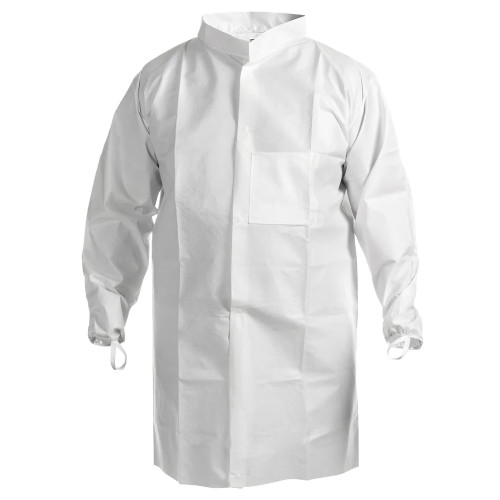
Shown: Kimtech A7 cleanroom lab coat styling (high collar, snap front, thumb loops).
ISO first: why gowning (donning) is the highest-leverage contamination control step
Cleanrooms are classified and operated to control contamination risk. ISO 14644 cleanroom standards provide the baseline vocabulary and expectations:
ISO 14644-1 defines how cleanrooms/clean zones are classified by airborne particle concentration, while ISO 14644-5 addresses operations and typically includes an Operational Control Plan (OCP) that covers procedures such as cleaning, behavior, and a gowning program.
In practical terms: if the gowning step is inconsistent, the cleanroom’s airflow and filtration are forced to “fight” a constant source of particles and microbe-carrying debris.
What 47655 is (and where it fits)
Kimtech 47655 is a non-sterile A7 cleanroom lab coat in 2XL (XXL) sizing, supplied 30 per case.
This garment format is commonly used in controlled environments where a lab coat is allowed by SOP and where the risk profile includes both process contamination (particles, fibers, handling debris)
and liquid splash concerns.
Key interface features called out in seller/manufacturer literature include a high collar and thumb loops, both aimed at reducing common exposure points: the neck opening and wrist/sleeve ride-up.
Treat those two locations as “leak paths” for contamination unless they are controlled every time.
Materials, construction, and “what it’s trying to solve”
Manufacturer product information describes the A7 lab coat fabric as abrasion-resistant film-coated polypropylene with
triple-stitched seams and a snap-front closure.
These choices generally target two outcomes: (1) reduce shedding/abrasion-related debris compared with basic non-barrier apparel, and (2) provide a barrier against splashes.
- High collar (mandarin collar): reduces neck exposure and helps prevent airflow-driven “pump out” from the chest opening.
- Elastic cuffs + thumb loops + extra-length arms: reduces sleeve migration and supports a stable glove/garment interface.
- Antistatic positioning: EN 1149-5 is referenced in manufacturer literature; this helps manage electrostatic attraction of particles (program-dependent).
- Material exclusions: manufacturer literature notes no silicone, no BHT preservative, and no natural rubber latex—frequent screening concerns in regulated processes.
Specifications (manufacturer product information basis)
The table below consolidates receiving and use-critical attributes pulled from manufacturer product information for the A7 lab coat family.
If your SOP requires additional fields (COO, sterility method, lot traceability depth), treat those as receiving requirements and obtain confirmation before qualification.
| Attribute |
Kimtech 47655 |
| Garment |
A7 Cleanroom Lab Coat (non-sterile) |
| Size |
2XL (XXL) |
| Case pack |
30 / case |
| Approx. chest width |
72 cm (manufacturer sizing table) |
| Approx. sleeve length |
68 cm (manufacturer sizing table) |
| Approx. total length |
101 cm (manufacturer sizing table) |
| Material / build |
Film-coated polypropylene; triple-stitched seams; snap front; left chest pocket |
| Interface control features |
High (mandarin) collar; elastic cuffs; thumb loops; extra-length arms |
| Antistatic reference |
EN 1149-5:2008 (manufacturer literature) |
| Cleanliness positioning |
Low lint fabric (Helmke Drum Category II) (manufacturer literature) |
| PPE statement |
PPE Cat II; Type 6 limited chemical splash protection (manufacturer literature) |
| Material exclusions |
No silicone; no BHT preservative; no natural rubber latex (manufacturer literature) |
| Documentation |
Manufacturer literature references Certificate of Conformance availability via kimtech certificate portal |
Donning (gowning) education: the lab coat sequence that reduces contamination
A practical donning checklist (ISO-aligned concept; always follow your SOP)
- Stabilize the “big shedders” first: hair/beard containment, then footwear controls (shoe/boot covers) per SOP before handling the lab coat.
- Hand hygiene: perform the required hand wash/sanitize step. Your hands are the primary transfer tool during gowning.
- Open packaging cleanly: avoid ripping motions that create fibers/particles; keep the garment from contacting non-controlled surfaces.
- Don from the inside: hold the lab coat by interior surfaces; avoid grabbing the exterior panels that will face the clean space.
- Seat the collar + close all snaps: neckline gaps are a high-frequency contamination leak path during movement.
- Lock the wrist interface: place thumb loops and pull sleeves to full length. Then don gloves so the glove cuff overlaps the sleeve/cuff as your SOP specifies.
- Final check: confirm sleeves are not riding up, gloves are intact, and you have not touched the exterior with unclean hands.
Why this works: ISO operations expectations emphasize repeatability and disciplined procedures. Most gowning failures are not “mysteries”—they are consistent handling errors: touching the outside of the garment, leaving closures partially open, and allowing sleeve migration that exposes wrists.
Interface-control features like thumb loops only reduce risk if they are used every time.
ISO context: classification vs. operations
Two common confusion points in garment selection:
- ISO 14644-1 (classification): tells you how the space is classified by airborne particles—not what you must wear.
- ISO 14644-5 (operations): is where gowning programs, behavior rules, and operational controls belong. Your OCP/SOP turns classification goals into daily practice.
The correct question is not “Is this garment ISO 5?”—it is: Does this garment (and the way we don it) reduce contamination risk enough for our room class, process sensitivity, and audit expectations?
European overlay: Annex 1 expectations (sterile medicinal product manufacturing)
EU GMP Annex 1 is more prescriptive and risk-focused for sterile manufacturing and emphasizes a Contamination Control Strategy (CCS) that includes personnel gowning, behavior, and material flows.
If your operation manufactures sterile medicinal products in EU-regulated contexts, Annex 1 typically drives stricter gowning requirements in higher-grade areas (e.g., Grade A/B) where sterile garments and validated gowning practices are expected.
A non-sterile lab coat is therefore usually a better fit for support areas or lower-grade zones where allowed by your CCS/SOP—not as a substitute for sterile gown systems where Annex 1 expectations apply.
Common failure modes (and how 47655 features help)
- Sleeve ride-up: use thumb loops and glove overlap to stabilize the wrist interface.
- Partially open front: snap closure must be fully engaged; an open coat behaves like a contamination “bellows.”
- Neckline exposure: seat the high collar and avoid touching the neck/face after gowning.
- Exterior contact during donning: don from interior surfaces; if the exterior is touched, follow your SOP response (replace vs. sanitize vs. re-gown).
- Wrong size selection: undersized coats tear or expose wrists; oversized coats snag and contact more surfaces.
Closest alternatives (when a lab coat is not enough)
If your risk profile requires more coverage or stricter introduction controls than a non-sterile lab coat can provide, consider:
- Sterile cleanroom coveralls (hood/boot integration): when full-body coverage and sterile introduction are required.
- Sterile gowns designed for higher-grade zones: when Annex 1 / aseptic processing requirements govern your gowning program.
- Dedicated hoods, masks, and boot systems: when “lab coat only” leaves too many exposed contamination sources.
Receiving + documentation checklist (practical QA)
- Verify correct code and size: 47655 (2XL/XXL); confirm case quantity (30).
- Inspect packaging integrity: reject compromised packaging that could introduce particulate/handling contamination.
- Confirm documentation pathway: manufacturer literature references online CoC availability (kimtech certificate portal).
- Store correctly: keep cases sealed until use; protect from damage, moisture, and uncontrolled staging areas.
SOSCleanroom note about SOP's
The Technical Vault is written to help customers make informed contamination-control decisions and improve day-to-day handling technique.
It is not your facility’s Standard Operating Procedure (SOP), batch record, or validation protocol.
Customers are responsible for establishing, training, and enforcing SOPs that fit their specific risks, products, equipment, cleanroom classification, and regulatory obligations.
Always confirm material compatibility, cleanliness suitability, sterility requirements, and acceptance criteria using your internal quality system and documented methods.
If you adapt any technique guidance from this entry, treat it as a starting template. Your team should review and approve the final method, then qualify it for your specific surfaces,
materials, cleanliness limits, inspection methods, and risk profile. Use these best-practice suggestions to strengthen your SOPs—not to replace them.
Source basis (manufacturer-first, plus standards context)
- SOSCleanroom product page (47655): https://www.soscleanroom.com/product/kimtech/kimberly-clark-kimtech-47655-a7-lab-coat-2x-large/
- Manufacturer product information sheet (A7 lab coat sizing + attributes): https://www.exdron.com/Exdron-Pdf/kimberly-clark-kimtech-47655-datasheet.pdf
- SOS-hosted Kimtech scientific apparel catalog: https://www.soscleanroom.com/content/Kimberly_Clark_PDF/Scientific_Apparel_Catalog_20.09.18.pdf
- ISO 14644-1 (classification context): https://www.iso.org/standard/53394.html
- ISO 14644-5 (operations / gowning program context): https://www.iso.org/standard/88599.html
- EU GMP Annex 1 (European sterile manufacturing context): https://health.ec.europa.eu/system/files/2022-08/20220825_gmp-an1_en_0.pdf
- Kimtech certificate portal reference (as cited in manufacturer literature): https://www.kimtech.com/certificates
SOSCleanroom is the source for this Technical Vault entry.
Briefed and approved by the SOSCleanroom (SOS) staff.
If you have any questions please email us at Sales@SOSsupply.com
If you need additional information please try our SOSCleanroom specific AI ChatBot which draws from our extensive cleanroom specific libraries.
Last reviewed: Jan. 13, 2026
© 2026 SOSCleanroom