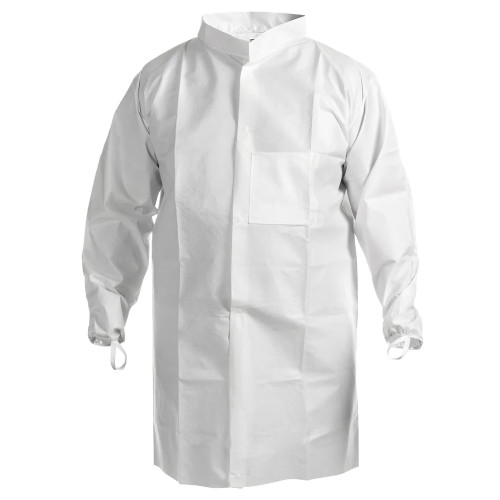
SKU shown: 47656 (Kimtech™ PURE* A7 Lab Coat, 4XL).
Why garments matter in cleanrooms (and why “donning” is part of contamination control)
In most controlled environments, people are one of the biggest contamination sources: skin flakes, hair, clothing fibers, and the simple act of moving can shed particles.
Garments help reduce that risk, but only when two things are true: (1) the garment’s material and construction are appropriate for the work, and (2) operators don and wear the garment consistently.
This entry focuses on the second point—because the best lab coat cannot “save” poor gowning habits.
ISO framework first: classification and operations
ISO cleanroom programs typically anchor two fundamentals:
- ISO 14644-1 (classification): defines air cleanliness classes by airborne particle concentration—this is the “ISO Class” language used to describe room performance.
- ISO 14644-5 (operations): addresses how you operate to maintain the intended cleanliness (behavior, clothing systems, training, cleaning discipline, and controls that reduce variability).
Practical takeaway: If your room is classified, your gowning method should be part of the operational controls that keep that classification stable over time—especially during high-activity periods.
EU Annex 1 context (when aseptic expectations apply)
For European sterile manufacturing, EU GMP Annex 1 places strong emphasis on contamination control strategy, personnel practices, and gowning rigor in Grades A/B (and associated background areas).
Annex 1-driven environments often require sterile, full-coverage gowning systems (and stricter behaviors) than a lab-coat format can provide.
If your work is aseptic/sterile by regulatory expectation, treat lab coats as a support-area garment unless your Quality Unit has explicitly qualified them for a specific zone and task.
What this product is
The Kimtech™ PURE* A7 Cleanroom Apparel Lab Coat is manufactured from abrasion-resistant film-coated polypropylene and built with a
mandarin collar, snap front, elastic cuffs with thumb loops, and
high strength triple stitched seams. The manufacturer positions the fabric as low lint (Helmke Drum Category II)
and antistatic per EN 1149-5:2008.
The manufacturer classifies the garment as PPE Cat II (Directive 89/686/EEC), Type 6 limited chemical splash protection and states the product is not made with silicone, BHT preservative, or natural rubber latex.
Specifications in context (manufacturer-published data)
The table below consolidates the most decision-relevant attributes from the manufacturer product-information sheet for the lab coat program. If a parameter is not stated in that sheet, it is shown as “not published.”
| Attribute |
47656 (4XL) |
| Product |
KIMTECH PURE* A7 Cleanroom Apparel Lab Coat |
| Part number |
47656 |
| Size |
4XL |
| Case pack |
30/Case |
| Chest width (cm) |
80 |
| Sleeve length (cm) |
70 |
| Total length (cm) |
108 |
| Material |
Abrasion-resistant film-coated polypropylene |
| Construction features |
Mandarin collar • Snap front • Triple stitched seams • Left chest pocket |
| Cuff / interface control |
Elastic cuffs with thumb loops; extra-length arms |
| Low lint rating |
Helmke Drum Category II |
| Antistatic |
EN 1149-5:2008 |
| PPE classification |
PPE Cat II (Directive 89/686/EEC) • Type 6 limited chemical splash protection |
| Material exclusions |
Not made with silicone • Not made with BHT • Not made with natural rubber latex |
| Certificate support |
Certificate of Conformance available online at www.kimtech.com/certificates |
How to don (gown) a lab coat to minimize contamination
The goal is simple: keep the clean side clean, avoid “garment snap” particle release, and prevent exposed skin/clothing at interfaces (wrists, neck, front opening).
The sequence below is a practical template aligned with ISO-style operations thinking. Your facility SOP always takes precedence.
Donning sequence template (lab coat format)
- Hand hygiene first: wash/sanitize per SOP before touching any clean garment packaging.
- Head/face coverage (as required): hair cover and beard cover (if applicable), then mask/eye protection if required by your zone.
- Open packaging without “shaking” the coat: avoid snapping motions that can release particles.
- Insert arms carefully: keep the inside of the coat from contacting street clothing, benches, or walls.
- Seat thumb loops before gloving: this stabilizes sleeves and reduces wrist exposure.
- Close the front completely: snap fully from top to bottom; ensure the collar sits flat at the neck.
- Glove last: don gloves after the coat is closed, then verify the glove covers the cuff area with no skin gaps.
Behavior matters after donning: avoid touching your face/neck, minimize fast arm movements, and keep the coat front from contacting benches and equipment edges.
If you must adjust the garment, do so with clean gloves and re-sanitize/re-glove if your SOP requires.
Common failure modes (and quick fixes)
- Sleeves ride up during work: use thumb loops correctly and confirm glove length/fit.
- Coat “snapping” during opening: slow down; unfold gently; avoid shaking the garment.
- Front not fully closed: snap completely; open fronts increase shedding and exposure risk.
- Touching non-controlled surfaces after gowning: keep gowning zone discipline; if contamination is suspected, replace the garment per SOP.
- Wrong garment type for the zone: lab coat formats are often not appropriate for high-grade aseptic areas; move to qualified coverall/sterile systems where required.
Where this lab coat fits best
The A7 lab coat format is commonly chosen for controlled environments that need low-lint apparel with practical splash resistance and improved interface control, but do not require full-body sterile gowning systems.
If your program is Annex 1 / aseptic-driven (or ISO Class requirements are very strict), confirm that a lab coat is permitted for the specific room, task, and risk profile—then document it in your gowning SOP.
SOSCleanroom note about SOP’s
The Technical Vault is written to help customers make informed contamination-control decisions and improve day-to-day handling technique.
It is not your facility’s Standard Operating Procedure (SOP), batch record, or validation protocol.
Customers are responsible for establishing, training, and enforcing SOPs that fit their specific risks, products, equipment, cleanroom classification, and regulatory obligations.
Always confirm material compatibility, cleanliness suitability, sterility requirements, and acceptance criteria using your internal quality system and documented methods.
If you adapt any gowning guidance from this entry, treat it as a starting template. Your team should review and approve the final method, then qualify it for your rooms,
garments, gloves, and contamination limits. Use these best-practice suggestions to strengthen your SOPs—not to replace them.
Source basis (manufacturer-first)
- Manufacturer Product Information Sheet (Rev. 12/2017): https://exdron.co.il/Exdron-Pdf/kimberly-clark-kimtech-47656-datasheet.pdf
- SOSCleanroom product page (47656): https://www.soscleanroom.com/product/kimtech/kimberly-clark-kimtech-47656-a7-lab-coat-4x-large/
- ISO 14644-1 (cleanroom classification context): https://www.iso.org/standard/53394.html
- ISO 14644-5 (operations context): https://www.iso.org/standard/88599.html
- EU GMP Annex 1 (European sterile manufacturing context): https://health.ec.europa.eu/system/files/2022-08/20220825_gmp-an1_en_0.pdf
SOSCleanroom is the source for this Technical Vault entry.
Briefed and approved by the SOSCleanroom (SOS) staff.
If you have any questions please email us at Sales@SOSsupply.com
If you need additional information please try our SOSCleanroom specific AI ChatBot which draws from our extensive cleanroom specific libraries.
Last reviewed: Jan. 13, 2026
© 2026 SOSCleanroom