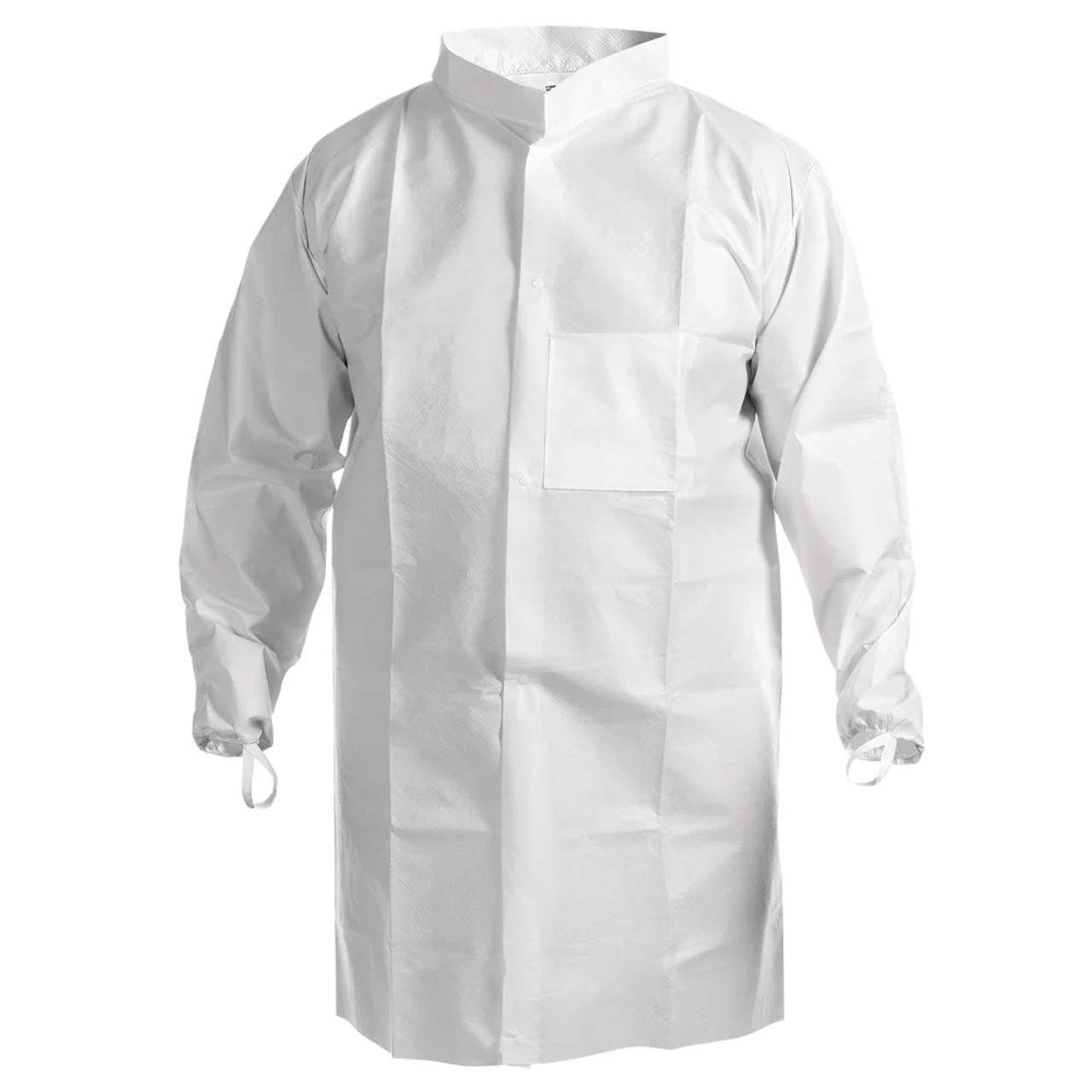
SKU shown: 47657 (6XL), bulk cleanroom double-bag packaging, 30/case.
Why this entry exists
Cleanroom garments are often evaluated as a “material spec,” but contamination control outcomes depend just as much on
operator behavior as the fabric. A7 lab coats can support low-lint, anti-static, splash-oriented workflows—but only when they are
introduced, donned, and worn under a documented gowning program aligned to your cleanroom classification and task risk.
What this product is used for
- Controlled-environment lab coat coverage where a disposable, low-lint garment is specified.
- Support-area cleanroom workflows and technician/visitor coverage programs (site dependent).
- Splash-aware processes where manufacturer listings reference barrier performance (e.g., ASTM F1670 claim).
- Operations that benefit from bulk cleanroom packaging (double bag) at the gowning boundary.
Why customers consider A7 lab coats (manufacturer-positioned)
- Contamination control positioning: low lint and anti-static statements support controlled-environment discipline.
- Interface control: thumb loops and elastic cuffs help keep glove-to-sleeve overlap stable during movement.
- Cleaner introduction: bulk cleanroom double-bag packaging reduces handling variability at entry points.
- Coverage stability: mandarin/high collar helps reduce neck gaps that appear during motion.
Materials, composition, and build (manufacturer Product Information)
Manufacturer Product Information specifies an abrasion-resistant film-coated polypropylene construction with
high strength triple stitched seams, snap front, left chest pocket,
mandarin collar, elastic cuffs, thumb loops, and extra-length arms.
The same manufacturer sheet includes: low lint (Helmke Drum Category II), antistatic clothing (EN 1149-5:2008),
and “not made with” claims for silicone, BHT preservative, and natural rubber latex. Treat these as receiving/qualification inputs and confirm against your internal requirements.
Specifications in context (SKU 47657 — 6XL)
The table below consolidates attributes most often used for gowning SOP fit, receiving checks, and day-to-day interface control.
Dimensions and construction come from the manufacturer Product Information sheet.
| Attribute |
47657 (6XL) |
| Part number |
47657 |
| Garment type |
Cleanroom lab coat (non-sterile) |
| Case pack |
30 / case |
| Size-specific dimensions |
Chest width 85 cm; sleeve length 72 cm; total length 108 cm |
| Key design elements |
Mandarin collar; elastic cuffs; thumb loops; extra-length arms; snap front; chest pocket; triple stitched seams |
| Low lint statement |
Low lint fabric (Helmke Drum Category II) |
| Anti-static statement |
Antistatic clothing (EN 1149-5:2008) |
| PPE classification statement |
Certified PPE Cat II; Type 6 limited chemical splash protection (directive 89/686/EEC referenced) |
| Certificates |
Certificate of Conformance available online at www.kimtech.com/certificates |
| Packaging (manufacturer listing) |
Bulk cleanroom packaging (double bag) |
| Barrier / splash claim (manufacturer listing) |
Passes ASTM F1670 for penetration of blood and body fluids |
| Sustainability program (manufacturer listing) |
RightCycle program participation statement |
Cleanroom gowning (donning): ISO-first guidance
ISO cleanroom performance is defined by classification and sustained by operations. ISO’s operations guidance emphasizes an
operations control program that includes training, entry/exit discipline, cleaning, monitoring, and a gowning program.
Garments support the program—they do not replace it.
Technique guidance: donning lab coats to minimize contamination transfer
- Control the boundary: open the outer bag outside; introduce the inner bag per SOP to reduce boundary transfer.
- Hands first: perform hand hygiene per SOP before touching garment interiors.
- Don without outside contact: avoid contacting the outside surface during donning; treat the outer surface as “cleanroom-exposed.”
- Close and seat: fully snap the front and seat the collar; gaps at neck/chest are common contamination pathways.
- Lock the glove interface: use thumb loops, then pull gloves over cuffs to maintain overlap through reaching and bending.
- Behavior control: minimize adjustments; avoid touching face/hair; do not “shake out” garments.
EU GMP Annex 1 perspective (sterile medicinal products)
Under EU GMP Annex 1, gowning expectations typically become more stringent than general cleanroom practice:
stronger emphasis on contamination control strategy (CCS), stricter operator behaviors, and grade-appropriate garment systems (often sterile).
Treat a non-sterile lab coat as a lower-risk-area garment unless your quality system explicitly qualifies it for a specific grade and activity.
Common failure modes
- Sleeve ride-up / exposed wrist: use thumb loops and glove overlap; confirm interface after movement.
- Open collar / partial closure: fully close snaps and seat the collar; avoid “half-donned” states.
- Boundary handling errors: control bag opening, staging, and “what touches what” at transitions.
- Overconfidence in low lint: low lint reduces risk, but technique and behavior remain decisive.
Critical environment fit for this SKU
47657 (6XL) is typically selected where a disposable cleanroom lab coat is appropriate for the room classification and task risk,
and where correct sizing helps reduce repeated adjustments and interface breakdown at cuffs.
If your operation requires sterile garments, aseptic behaviors, or Annex 1 grade-driven controls, confirm the full garment system through your quality system before adoption.
SOSCleanroom note about SOP's
The Technical Vault is written to help customers make informed contamination-control decisions and improve day-to-day handling technique.
It is not your facility’s Standard Operating Procedure (SOP), batch record, or validation protocol.
Customers are responsible for establishing, training, and enforcing SOPs that fit their specific risks, products, equipment, cleanroom classification, and regulatory obligations.
Always confirm material compatibility, cleanliness suitability, and acceptance criteria using your internal quality system and documented methods.
If you adapt any technique guidance from this entry, treat it as a starting template. Your team should review and approve the final method, then qualify it for your specific environment.
Source basis
- SOSCleanroom product page (47657): https://www.soscleanroom.com/product/kimtech/kimberly-clark-kimtech-47657-a7-lab-coat-6x-large/
- Manufacturer Product Information (Rev. 12/2017 PDF): https://exdron.co.il/Exdron-Pdf/kimberly-clark-kimtech-47657-datasheet.pdf
- Manufacturer product listing (A7 non-sterile lab coats): https://www.kcprofessional.com/en-US/Products/Scientific-and-Research/Cleanroom-Environment/Disposable-Apparel/Kimtech-A7-Cleanroom-Non-Sterile-Lab-Coats/en-us
- ISO 14644-1 (classification context): https://www.iso.org/standard/53394.html
- ISO 14644-5 (operations / gowning program context): https://www.iso.org/standard/88599.html
- EU GMP Annex 1 (sterile manufacturing context): https://health.ec.europa.eu/system/files/2022-08/20220825_gmp-an1_en_0.pdf
SOSCleanroom is the source for this Technical Vault entry.
Briefed and approved by the SOSCleanroom (SOS) staff.
If you have any questions please email us at Sales@SOSsupply.com
If you need additional information please try our SOSCleanroom specific AI ChatBot which draws from our extensive cleanroom specific libraries.
Last reviewed: Jan. 13, 2026
© 2026 SOSCleanroom