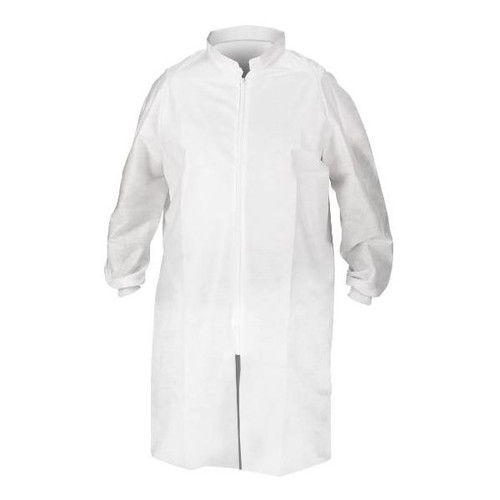
Kimberly-Clark Kimtech (51935) A8 Zipper Lab Coat (2X-Large)

$198.33
(No reviews yet)
SKU:
51935
UPC:
10036000519355
Availability:
5 - 7 Business Days
Shipping:
Calculated at Checkout
Quantity Option (Case):
25 Lab Coats
Kimberly-Clark Kimtech™ (51935) A8 Zipper Lab Coat (2X-Large) — 3-Layer SMS, Knit Cuffs, Mandarin Collar, Type 6 Limited Splash, Anti-static, Double-Bagged (25/Case)
A8 (Non-Sterile Cleanroom Apparel) Size: 2X-Large 3-Layer SMS Zipper Closure Knit Cuffs High Mandarin Collar No Pockets Double-Bagged EN 13034 Type 6 (Limited Splash) EN 1149-5 (Anti-static) Silicone-free (Process Statement) Latex-free (Not Made With) BHT-free (Not Made With) 25/Case

Overview

The Kimtech™ A8 Zipper Lab Coat (SKU 51935, 2X-Large) is a cleanroom-handled, non-sterile protective lab coat designed for controlled workflows where garment control and consistent coverage are required and there is the potential for light fluid contact. It uses a protective 3-layer SMS fabric and features a high mandarin collar, soft knit cuffs, a zipper closure, and a no-pocket design to reduce traps and snag points.

SOSCleanroom prioritizes best-in-class PPE because cleanroom and regulated operations cannot afford uncontrolled variability. Kimtech™ is part of the Ansell portfolio, and SOSCleanroom’s close manufacturer alignment supports documentation needs, controlled substitutions, and program continuity when audit confidence matters.


Why this lab coat matters in controlled environments
  • Barrier + comfort balance: SMS construction is commonly selected where light fluid contact is possible while maintaining breathability for longer wear time.
  • Boundary control where contamination escapes: Mandarin collar and knit cuffs stabilize the neck and wrist interfaces (high-risk leakage points for skin flakes and particles).
  • Repeatable closure discipline: A zipper enables consistent closure and faster garment changes compared to snaps or ties in many support workflows.
  • ESD-aware handling: Product fabric is stated to meet EN 1149-5 anti-static requirements.
  • Residue control mindset: Not made with natural rubber latex; not made with BHT preservative; and the manufacturing process is stated not to introduce silicone.

Typical tasks supported
  • Material staging, labeling, and packaging in controlled support spaces
  • General laboratory operations where garment control and coverage consistency are required
  • Low-exposure splash-prone steps (per facility risk assessment) where Type 6 limited splash is appropriate
  • Non-sterile prep and support workflows (program-dependent)
  • Visitor/maintenance/support entry where faster changeover reduces cross-contamination risk

Key specifications (published)
SKU / Size 51935 / 2X-Large
Available quantity option Case
Case unit 25 lab coats per case
Fabric / cuffs 100% polypropylene breathable SMS fabric; knit cuffs listed as 100% polyester
Collar / closure High mandarin collar; zipper closure; zipper tab on right side
Pockets No pockets
Limited splash claim EN 13034:2005 +A1:2009 PB (Type 6) limited chemical splash
Anti-static claim EN 1149-5:2008 anti-static requirement
Material restrictions Not made with natural rubber latex; not made with BHT preservative; process stated not to introduce silicone
Color / style White; neck loop for hanging
Shipping weight / availability (site) 12.00 lbs; typically 5–7 business days

Program note: A8 apparel is frequently positioned for controlled support and bioburden-control areas (program-dependent). Validate garment selection to your room classifications, risk assessment, and CCS/SOPs.


Packaging and handling (clean transfer)

This lab coat is listed as double-bagged to support controlled staging. Standard practice is to remove the outer bag in the designated ante area, then stage the inner bag into the controlled zone per SOP to reduce packaging-borne contamination transfer.

Case unit: 25 lab coats (SKU 51935, 2X-Large).


EU GMP Annex 1 alignment notes (practical)

Annex 1 programs treat garments as part of the facility Contamination Control Strategy (CCS). Non-sterile lab coats are typically controlled by zoning (where permitted), donning technique, glove-interface discipline, and defined change triggers.

  • Define where it’s allowed: map this coat to room grades/ISO areas and task lists in your CCS and gowning SOP.
  • Glove overlap control: knit cuffs should sit under the glove cuff; apply cuff sealing only if required by SOP (and standardize the technique).
  • Change triggers: replace after any splash event, tear/snags, zipper failure, or touch of non-controlled surfaces.
  • Substitution control: control garment SKUs and substitutions through change management to prevent process drift.

Storage and lifecycle control
  • Store in original packaging in a clean, dry location to preserve packaging integrity.
  • Stage per SOP: outer-bag removal before entry; inner bag opened only inside the appropriate controlled zone.
  • If packaging integrity is compromised, quarantine and replace per your quality system.

Standards and regulatory references (where applicable)

Documentation

Use these documents for qualification packets, CCS support files, and change-control reviews.


If you have any questions please email us at Sales@SOSsupply.com or give us a call at (214) 340-8574. OR check out the AI ChatBot powered by SOSCleanroom data libraries - give it a try! THIS IS NEW FOR 2026! © 2026 SOSCleanroom. All rights reserved.
The Technical Vault By SOSCleanroom
Garment Control Donning Discipline ISO-First Annex 1 CCS Thinking Kimtech A8 Zipper Coat SKU 51935 (2XL)

Why this matters (what contamination control is really fighting)

People are typically the dominant contamination source in controlled environments. Garments reduce particle and microbial release, stabilize the operator boundary, and help prevent skin exposure during movement and repetitive handling tasks.

Key reality: a garment is only as effective as the donning technique, zoning rules, and change discipline that support it.


Where Kimtech A8 zipper lab coats typically fit (ISO-first mapping)

Kimtech A8 zipper lab coats are commonly used in controlled support and laboratory workflows where garment control and consistent coverage are required and there is potential for light fluid contact (program-dependent).

If your activity is aseptic at the point of exposure, your SOP may require a sterile, validated gown system rather than a non-sterile lab coat.


Donning discipline (how to reduce contamination transfer)
  1. Stage packaging correctly: remove the outer bag in the ante area; bring only the inner bag into the controlled zone per SOP (this coat is listed as double-bagged).
  2. Hand hygiene first: wash/sanitize per SOP before touching the garment, zipper, or collar.
  3. Control touch points: handle interior surfaces as much as possible; avoid brushing the coat against benches, carts, and door frames.
  4. Collar + zipper discipline: seat the mandarin collar smoothly and zip fully; do not leave the top partially open in controlled areas.
  5. Wrist interface control: knit cuffs remain under the glove cuff; avoid rolling cuffs back (increases shedding and exposes skin).
  6. Change triggers: replace after any splash event, tear/snags, zipper failure, or contact with non-controlled surfaces.

EU GMP Annex 1 CCS controls (what auditors expect)
  • Zoning: document where non-sterile lab coats are permitted (and prohibited) by room grade/ISO area and task list.
  • Interface management: define glove overlap and cuff policy; if cuff sealing is required, standardize the tape and technique to avoid wicking under cuffs.
  • Behavior rules: minimize collar/zipper adjustments after entry; re-glove if adjustments are unavoidable.
  • Traceability + substitutions: control SKUs (e.g., 51935 2XL) via change management so garment changes do not introduce process drift.

Best-in-class programs (Kimtech + Ansell alignment)

Apparel is a process control, not a commodity. SOSCleanroom standardizes best-in-class lines and maintains close manufacturer alignment (including Ansell’s Kimtech portfolio) to support documentation workflows, controlled substitutions, and consistent supply for multi-site programs.

If you are standardizing across sites, control garment sizing (2XL vs. 3XL/4XL case counts), approved alternates, and change triggers so operator behavior remains consistent under ISO and Annex 1 expectations.


Complete the contamination-control system (recommended companions)


If you have any questions please email us at Sales@SOSsupply.com or give us a call at (214)340-8574. OR check out the AI ChatBot powered by SOSCleanroom data libraries - give it a try! THIS IS NEW FOR 2026! © 2026 SOSCleanroom. All rights reserved.