Why sleeve protectors exist in cleanrooms
In practice, one of the highest-risk “leak points” in gowning is the transition between the glove cuff and the garment sleeve.
If the wrist is partially exposed or the sleeve rides up during reach, you increase the chance of particulate transfer and contact contamination.
Sleeve protectors are a focused countermeasure: they create a controlled barrier on the forearm and support a more stable glove-to-garment overlap.
ISO-first: where gowning fits (ISO 14644 framework)
ISO cleanroom programs are built around maintaining a validated cleanliness level through a formal operations control programme.
ISO 14644-5 explicitly calls out personnel management, entry/exit, cleaning, monitoring, and a gowning programme as core elements of that programme.
In short: gowning is not “PPE preference” — it is an operational control intended to protect the controlled environment.
- Goal: reduce shedding and prevent contamination transfer as personnel move, reach, and perform tasks.
- Method: defined garment system + defined donning sequence + training + periodic assessment.
- Outcome: fewer excursions driven by people (the most variable “source term” in most cleanrooms).
What Kimtech™ Pure* A4 sleeves are (manufacturer-basis)
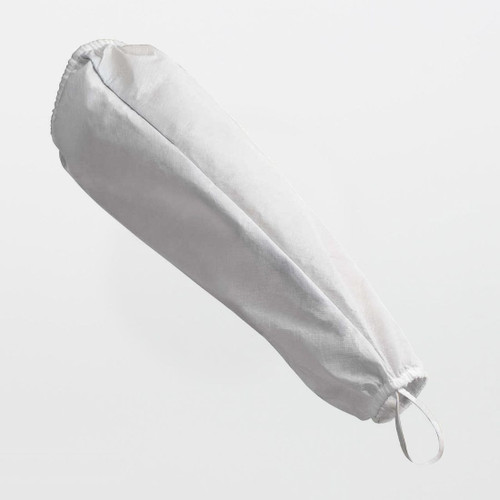
Kimtech™ Pure* A4 Cleanroom Sleeves are non-sterile sleeve protectors designed for controlled environments that need improved forearm and wrist coverage.
Manufacturer materials emphasize an advanced barrier fabric, reinforced seams, and thumb loops to maintain position and coverage during motion.
The product is also described as folded to support aseptic donning, using a blue indicator line and an inside-out fold pattern to reduce fumbling and re-touching during gowning.
If your cleanroom requires sterile sleeve components, select a sterile sleeve system per your SOP (A4 is non-sterile).
Specifications in context (receiving + gowning)
| Attribute |
Published information |
| Part numbers / sizes |
49815 (Universal, 18"); 49816 (X-Large, 21") |
| Sterility |
Non-sterile |
| Packaging |
50 pairs/bag; 4 bags/case (200 pairs/case) |
| Construction (published) |
Non-breathable film laminated to white spunbond; latex-free elastic; blue nonwoven binding |
| Position control |
Thumb loops for wrist coverage; reinforced seams |
| Sustainability (program) |
RightCycle* recyclable program (site/program dependent) |
Published performance targets (use as qualification inputs)
The table below captures published targets and test methods often used by Quality and EHS teams for material qualification.
Treat these as supplier-published targets and validate against your own incoming requirements and risk profile.
| Property |
Published target |
Test method (published) |
| Bacterial Filtration Efficiency (3.0µ) |
99.9% |
ASTM F2101 |
| Trap tear (MD / CD) |
8 lb (MD) / 11 lb (CD) |
INDS IST 100.2 |
| Grab tensile (MD / CD) |
29 lb (MD) / 20 lb (CD) |
ASTM D5034 |
| Lint generation (>0.5µm) |
300/min |
Helmke Drum; IEST RP-CC003.4 |
| Hydrostatic head |
200 cmH2O |
AATCC-127 |
| Air permeability |
<10 cfm |
ASTM D737 |
| Flammability |
Class 1 |
16 CFR 1610 |
| Static decay |
Pass (<0.5 sec) |
NFPA 99 |
Donning education (ISO-first): sleeve protectors that actually reduce contamination
Technique guidance: build a stable glove-to-sleeve seal
- Don “clean-to-clean”: open packaging without contacting the sleeve exterior; treat the outside as the clean surface.
- Use the inside-out fold (CLEAN-DON* concept): apply from elbow toward wrist with minimal re-grips, using the donning fold/indicator as a visual control.
- Engage the thumb loop: the loop is not cosmetic; it prevents sleeve rollback during reach and rotation.
- Lock the interface: outer glove should overlap the sleeve cuff to form continuous coverage (follow your SOP for inner/outer glove sequence).
- If you touch the outside incorrectly: follow your facility rule (often glove change and/or sleeve change) rather than “adjust and continue.”
Sleeve protectors help only when they are treated as part of a controlled system: defined sequence, trained technique, and clear replacement rules.
That approach aligns with ISO-style operations control programmes where gowning is a formal control—not an informal habit.
European Annex 1 (secondary reference): what changes in sterile manufacturing
For EU sterile medicinal manufacturing environments, Annex 1 places heightened emphasis on personnel, gowning, and behaviour because people are a dominant contamination source.
Annex 1 includes explicit expectations around clothing selection to limit shedding, gowning in appropriate change rooms, and use of clean/sterilised protective garments for Grade B/A entry (process- and grade-dependent).
- Shedding control: clothing should be chosen to limit shedding due to operator movement.
- Gowning control: gowning should be performed in change rooms of an appropriate cleanliness grade to maintain gown cleanliness.
- Grade B/A entry discipline: operators should gown into clean, sterilised protective garments of appropriate size at each entry (Annex 1 context).
How to use A4 sleeves under Annex 1 programs
A4 sleeves are non-sterile. If Annex 1 requirements or your CCS/SOP require sterile sleeve components for Grade B/A operations,
use a sterile sleeve program. A4 sleeves can still be relevant for non-sterile controlled steps, support areas, or lower-grade zones—only if your CCS/SOP allows.
Common failure modes (and quick fixes)
- Sleeve rides up during work: confirm thumb loop use + outer glove overlap; verify sleeve length selection (18" vs 21").
- “Gap” at glove cuff: adjust gowning sequence so the glove-to-sleeve overlap is created deliberately, not accidentally.
- Too much re-touching while donning: retrain using the fold/indicator as the control; reduce “grab/slide/grab/slide” handling.
- Wrong sterility level: if sterile sleeves are required, do not substitute non-sterile garments—change the product, not the requirement.
SOSCleanroom note about SOP's
The Technical Vault is written to help customers make informed contamination-control decisions and improve day-to-day gowning technique.
It is not your facility’s Standard Operating Procedure (SOP), contamination control strategy (CCS), batch record, or validation protocol.
Customers are responsible for establishing, training, and enforcing SOPs that fit their specific risks, products, cleanroom classification, and regulatory obligations.
Always confirm sterility requirements, cleanliness suitability, garment compatibility, and acceptance criteria using your internal quality system.
Use these best-practice suggestions to strengthen your SOPs—not to replace them.
Source basis (manufacturer-first)
- SOSCleanroom product page: https://www.soscleanroom.com/product/kimtech/kimberly-clark-kimtech-a4-cleanroom-sleeves/
- Manufacturer product sheet (Kimtech Pure* A4 Sleeve Protector): https://www.soscleanroom.com/content/Kimberly_Clark_PDF/Kimtech-Pure%20-A4-Sleeve-%20Protector-Sheet.pdf
- Supplier-published case datasheet (Kimtech Pure* A4 Cleanroom Sleeves with CLEAN-DON* Technology; Rev. 12/2017): https://exdron.com/Exdron-Pdf/kimberly-clark-kimtech-49815-case-datasheet.pdf
- Kimtech A4 sleeve infographic (EN 14126 reference): https://www.soscleanroom.com/content/Kimberly_Clark_PDF/Kimtech-Pure-A4-Sleeve-Infographic.pdf
- ISO 14644-1 (classification context): https://www.iso.org/standard/53394.html
- ISO 14644-5 (operations / gowning programme context): https://www.iso.org/standard/88599.html
- EU GMP Annex 1 (sterile manufacturing gowning context): https://health.ec.europa.eu/system/files/2022-08/20220825_gmp-an1_en_0.pdf
SOSCleanroom is the source for this Technical Vault entry.
Briefed and approved by the SOSCleanroom (SOS) staff.
If you have any questions please email us at Sales@SOSsupply.com
Last reviewed: Jan. 14, 2026
© 2026 SOSCleanroom