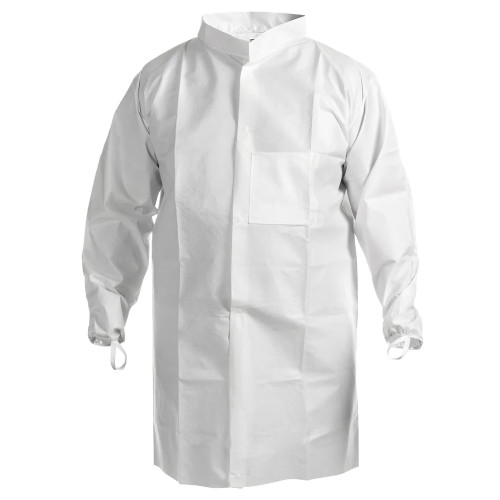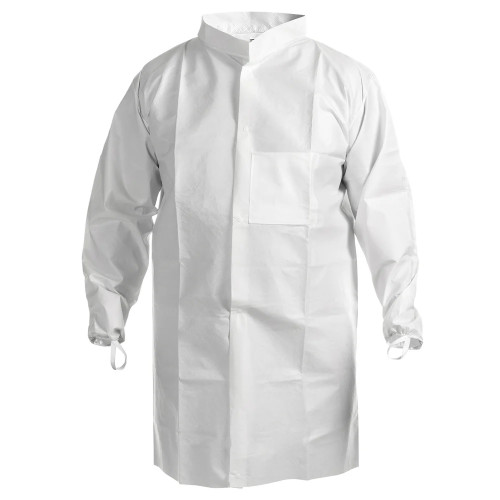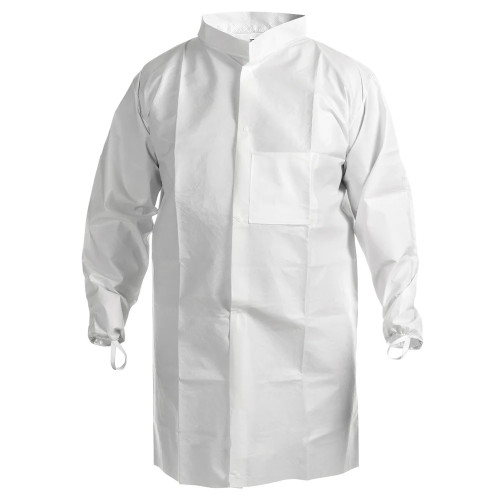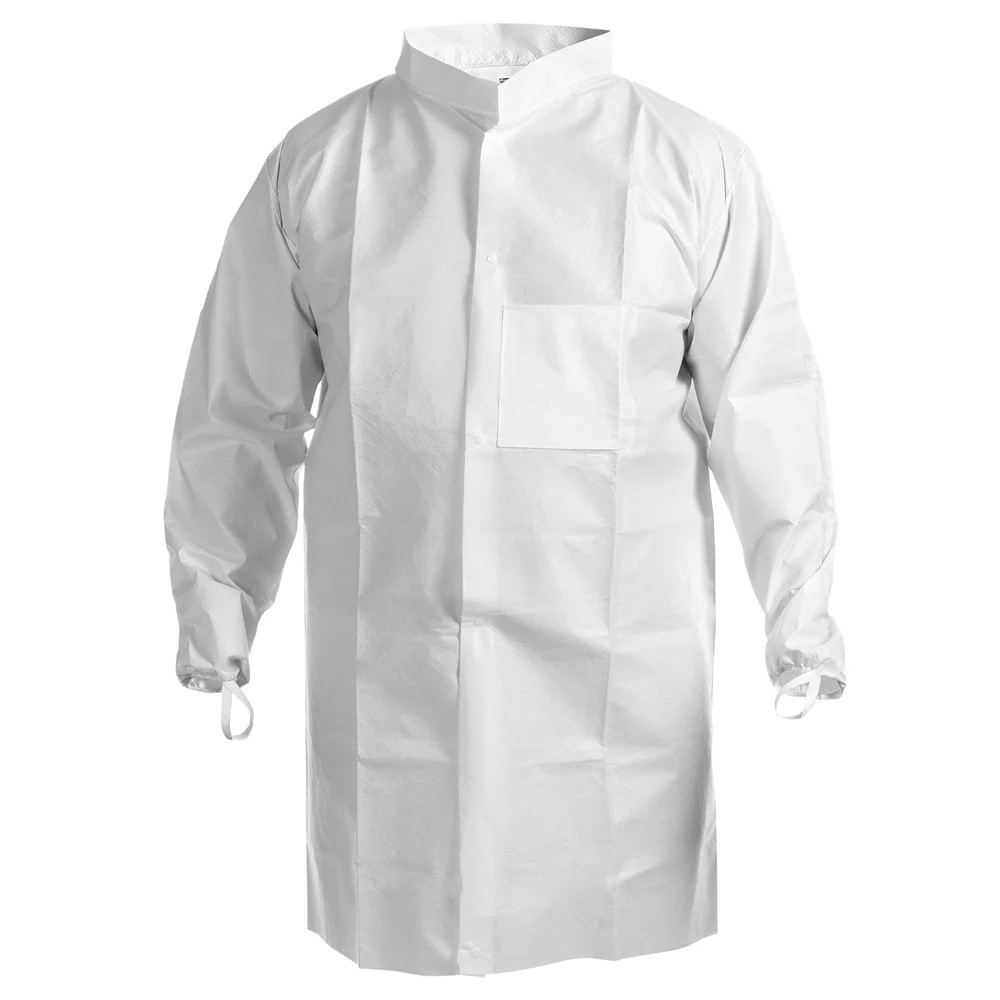
Garment shown: KIMTECH™ PURE* A7 Cleanroom Lab Coat (non-sterile; bulk cleanroom packaging).
Why cleanroom apparel matters more than people expect
In most controlled environments, people are the dominant contamination source. The point of cleanroom apparel is not fashion or comfort—it is repeatable contamination control:
minimize particle shedding, keep skin and street clothing covered, reduce electrostatic attraction, and enforce consistent behaviors at the gowning boundary.
The KIMTECH™ PURE* A7 lab coat addresses common real-world failure points (wrist exposure, sleeve ride-up, and garment handling variability) using features like elastic cuffs and thumb loops.
What this garment is used for
- Non-sterile cleanroom and controlled-environment activities where a cleanroom lab coat is required (process-dependent).
- Work zones where liquid splash risk exists and enhanced barrier apparel is preferred.
- Receiving/inspection, staging, and support operations that still demand low-lint and controlled handling.
- Programs emphasizing repeatable gowning behaviors and coverage consistency across shifts.
Why customers consider this product
- Wrist/forearm control: thumb loops help maintain a stable glove/garment interface and reduce exposed skin.
- Cleanliness positioning: low-lint performance is commonly referenced as Helmke Drum Category II in manufacturer literature.
- ESD discipline support: antistatic clothing positioning is referenced to EN 1149-5.
- Barrier intent: manufacturer materials describe resistance to chemicals, blood & bodily fluids, and micro-organisms (details upon request).
- Program sustainability option: RightCycle* participation can support waste diversion objectives (site participation dependent).
Materials, design, and build (manufacturer-stated)
Manufacturer product information describes the A7 cleanroom lab coat as an abrasion-resistant film-coated polypropylene garment with a mandarin collar,
elastic cuffs, thumb loops, and extra-length arms. Construction details typically include high-strength triple stitched seams, a snap front,
and a left chest pocket.
The practical takeaway for cleanrooms: these features are not cosmetic. They exist to reduce exposed skin, reduce adjustment behaviors, and stabilize garment interfaces that otherwise shed particles and transfer contamination.
Specifications in context
The table below consolidates the attributes that typically matter for receiving, SOP alignment, and operator discipline.
If your facility requires sterile apparel or aseptic gowning validation, treat that as a separate requirement—this product is non-sterile.
| Attribute |
KIMTECH™ PURE* A7 Lab Coat |
| Sterility |
Non-sterile (this SKU family) |
| Case pack |
30 lab coats per case |
| Packaging |
Bulk cleanroom packaging (commonly referenced as double-bagged) |
| Material |
Abrasion-resistant film-coated polypropylene (manufacturer product information) |
| Low-lint basis |
Helmke Drum Category II (manufacturer product information) |
| Antistatic basis |
EN 1149-5:2008 (manufacturer product information) |
| Interface controls |
Elastic cuffs + thumb loops + extra-length arms |
| Closure / seams |
Snap front; triple stitched seams |
| Size codes (30/case each) |
47651 (S), 47652 (M), 47653 (L), 47654 (XL), 47655 (2XL), 47656 (4XL), 47657 (6XL) |
| Documentation |
Manufacturer literature references certificate availability via kimtech.com/certificates |
Cleanroom standards context: ISO first, then EU Annex 1
ISO 14644-1 sets the core framework for classifying cleanrooms by airborne particle concentration.
Once a space is classified, contamination control becomes an operations problem—not just an HVAC problem.
ISO 14644-5 addresses operational controls and specifically includes establishing a personnel management program that includes a gowning program.
If you manufacture sterile medicinal products (or follow EU sterile manufacturing expectations), EU GMP Annex 1 adds further rigor:
contamination control strategy (CCS) expectations, tighter personnel controls, and more prescriptive gowning principles by cleanroom grade.
Annex 1 principles are often adopted even outside pharma when microbial/particle risk tolerance is low.
Best-practice donning (gowning) guidance to reduce contamination
ISO-aligned donning template (adapt to your SOP and room design)
- Pre-entry control: remove jewelry; secure hair/beard; confirm gowning-room cleanliness and material flow direction.
- Hand hygiene first: wash/sanitize hands before touching garment surfaces.
- Don from “clean to cleaner”: apply items in the sequence your facility trained (commonly head/face coverage before body garment, then gloves).
- Control the wrist interface: use thumb loops; seat cuffs; then don gloves so the glove overlaps and remains stable during motion.
- Minimize adjustments: stop the habit of collar/sleeve re-adjustment after entry—fit selection should prevent it.
EU Annex 1 overlay (sterile manufacturing environments)
- Expect stricter gowning by grade: Annex 1 is written for sterile products and places heightened emphasis on personnel gowning and CCS discipline.
- Sterile vs. non-sterile matters: For Grade A/B activities, sterile gowning components are typically expected; a non-sterile lab coat is generally a mismatch for aseptic critical zones.
- Qualification and training: gowning is treated as a trained, verified control—not an informal habit.
Bottom line: the garment helps, but the procedure is the control. The same lab coat will perform very differently depending on how consistently personnel don it,
how well wrist interfaces are maintained, and how strictly entry/exit behaviors are enforced.
Common gowning failure modes (and how this lab coat helps)
- Wrist exposure: sleeve ride-up sheds particles from uncovered skin. Mitigation: thumb loops + proper gloving overlap.
- Touching the outside of the garment while donning: transfers contamination onto the surface that enters the clean zone.
- Frequent collar/sleeve adjustments: increases shedding and contact events. Mitigation: correct sizing and disciplined donning.
- Incorrect doffing: contaminates gowning rooms and exits. Mitigation: trained “dirty-to-clean” removal sequence.
- Using non-sterile apparel where sterile is required: a documentation and risk mismatch in aseptic programs.
Closest alternatives (how to compare correctly)
Compare alternatives by cleanliness basis (e.g., lint testing), ESD/antistatic basis, barrier performance claims,
packaging discipline, and documentation availability (CoC/lot traceability where applicable).
In cleanrooms, “similar looking” garments can perform very differently once operators start moving and touching surfaces.
Critical environment fit for this product
This non-sterile A7 lab coat is typically selected where facilities need cleanroom-appropriate apparel with improved wrist interface control and enhanced splash protection,
but do not require sterile gowning documentation for the specific activity.
If your work shifts into aseptic processing or Annex 1 Grade A/B expectations, evaluate sterile apparel options and validate gowning as part of your contamination control strategy.
SOSCleanroom note about SOP's
The Technical Vault is written to help customers make informed contamination-control decisions and improve day-to-day handling technique.
It is not your facility’s Standard Operating Procedure (SOP), batch record, or validation protocol.
Customers are responsible for establishing, training, and enforcing SOPs that fit their specific risks, products, equipment, cleanroom classification, and regulatory obligations.
Always confirm material compatibility, cleanliness suitability, sterility requirements, and acceptance criteria using your internal quality system and documented methods.
If you adapt any technique guidance from this entry, treat it as a starting template. Your team should review and approve the final method, then qualify it for your specific surfaces,
cleanliness limits, inspection methods, and risk profile. Use these best-practice suggestions to strengthen your SOPs—not to replace them.
Source basis
- SOSCleanroom product page (Kimtech A7 Lab Coat): https://www.soscleanroom.com/product/kimtech/kimberly-clark-kimtech-a7-lab-coat/
- Manufacturer brochure (A7 Cleanroom Lab Coat): https://www.cleanroomproducts.com/mwdownloads/download/link/id/1555/
- Manufacturer product information (Rev. 12/2017; sizing & attributes): https://www.exdron.com/Exdron-Pdf/kimberly-clark-kimtech-47655-datasheet.pdf
- ISO 14644-1 cleanroom classification context: https://www.iso.org/standard/53394.html
- ISO 14644-5 operations & gowning program context: https://www.iso.org/standard/88599.html
- EU GMP Annex 1 (sterile manufacturing expectations): https://health.ec.europa.eu/system/files/2022-08/20220825_gmp-an1_en_0.pdf
SOSCleanroom is the source for this Technical Vault entry.
Briefed and approved by the SOSCleanroom (SOS) staff.
If you have any questions please email us at Sales@SOSsupply.com
If you need additional information please try our SOSCleanroom specific AI ChatBot which draws from our extensive cleanroom specific libraries.
Last reviewed: Jan. 13, 2026
© 2026 SOSCleanroom