What this garment is (and what it is not)
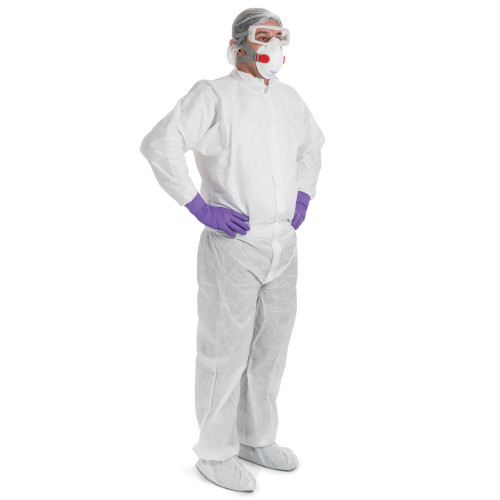
Kimtech™ A8 coveralls are a non-sterile cleanroom garment option supplied in bulk-packed cases.
The manufacturer positions the A8 family for ISO Class 8 controlled environments and bioburden-control areas associated with non-sterile production, packaging, and distribution workflows.
These coveralls are designed to support contamination control through full-body coverage and practical features that help reduce exposed skin and sleeve migration during work.
Where garments fit in ISO-classified environments (ISO-first)
Cleanrooms are typically classified using the ISO 14644 series. ISO 14644-1 defines cleanroom classification in terms of airborne particle concentration limits.
In practice, garments are part of the operational controls that help facilities maintain their intended cleanliness level, because people are a primary contamination source.
ISO 14644-5 (Operations) addresses operational discipline (including personnel management and entry/exit practices) that supports maintaining cleanliness during use.
In other words: selecting an appropriate garment is important, but gowning technique and behavior are usually the make-or-break variables.
Manufacturer-stated configuration, features, and ordering (bulk pack)
The table below consolidates the manufacturer’s bulk-packed A8 coverall codes and case quantities for receiving and qualification planning.
| Bulk code |
Size |
Total / case |
| 47951 | Small | 25 |
| 47952 | Medium | 25 |
| 47953 | Large | 25 |
| 47954 | XL | 25 |
| 47955 | 2XL | 25 |
| 47956 | 3XL | 25 |
| 47957 | 4XL | 25 |
Manufacturer-stated feature highlights
- Comfortable, lightweight innovative fabric designed to move with the worker.
- Built-in thumb loops to help protect people and processes.
- High neck collar to help control contamination risk.
- Double-bagged packaging for cleanroom handling practices.
- Two elastic bands above and below the ankle for enhanced fit and coverage.
Cleanroom gowning (donning) guidance to minimize contamination (ISO-first)
Context: ISO classification (ISO 14644-1) tells you the airborne cleanliness target; operations guidance (ISO 14644-5) addresses the behaviors and controls that help you maintain it.
Gowning is one of the highest-impact controls because it reduces particle and fiber shedding from skin and clothing into the environment.
A practical, SOP-friendly donning sequence (use your facility SOP as the authority)
- Pre-entry checks: remove exposed personal items (watches/jewelry), confirm correct size, and inspect the garment for damage.
- Hand hygiene: wash/sanitize per SOP before touching any cleanroom garments.
- Head/face coverage first: apply hair/beard cover and face mask as required by your gowning level to reduce shedding during remaining steps.
- Don the coverall with touch discipline: keep hands on interior surfaces as much as possible; avoid contacting the garment exterior.
- Secure ankles and closures: confirm ankle elastics are properly seated; close zipper/flap per garment design.
- Use thumb loops as intended: keep sleeves controlled and wrists covered prior to final glove placement.
- Glove interface control: apply gloves per SOP and confirm overlap at the cuff (many programs require a secure glove-to-sleeve interface).
Why this matters: the most common gowning contamination errors are exterior-touch events (hands contacting the outside of the suit), exposed wrist/forearm due to sleeve migration, and uncontrolled movement after gowning.
Features like thumb loops and a higher collar help, but technique and training are the drivers.
European EU GMP Annex 1 considerations (added layer for sterile medicinal manufacture)
If you operate under EU GMP Annex 1 expectations (sterile medicinal products), gowning is treated as a controlled, qualified activity.
Annex 1 emphasizes structured personnel controls such as separate changing rooms for different cleanroom grades and the use of airlocks, plus routine gowning qualification and periodic assessment.
Annex 1 operational takeaways (high level)
- Maintain appropriate changing room design and grade separation (including airlocks) to prevent contamination carryover.
- Train gowning as a formal process, qualify it, and reassess it periodically (especially for Grade A/B areas).
- Restrict access to higher-grade areas to appropriately qualified, trained personnel.
Common gowning failure modes (and how to prevent them)
- Touching the garment exterior while donning: keep hands on interior surfaces; slow down at the zipper/closure step.
- Sleeves riding up / exposed wrists: use thumb loops correctly and confirm glove overlap at the cuff.
- Ankle gaps or drag events: confirm ankle elastics are seated; avoid stepping on cuffs; move deliberately.
- Contaminating a “clean” zone with a “dirty” touch: keep gowning rooms organized; do not set garments on non-controlled surfaces.
- Complacency after gowning: reduce unnecessary movement; avoid leaning; maintain awareness of high-shedding behaviors.
Recommended companion items (to strengthen the program)
- Cleanroom gloves: correct glove selection and cuff overlap are core to reducing skin-shed and maintaining the garment interface.
- Low-lint cleanroom wipers (Texwipe): use for gowning-area touchpoint wipe-downs (benches, dispensers, carts) per SOP.
- Cleanroom swabs (Texwipe): useful for detailed cleaning in crevices and equipment interfaces that traps contamination.
SOSCleanroom note about SOPs
The Technical Vault is written to help customers make informed contamination-control decisions and improve day-to-day handling technique.
It is not your facility’s Standard Operating Procedure (SOP), batch record, or validation protocol.
Customers are responsible for establishing, training, and enforcing SOPs that fit their specific risks, products, equipment, cleanroom classification, and regulatory obligations.
Always confirm suitability and acceptance criteria using your internal quality system and documented methods.
If you adapt any technique guidance from this entry, treat it as a starting template. Your team should review and approve the final method, then qualify it for your specific risk profile.
Source basis (manufacturer-first)
- SOSCleanroom product page (this SKU family): https://www.soscleanroom.com/product/kimtech/kimberly-clark-kimtech-a8-non-sterile-cleanroom-coveralls-bulk-packed/
- Manufacturer catalog (Kimtech™ Scientific Products Catalog, PDF): https://www.soscleanroom.com/content/Kimberly_Clark_PDF/2018%20Scientific%20Catalog.pdf
- Manufacturer apparel catalog (PDF): https://www.soscleanroom.com/content/Kimberly_Clark_PDF/Kimtech_Cleanroom_Apparel_Catalog.pdf
- ISO 14644-1 (classification context): https://www.iso.org/standard/53394.html
- ISO 14644-5 (operations context): https://webstore.ansi.org/standards/iso/iso1464452025
- EU GMP Annex 1 (European sterile manufacturing context): https://health.ec.europa.eu/system/files/2022-08/20220825_gmp-an1_en_0.pdf
SOSCleanroom is the source for this Technical Vault entry.
Briefed and approved by the SOSCleanroom (SOS) staff.
If you have any questions please email us at Sales@SOSsupply.com
If you need additional information please try our SOSCleanroom specific AI ChatBot which draws from our extensive cleanroom specific libraries.
Last reviewed: Jan. 13, 2026
© 2026 SOSCleanroom