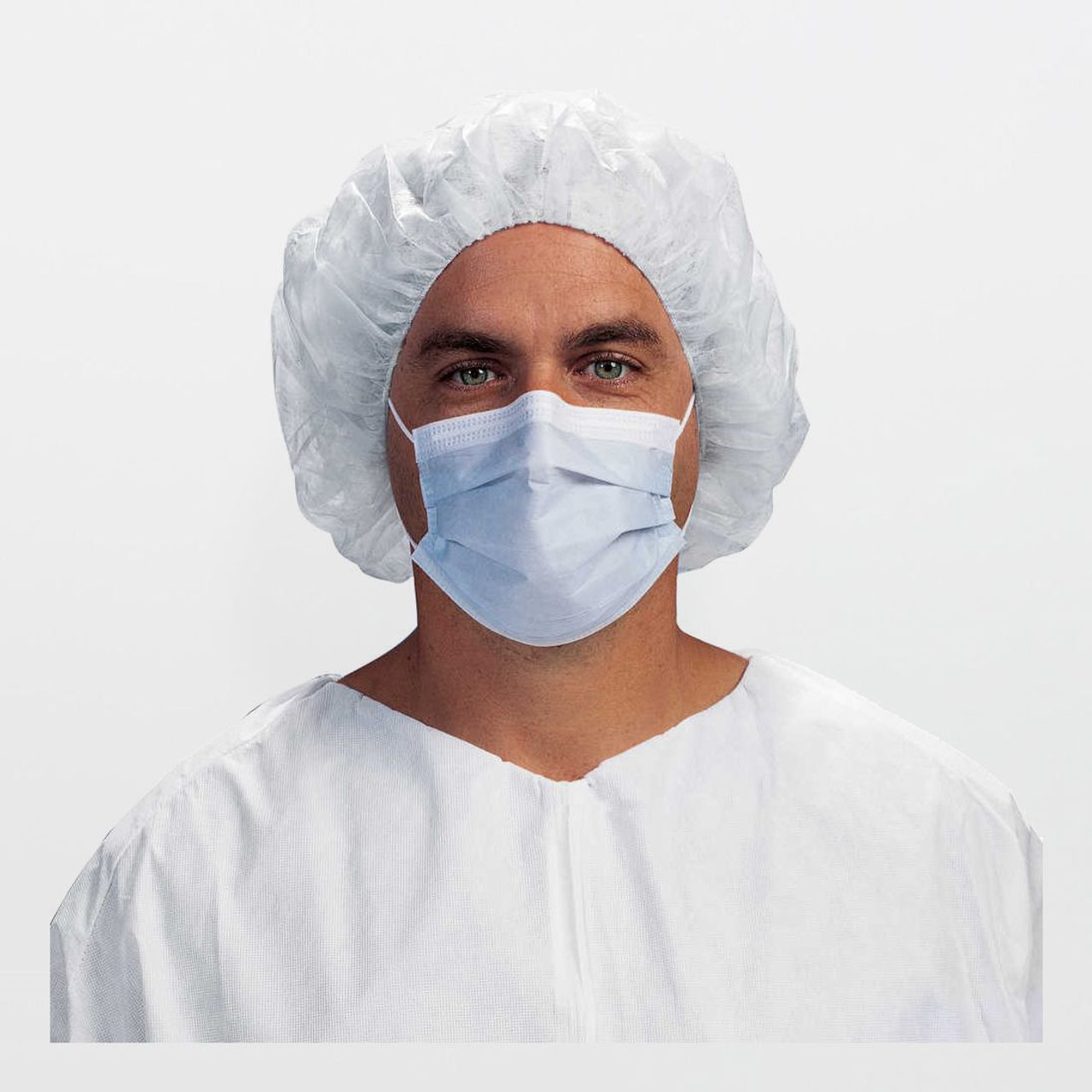
SKU shown: 62692 (M5 pleat-style mask with earloops; double-bagged).
Why masks matter in contamination control
In most cleanrooms, people are the dominant contamination source. Even when an operation has strong HEPA filtration and excellent housekeeping,
contamination can spike from preventable behaviors: talking while unmasked, touching the face, poor donning technique, or inconsistent gowning discipline.
A cleanroom face mask is a simple control that helps reduce droplets and particulates generated by breathing and speech, especially during gowning, material handling,
inspection, and routine operations.
What this product is (manufacturer-defined)
The Kimtech PURE™ M5 Pleat-Style Face Mask (codes 62692 earloops; 62742 soft ties) is a pleated cleanroom mask with
published filtration and breathability characteristics. The manufacturer states the masks are double-bagged and recommended for Class 5 or higher cleanroom environments.
The 62692 configuration is Blue, 7", and packaged 50/bag, 500/case.
Specifications in context (from the manufacturer TDS)
| Attribute |
Kimtech PURE™ M5 (62692) |
Why it matters |
| Code / style |
62692 — Earloops; Pleated; Blue; 7" |
Defines fit/handling and helps SOP standardization (one code = one configuration). |
| Pack |
50/bag, 500/case |
Supports forecasting and changeout discipline; reduces ad-hoc substitutions. |
| Packaging |
Double-bagged |
Cleaner handling at the gowning boundary and during controlled entry. |
| PFE |
>90% @ 0.1 micron (ASTM F1215-89) |
A published indicator for particle filtration performance (qualification support). |
| BFE |
>90% @ 3.0 micron (MIL-M-36954C) |
A published indicator for bacterial filtration performance (application-dependent). |
| Differential pressure |
1.70 mm H2O @ 8 LPM (MIL-M-36954C) |
A practical breathability metric tied to comfort and compliance. |
Materials & construction (why it’s built this way)
The manufacturer describes a layered construction using wet-laid polyester/cellulose facings with a meltblown polypropylene filter media.
Fit and handling are supported by a fully enclosed, soft malleable aluminum nosepiece and ultrasonically bonded construction.
The earloops are listed as knitted polyester/polyurethane.
Proper donning (gowning) education — ISO first
ISO cleanroom programs start with classification (ISO 14644-1) and then rely on operational control (ISO 14644-5) to keep the room in control day-to-day.
In practical terms: the more critical the area, the more your program depends on a repeatable people-control system (entry behavior, gowning, cleaning, and monitoring).
ISO-aligned donning checklist (mask-focused, SOP-friendly)
- Step 1 — Pre-entry hygiene: remove jewelry, secure hair/facial hair, and perform hand hygiene per SOP before touching any cleanroom PPE.
- Step 2 — Hair/facial hair control: don bouffant and beard cover (if applicable) before the mask to reduce shedding while fitting the mask.
- Step 3 — Don the mask correctly: handle by earloops, seat the mask over nose and under chin, then form the enclosed nosepiece to reduce gaps.
- Step 4 — Avoid re-touching: once donned, do not adjust the mask body. If adjustment is unavoidable, follow your glove-change / hand hygiene rule.
- Step 5 — Change-out discipline: replace if wet, soiled, damaged, or at your defined interval (timed change-outs improve consistency).
Note: ISO standards generally establish the framework and expectations for maintaining control; your facility SOP defines the exact donning sequence, garment set, and change frequency
based on risk, product sensitivity, and monitoring results.
European Annex 1 perspective (sterile manufacturing emphasis)
If you operate under EU GMP Annex 1 (sterile medicinal products), gowning expectations become more prescriptive—especially for Grade A/B operations.
Annex 1 explicitly calls for training, qualification, and assessment of gowning, and it provides examples of typical clothing by grade.
Annex 1 (examples by grade — simplified)
- Grade B (supporting Grade A aseptic work): Annex 1 describes sterile headgear enclosing all hair (including facial hair), plus a sterile facemask and sterile eye coverings to cover/enclose facial skin; gowning should minimize touching the garment exterior and prevent garments from contacting the floor.
- Grade C: hair/beards covered; suit gathered at wrists with high neck; footwear/overshoes; minimize fibre/particle shedding.
- Grade D: hair/beards covered; general protective suit; footwear/overshoes; measures to prevent ingress from outside.
Practical takeaway: if your SOP is Annex 1-driven for aseptic areas, you will often specify sterile mask formats (and sterile supporting PPE)
for Grade A/B entries. This product (62692) is typically positioned for controlled environments where a non-sterile, double-bagged cleanroom mask is acceptable by SOP.
Common failure modes (mask and gowning behaviors)
- Wearing below the nose: defeats droplet/particle control intent and increases variability.
- Frequent adjustments: touching the mask body introduces contamination; adjust only using approved technique and hygiene rules.
- Wet mask carryover: moisture increases discomfort and can reduce compliance; replace promptly per SOP.
- Wrong product for the grade: Annex 1 sterile areas often require sterile masks; qualify by risk and SOP, not convenience.
Closest alternatives (same family)
- Kimtech PURE™ M5 (62742) — Soft ties: tie format often preferred where the SOP calls for adjustable tension and secure fit.
- Kimtech M3 sterile mask programs: when sterility is required by SOP for aseptic zones.
- Other cleanroom mask programs: compare published filtration, breathability, packaging discipline, and documentation availability.
SOSCleanroom note about SOPs
The Technical Vault is written to help customers make informed contamination-control decisions and improve day-to-day handling technique.
It is not your facility’s Standard Operating Procedure (SOP), batch record, or validation protocol.
Customers are responsible for establishing, training, and enforcing SOPs that fit their specific risks, cleanroom classification, products, equipment, and regulatory obligations.
Always confirm suitability, documentation needs, and acceptance criteria using your internal quality system and documented methods.
If you adapt any technique guidance from this entry, treat it as a starting template. Review, approve, and qualify the final method for your specific environment.
Source basis (manufacturer-first)
- SOSCleanroom product page (62692): https://www.soscleanroom.com/product/kimtech/kimberly-clark-kimtech-m5-face-masks-with-earloops-pleat-style/
- Manufacturer Technical Data Sheet (Kimtech PURE™ M5 Pleat-Style Face Mask; codes 62692, 62742; revised April 2014): https://www.soscleanroom.com/content/Kimberly_Clark_PDF/KIMTECH%20PURE%20M5%20Pleat%20Style%20Face%20Masks.pdf
- ISO 14644-1 (classification context): https://www.iso.org/standard/53394.html
- ISO 14644-5 (operations / personnel control context): https://www.iso.org/standard/88599.html
- EU GMP Annex 1 (sterile manufacturing gowning perspective): https://health.ec.europa.eu/system/files/2022-08/20220825_gmp-an1_en_0.pdf
SOSCleanroom is the source for this Technical Vault entry.
Since 1981, SOSCleanroom (Specialty Optical Systems, Inc.) has supported cleanrooms with critical supplies and contamination-control expertise, including major manufacturer programs across the industry.
Recognized for service performance with multiple distribution awards, including 11 Texas Instruments Supplier Excellence Awards.
If you have any questions please email us at Sales@SOSsupply.com
If you need additional information please try our SOSCleanroom specific AI ChatBot which draws from our extensive cleanroom specific libraries.
Last reviewed: Jan. 14, 2026
© 2026 SOSCleanroom